
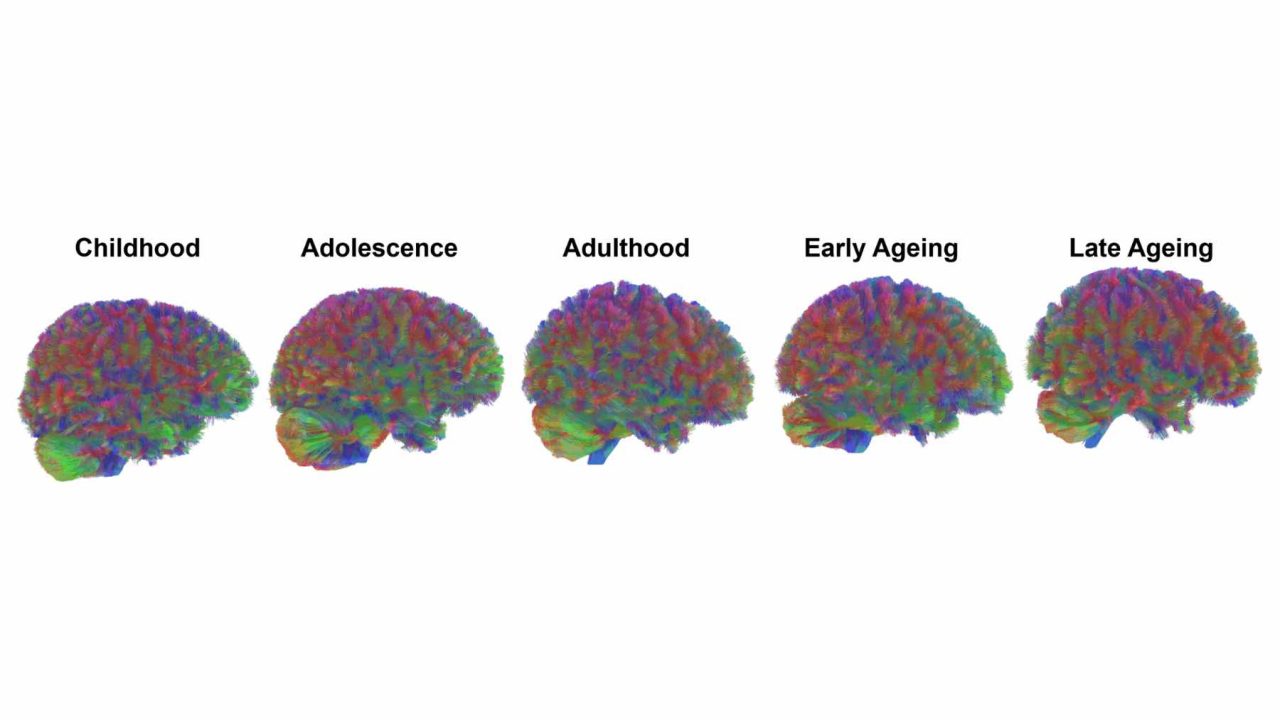
Your brain doesn’t age in a straight line. According to a large new analysis published in late 2025, the brain actually shifts direction at four distinct points in life — around ages 9, 32, 66, and 83 — and at least one of those turning points is far earlier than most people would expect.
The study, peer-reviewed and published on November 25, 2025, drew on advanced MRI data from 4,216 people between the ages of 0 and 90, pooled from nine major research projects. That’s an unusually large and wide-ranging dataset for brain science, and it allowed researchers to map how the brain’s internal wiring evolves across an entire human lifetime.
The finding isn’t that the brain simply declines with age. It’s that it changes course — sometimes in ways that suggest development, and sometimes in ways that reflect natural aging — and those shifts happen at predictable, identifiable moments.
What the Researchers Were Actually Looking At
The study focused specifically on white matter, the dense bundles of nerve fibers that act like communication cables between distant regions of the brain. Think of gray matter as the processing centers and white matter as the wiring that connects them. When white matter is healthy and well-organized, signals travel efficiently. When it changes, so does the brain’s ability to coordinate complex tasks.
To study this wiring, the research team used diffusion MRI, a scanning technique that tracks how water molecules move through brain tissue. The way water moves reveals the structure of the underlying fibers — essentially giving scientists a detailed map of the brain’s internal highways without any surgery or invasive procedure.
The study was led by Alexa Mousley, working alongside Richard A. I. Bethlehem and Duncan E. Astle at the MRC Cognition and Brain Sciences Unit at the University of Cambridge, and Fang-Cheng Yeh at the University of Pittsburgh. The collaboration brought together expertise in cognitive neuroscience, brain imaging, and large-scale data analysis.
The Four Turning Points in Brain Development
Rather than a smooth, gradual shift from birth to old age, the data revealed four clear moments when the overall pattern of brain connections tends to change direction. Researchers are careful to frame these as group averages, not fixed biological milestones — every brain is different, and these ages reflect trends across thousands of people, not a universal schedule.
| Age Turning Point | Phase of Life | Significance |
|---|---|---|
| Around age 9 | Late childhood | First major shift in white matter connectivity patterns |
| Around age 32 | Early adulthood | Surprising mid-life course change, earlier than expected |
| Around age 66 | Early older age | Shift consistent with known aging processes |
| Around age 83 | Late older age | Further change in connectivity patterns in advanced age |
The turning point that surprised researchers most was age 32. While shifts in childhood and in older age fit comfortably with existing models of brain development and decline, a significant change in one’s early thirties wasn’t widely anticipated. It suggests the brain may be more actively reorganizing itself well into adulthood than previously understood.
Why This Matters Beyond the Lab
For most people, the brain feels like a stable background presence — always there, always working, not something that dramatically changes unless something goes wrong. This research challenges that assumption in a meaningful way.
If the brain undergoes a genuine shift in its connectivity patterns around age 32, that has potential implications for how we think about learning, mental health, cognitive resilience, and even career or lifestyle decisions in early adulthood. It raises questions about whether certain interventions — education, exercise, social engagement — might have different effects depending on where someone sits relative to these turning points.
The childhood turning point at age 9 is also worth noting. That’s a period of rapid cognitive development, and identifying it as a moment when brain wiring shifts course could eventually inform how educators and clinicians think about learning support during those years.
The later turning points, at 66 and 83, align more closely with what researchers already know about cognitive aging — but having them clearly mapped against a large, multi-study dataset adds precision to what was previously more of a general picture.
The Scale of the Study Is What Sets It Apart
Brain imaging studies often rely on relatively small groups of participants, which limits how broadly their findings can be applied. What makes this analysis different is its scale: 4,216 participants spanning nine decades of human life, drawn from nine separate research projects.
Combining datasets like this comes with its own challenges — different scanners, different protocols, different populations — but it also produces something that a single study rarely can: a lifespan view. Most brain research zooms in on one age group. This one zoomed out.
The authors are also transparent about what the findings are not. These turning points are not precise biological birthdays. They are statistical patterns observed across a large and varied population. An individual’s brain may shift earlier, later, or in a different sequence entirely depending on genetics, health, lifestyle, and environment.
What Comes Next in This Research
The study, published in November 2025, represents a foundation rather than a final answer. Identifying when the brain changes course is a first step. Understanding exactly what drives those changes — and whether they can be influenced — is the harder question that follows.
Researchers at Cambridge and Pittsburgh now have a detailed lifespan map of white matter connectivity to work from. Future studies could examine whether the timing of these turning points differs across populations, whether early interventions shift them, or whether the age-32 transition has specific links to cognitive or mental health outcomes that have gone unnoticed until now.
What this study does clearly is reframe how we think about the brain across a lifetime — not as something that simply grows and then slowly fades, but as something that actively changes course, more than once, and at ages that don’t always match our intuitions.
Frequently Asked Questions
What are the four ages at which the brain changes course?
According to the study, the brain’s white matter connectivity patterns shift at around ages 9, 32, 66, and 83, based on data from 4,216 participants.
Which turning point surprised researchers the most?
The shift around age 32 was considered the most unexpected, as a significant change in early adulthood was not widely anticipated by existing brain development models.
What part of the brain did the study focus on?
The researchers focused on white matter — the nerve fiber bundles that connect different brain regions — using a technique called diffusion MRI to map connectivity patterns.
Who led the research?
The study was led by Alexa Mousley, working with Richard A. I. Bethlehem and Duncan E. Astle at the MRC Cognition and Brain Sciences Unit at the University of Cambridge, and Fang-Cheng Yeh at the University of Pittsburgh.
Do these turning points happen at exactly those ages for everyone?
No. The researchers emphasize these are group averages drawn from a large population, not a fixed biological schedule — individual brains may vary significantly.
How large was the study?
The analysis combined MRI data from 4,216 people aged 0 to 90, drawn from nine separate major research projects, making it an unusually broad lifespan dataset.




Leave a Reply