
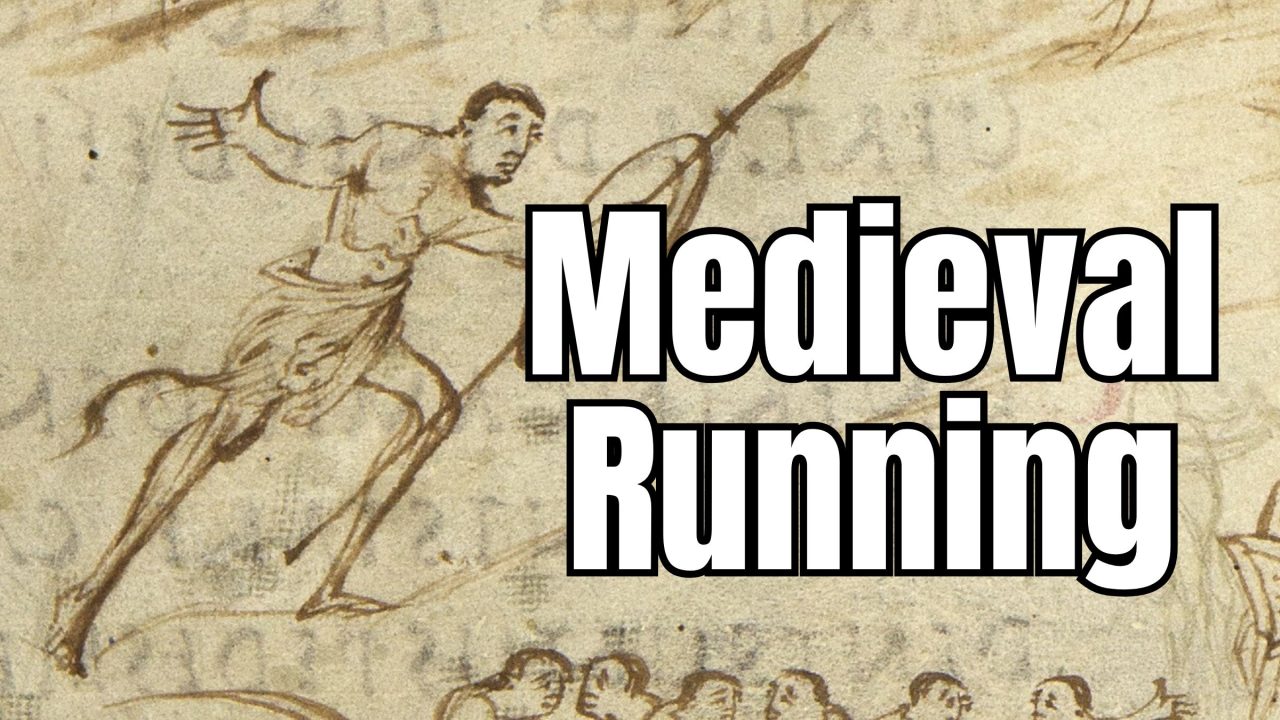
Did people in the Middle Ages actually run? It sounds like a strange question — almost too obvious to ask. But when historians go looking for evidence of running as a physical activity in medieval sources, they find surprisingly little. The scholarly neglect of the subject is striking, and one researcher’s attempt to track it down leads to a fascinating corner of early medieval hagiography, a possessed man, and a superhuman sprint across the French countryside.
The question was posed by Lorris Chevalier in a study published by Medievalists.net, and what begins as a deceptively simple inquiry opens into something far more revealing about how medieval people understood the body, speed, and the supernatural.
Running, it turns out, was there all along — it just wasn’t always recorded as ordinary physical exercise. Sometimes it was punishment. Sometimes it was a miracle. And sometimes it was both at once.
Why Historians Have Largely Ignored Running in the Middle Ages
For a physical activity that every human being does, running has received almost no sustained attention from medieval historians. Chevalier notes that aside from one well-documented practice — forcing adulterous couples to run naked through the streets of certain towns in southern France, to public jeering and humiliation — running as a subject has barely registered in the scholarship.
That’s a remarkable gap. Running would have appeared in warfare, in labor, in religious processions, in children’s play, and in countless other daily contexts. Yet the sources either didn’t bother to record it, or historians haven’t thought to look. Chevalier’s study sets out to change that.
The investigation begins with a single, unusual passage buried in a Carolingian hagiographical text — the kind of source that rarely gets read for what it says about the human body.
The Possessed Man Who Ran Twelve Roman Miles in an Hour
The source that sparked this inquiry is the Vita of Saint Yriex, also known as Aredius, a Limousin saint who died around 591. Two vitae were dedicated to him, and it is the Carolingian hagiographical account that contains the remarkable episode at the center of Chevalier’s research.
According to the text, a man named Baudenus was returning from Autun when he attempted to steal a flask of holy oil that had been used by Aredius. The theft triggered a fit of madness — Baudenus was seized by an evil spirit. To be freed from the possession, he was required to travel to the tomb of Saint Martial in Limoges.
What happened next is the detail that stopped Chevalier in his tracks. In his frantic flight toward the saint’s tomb, Baudenus is said to have covered nearly twelve Roman miles in a single hour. The author of the Vita attributed this extraordinary speed directly to his deranged state — the implication being that the possessed man was running at a pace no ordinary human could sustain.
It’s a small passage in an ancient religious text, but it raises large questions about how medieval writers thought about physical limits, the body under duress, and what running actually meant in a spiritual context.
What This Single Story Tells Us About Medieval Attitudes Toward Running
The episode is worth pausing on. Baudenus isn’t celebrated as an athlete. He isn’t training or competing. He’s running because he has no choice — he is mad, possessed, and desperate. The speed he achieves is presented not as human accomplishment but as something beyond normal capacity, enabled by the supernatural force controlling him.
This framing is significant. It suggests that, in the medieval imagination, extreme running speed wasn’t something a person could simply develop through effort or practice. It required an outside force — divine, demonic, or otherwise. Ordinary human running, by contrast, was perhaps so unremarkable that it didn’t need to be written down at all.
The one form of running that was recorded in legal and civic contexts — the naked public run as punishment for adultery in southern French towns — also wasn’t about athletic achievement. It was about shame, spectacle, and social control. Running, in both cases, was defined by what it meant socially and spiritually, not physically.
Key Details From
Why This Question Still Matters Today
It might be tempting to treat this as a curiosity — an odd footnote in medieval religious literature. But the broader question Chevalier raises has real implications for how we understand the history of the human body and physical culture.
Modern assumptions about exercise, fitness, and athletic performance are so deeply embedded in our culture that it’s easy to project them backward in time. We assume people have always run for health, for sport, for competition. The medieval evidence suggests the reality was more complicated — and that the meanings attached to running were shaped by religion, law, and social hierarchy in ways that look very different from anything we’d recognize today.
The fact that a possessed man’s frantic dash across the French countryside is one of the more detailed accounts of running speed in early medieval sources says something profound about which kinds of human movement were considered worth recording — and which were not.
Frequently Asked Questions
Did people in the Middle Ages run for exercise or sport?
According to the research, running as a physical activity attracted little sustained scholarly attention, and the medieval sources that do mention running tend to frame it in legal, religious, or supernatural contexts rather than athletic ones.
Who was Saint Yriex (Aredius)?
Aredius was a Limousin saint who died around 591 AD. Two vitae were dedicated to him, including a Carolingian hagiographical account that contains the story of Baudenus.
What happened to Baudenus in the story?
Baudenus attempted to steal a flask of holy oil used by Saint Aredius and was seized by a fit of madness. To be freed from the evil spirit, he had to travel to the tomb of Saint Martial in Limoges, reportedly covering nearly twelve Roman miles in one hour.
Was running ever used as punishment in the Middle Ages?
Yes — in certain towns of southern France, adulterous couples were documented as being forced to run naked through the streets amid public jeering as a form of punishment and public shaming.
Why has running in the Middle Ages been so little studied?
Lorris Chevalier notes that the neglect is striking given the many contexts in which running would have appeared in medieval life, but the subject has simply not attracted sustained focus from historians until now.
Is the speed attributed to Baudenus presented as realistic in the source?
No — the Carolingian text attributes his extraordinary speed directly to his deranged, possessed state, framing it as something beyond ordinary human capability rather than a natural athletic feat.


Leave a Reply