
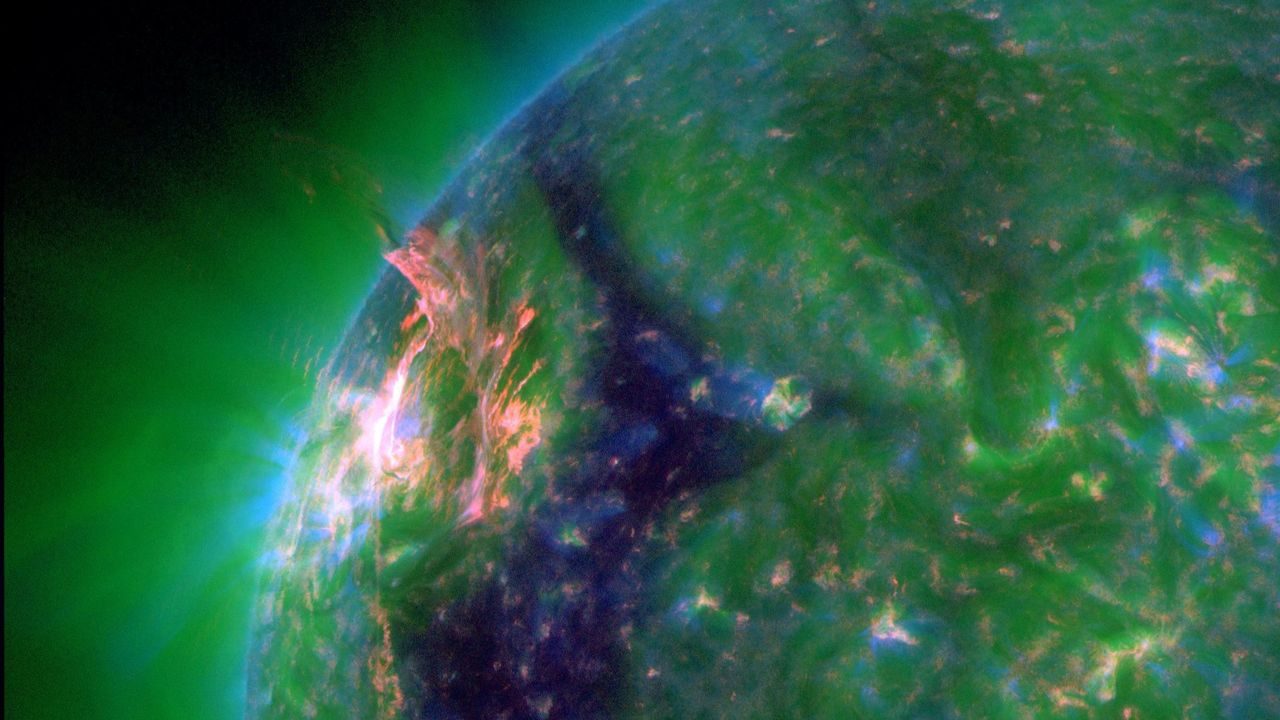
The sun blew a massive hole in its own atmosphere over the weekend — and the effects are already being felt here on Earth, with more potentially on the way.
Scientists recorded an M5.7-class solar flare on Sunday, May 10, peaking at 8:39 a.m. EST. The eruption temporarily knocked out high-frequency radio communications on the sunlit side of the planet and sent a slower-moving cloud of solar material hurtling through space — one that could deliver a glancing blow to Earth and spark a northern lights display.
If you’ve been hoping to catch the aurora, this week may be worth watching. But even if the light show doesn’t materialize, Sunday’s event is a reminder of just how directly the sun’s behavior shapes life on our planet.
What Actually Happened on the Sun
Solar flares are sudden, intense bursts of electromagnetic radiation released from the sun’s surface. They travel at the speed of light — meaning by the time scientists detect them, the energy has already arrived at Earth. There’s no warning window, no advance notice. It’s already here before anyone can sound the alarm.
Sunday’s flare was classified as an M5.7, placing it in the second-strongest category of solar eruption. The classification system runs from A and B at the low end, through C and M, all the way up to X-class — the most powerful category. An M-class flare is serious, capable of causing real disruption, though it sits one tier below the most extreme events the sun can produce.
The flare was recorded and tracked by the National Oceanic and Atmospheric Administration’s (NOAA) Space Weather Prediction Center, which monitors solar activity and its potential effects on Earth’s systems.
Why a “Hole in the Atmosphere” Matters
The dramatic description — a hole blown in the sun’s atmosphere — refers to the coronal region, the outermost layer of the sun’s atmosphere. Solar eruptions can tear through this layer, releasing not just radiation but also what scientists call a coronal mass ejection (CME).
A CME is fundamentally different from a solar flare. Where a flare is pure electromagnetic energy traveling at light speed, a CME is a physical cloud of solar plasma and radiation that moves far more slowly through space. It can take anywhere from one to three days to reach Earth after being launched from the sun.
That slower travel time is actually what creates the possibility of a northern lights display. When a CME collides with Earth’s magnetic field, it can trigger a geomagnetic storm — a disturbance in the magnetosphere that energizes particles and causes them to light up the sky near the poles as aurora.
According to the Space Weather Prediction Center, there’s no guarantee the CME from Sunday’s eruption will make a direct hit. Earth could take a glancing blow — enough to produce some aurora activity, but not necessarily a full geomagnetic storm.
Solar Flare Classification at a Glance
| Flare Class | Strength Level | Typical Effects |
|---|---|---|
| A / B | Weakest | Minimal to no Earth impact |
| C | Moderate | Minor radio interference possible |
| M | Strong (second highest) | Radio blackouts, potential aurora, satellite disruption |
| X | Strongest | Widespread radio blackouts, major geomagnetic storms |
Sunday’s M5.7 flare sits firmly in the upper range of the M-class category, making it a notable — though not record-breaking — solar event.
How This Affects You Right Now
The most immediate confirmed impact from Sunday’s flare was a temporary disruption to high-frequency radio communications on the sunlit side of Earth. This type of blackout affects aviation, maritime operations, emergency response teams, and amateur radio operators who rely on shortwave frequencies. The disruption is caused by the flare’s X-ray and ultraviolet radiation ionizing the upper atmosphere, which bends and absorbs radio signals rather than allowing them to pass through cleanly.
Satellites and spacecraft can also be affected by solar flares, according to NASA. Increased radiation can degrade satellite electronics, alter orbital paths due to atmospheric expansion, and interfere with GPS accuracy — consequences that ripple into navigation systems, financial transactions, and telecommunications networks that most people never think about.
Earth’s atmosphere and magnetic field do provide significant protection from the most harmful effects. The radiation from a solar flare won’t reach the ground in dangerous quantities for people going about their daily lives. The real vulnerabilities are in the technological infrastructure that modern society depends on.
What to Watch for in the Coming Days
The key variable now is whether the CME launched alongside Sunday’s flare will connect with Earth. Space weather forecasters at NOAA’s Space Weather Prediction Center are tracking its trajectory, but predicting an exact impact is difficult given the complex dynamics of solar plasma moving through interplanetary space.
- A direct hit could trigger a geomagnetic storm strong enough to produce visible aurora at lower latitudes than usual
- A glancing blow — considered a real possibility — could still produce aurora displays, particularly for observers in northern regions
- A miss would mean no significant geomagnetic activity from this particular eruption
If you’re hoping to see the northern lights, monitoring space weather updates from NOAA in the next 24 to 48 hours is your best strategy. Aurora visibility depends heavily on local cloud cover, light pollution, and how directly the CME interacts with Earth’s magnetic field.
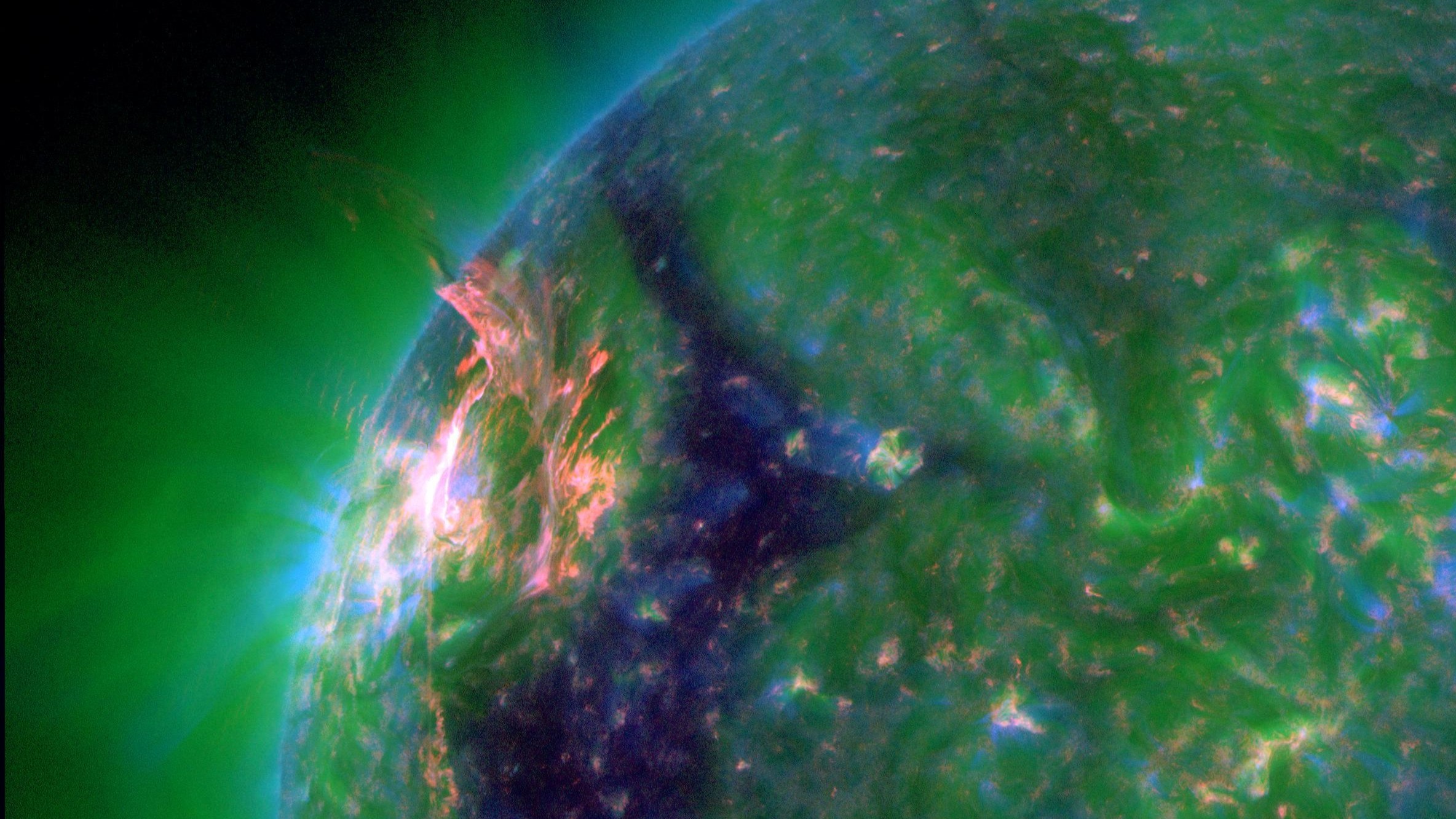
Solar activity follows an approximately 11-year cycle, and scientists have noted that the sun is currently in an active phase — meaning events like Sunday’s eruption are more likely to continue occurring in the months ahead.
Frequently Asked Questions
What is an M5.7 solar flare?
An M5.7 solar flare is a strong solar eruption in the second-highest classification category, just below the most powerful X-class flares. Sunday’s flare peaked at 8:39 a.m. EST on May 10.
Did Sunday’s solar flare cause any confirmed damage on Earth?
The flare caused temporary disruptions to high-frequency radio communications on the sunlit side of Earth, according to NOAA’s Space Weather Prediction Center. No other confirmed damage has been reported from
What is a coronal mass ejection and how is it different from a solar flare?
A solar flare is electromagnetic radiation that travels at the speed of light, while a coronal mass ejection (CME) is a slower-moving cloud of solar plasma and radiation that can take days to reach Earth and is capable of triggering geomagnetic storms.
Will the CME definitely hit Earth and cause a northern lights display?
There is no guarantee of a direct hit, according to the Space Weather Prediction Center. Earth could receive a glancing blow, which may still produce some aurora activity but is not certain to do so.
Is it safe to be outside during a solar flare?
Yes — Earth’s atmosphere and magnetic field protect people on the ground from harmful radiation produced by solar flares, according to NASA. The primary risks are to radio communications, satellites, and other technological infrastructure.
How are solar flares classified?
Solar flares are ranked in categories from weakest to strongest: A, B, C, M, and X. M-class flares are the second strongest category and can cause radio blackouts and potential satellite disruption.


Leave a Reply