
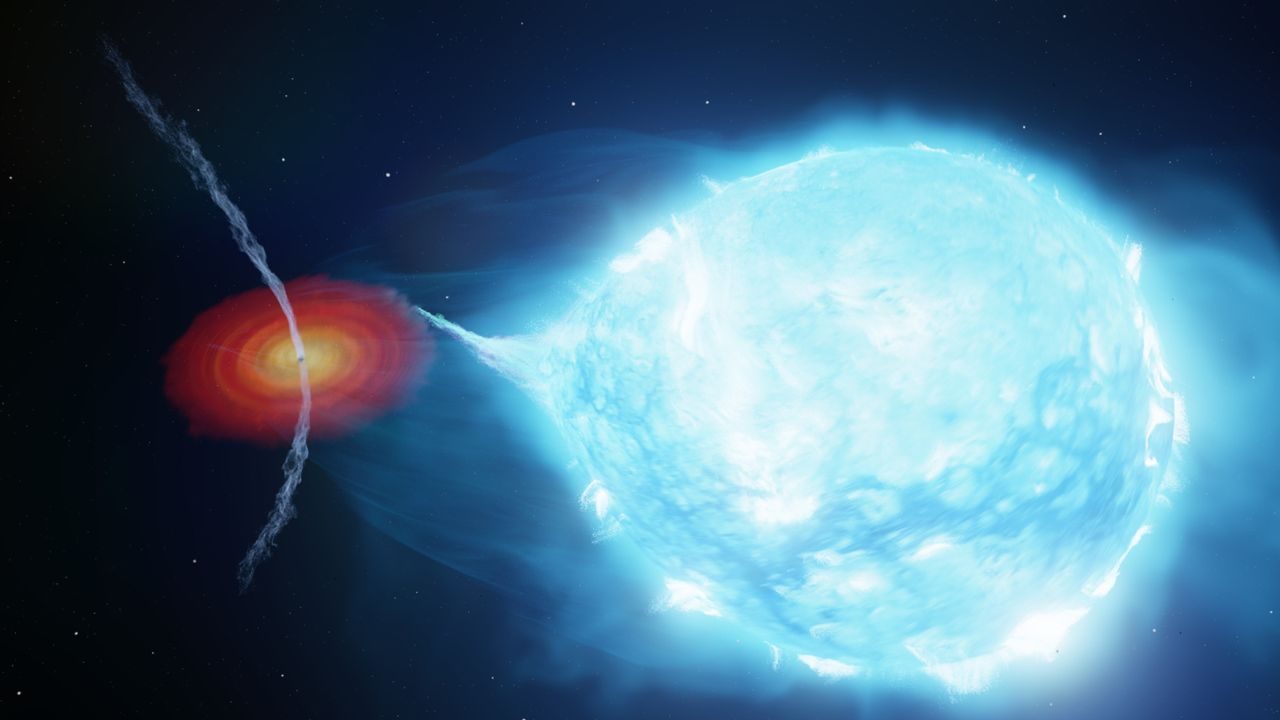
More than 60 years after scientists first identified it, the most famous black hole in the universe is still managing to surprise us. Cygnus X-1 — the first black hole ever confirmed to exist — has been caught firing enormous jets of energy into space at roughly half the speed of light, and those jets don’t travel in a straight line. They wobble. They dance. And researchers have only just figured out why.
New research has finally produced the first real measurement of the energy output from Cygnus X-1’s jets, and the method used to get there is as fascinating as the discovery itself. By mapping the way those jets wobble and shift direction, scientists were able to calculate just how much raw power this ancient black hole is putting out — and the answer is staggering by any measure.
This isn’t just a story about one black hole. What scientists learn from Cygnus X-1 has the potential to reshape our understanding of how black holes across the universe behave at their most extreme.
What Cygnus X-1 Actually Is — and Why It Matters
Cygnus X-1 holds a unique place in the history of science. It was the first object in the universe to be confirmed as a genuine black hole, making it the original reference point for everything we’ve come to understand about these objects. Located in the constellation Cygnus, it has been studied for decades — yet it keeps revealing new layers.
Like many black holes, Cygnus X-1 doesn’t exist in isolation. It is locked in a binary system with a companion star called HDE 226868, a massive stellar body whose powerful winds interact constantly with the black hole’s gravitational pull and surrounding environment. That relationship, it turns out, is central to the new discovery.
Black holes of this type — known as stellar-mass black holes — are formed when massive stars collapse. They are among the most energetic objects in the known universe, capable of launching jets of plasma and radiation across vast distances. But measuring those jets precisely has always been a challenge. Until now.
The Dancing Jets of Cygnus X-1 — What Researchers Found
The breakthrough came from a clever approach: rather than trying to measure the jets directly, researchers tracked how they wobble. The jets emanating from Cygnus X-1 don’t fire in a fixed direction. They dance — shifting and swaying due to the influence of stellar winds blowing off the companion star HDE 226868.
By carefully mapping this wobbling motion, the research team was able to work backward and calculate the energy those jets are carrying. The jets themselves travel at approximately half the speed of light — a velocity that places them among the fastest-moving structures produced by any known black hole system.
The research was conducted with support from the International Centre for Radio Astronomy Research (ICRAR), which provided the imaging and analytical tools needed to track the subtle movements of the jets over time.
| Feature | Detail |
|---|---|
| Black hole name | Cygnus X-1 |
| Historical significance | First confirmed black hole ever discovered |
| Companion star | HDE 226868 |
| Jet speed | Approximately half the speed of light |
| Key research institution | International Centre for Radio Astronomy Research (ICRAR) |
| Discovery method | Mapping jet wobble caused by stellar winds |
| Years since initial discovery | More than 60 years |
Why the Wobble Is the Key to Everything
The concept of using a jet’s wobble to measure its energy is worth pausing on, because it’s not an obvious approach. Jets moving at relativistic speeds — meaning speeds close to the speed of light — are notoriously difficult to study directly. They are powerful, fast, and constantly changing.
But the wobble is different. The stellar winds from HDE 226868 push against the jets in a predictable way, causing them to deviate from their path in patterns that can be tracked and modeled. That wobbling motion carries information about the jet’s underlying power. Essentially, the stronger the jet, the more it resists being pushed off course — and the more precisely scientists can infer its energy output.
Researchers argue this technique could be applied beyond Cygnus X-1. If the wobble-mapping method proves reliable, it opens a new window into measuring the behavior of black hole jets across the broader universe — including in systems far too distant or faint to study by conventional means.
What This Discovery Could Change About Black Hole Science
The wider scientific significance here is substantial. Black hole jets are thought to play a major role in shaping galaxies — blasting energy into surrounding space, influencing star formation, and distributing matter across cosmic scales. But quantifying exactly how much energy those jets carry has remained one of the harder problems in astrophysics.
Getting a firm measurement from Cygnus X-1’s jets is a meaningful step forward. It gives researchers a concrete data point to work with — a verified energy output from a well-studied, nearby system that can serve as a benchmark for understanding jets elsewhere.
The results could also help answer broader questions about what happens at the most extreme boundaries of physics, where matter and energy behave in ways that still challenge our best theoretical models.
What Comes Next for Cygnus X-1 Research
Cygnus X-1 has been studied for more than six decades, and the pace of discovery shows no sign of slowing. Now that researchers have a method for measuring jet energy through wobble-mapping, the expectation is that further observations will refine these measurements and potentially reveal new details about how the jets form and evolve over time.
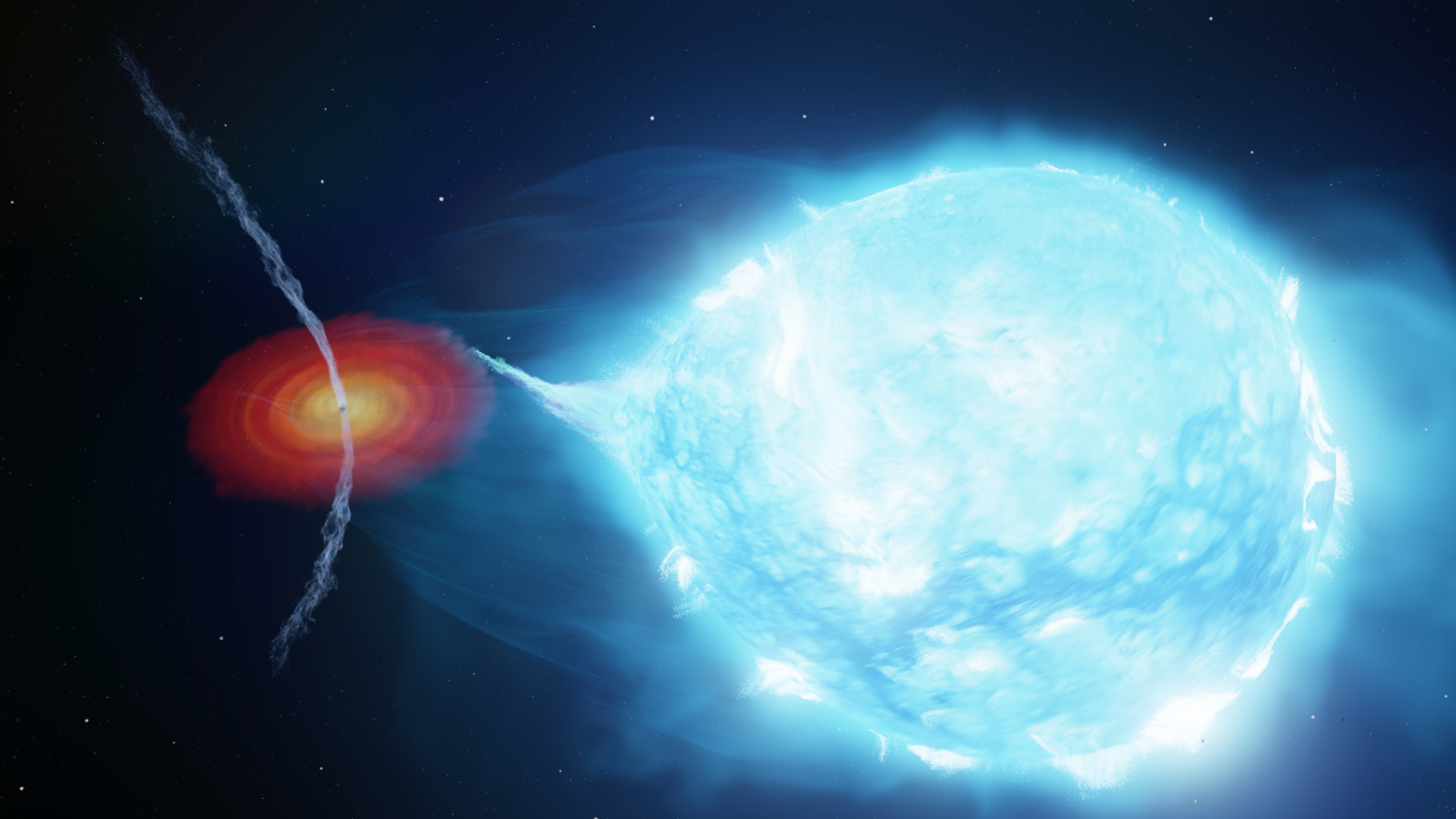
The interaction between the black hole and its companion star HDE 226868 is a dynamic, ongoing process — meaning there is no shortage of new data to collect. Every cycle of stellar wind, every shift in the jets’ direction, adds another piece to a puzzle that scientists have been working on since the early days of X-ray astronomy.
For now, the discovery stands as a reminder that even the most familiar objects in the cosmos can still catch us off guard — and that the first black hole we ever found still has plenty left to teach us.
Frequently Asked Questions
What is Cygnus X-1?
Cygnus X-1 is the first black hole ever confirmed to exist. It has been studied for more than 60 years and is located in a binary system with the companion star HDE 226868.
How fast are the jets coming from Cygnus X-1?
The jets from Cygnus X-1 travel at approximately half the speed of light, making them among the fastest-moving structures associated with any known black hole system.
Why do the jets wobble or “dance”?
The jets wobble because of stellar winds produced by Cygnus X-1’s companion star, HDE 226868. Those winds push against the jets, causing them to shift direction in ways that can be tracked and measured.
How did researchers measure the energy of the jets?
Rather than measuring the jets directly, researchers mapped the wobbling motion caused by stellar winds and used that data to calculate the jets’ underlying energy output.
Which institution was involved in the research?
The International Centre for Radio Astronomy Research (ICRAR) was involved in the research, providing imaging and analytical support for the study.
Why does this discovery matter beyond Cygnus X-1?
The wobble-mapping technique used in this research could potentially be applied to other black hole systems, offering a new way to measure jet energy across the broader universe and answer wider questions about extreme black hole behavior.



Leave a Reply