

The 24-hour day that has shaped every alarm clock, work schedule, and school bell on Earth is not actually a fixed feature of our planet — it is slowly getting longer. Scientists confirm that Earth’s rotation is gradually slowing down, and at some point in the distant future, a single day will stretch to 25 hours. The catch? That future is so far away it is almost impossible to picture.
The idea sounds dramatic, and online headlines love to treat it as imminent. But the real story is both more fascinating and more humbling than any clickbait suggests. Understanding why the day is lengthening, and over what kind of timescale, reveals something remarkable about the relationship between Earth and the Moon.
This is not science fiction. The mechanism is real, measurable, and has been operating for billions of years. It just works on a clock that makes human history look like a blink.
Why Earth’s Days Are Getting Longer
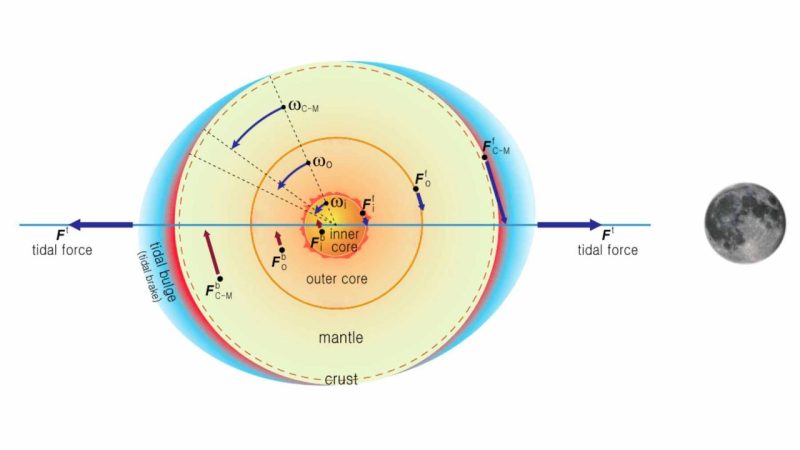
The force driving this change is the same one that moves the tides. The Moon’s gravitational pull tugs on Earth’s oceans, creating the familiar rise and fall of tidal water we see along coastlines. But those tides do not just move water — they act as a gentle, continuous brake on Earth’s spin.
Think of it as a tug-of-war between Earth and the Moon. Every time the tidal bulge of ocean water is pulled slightly out of alignment with Earth’s rotation, a tiny amount of rotational energy is lost. The planet slows, almost imperceptibly, and the day grows fractionally longer. This process is known as tidal friction, and it has been operating since the Moon first formed.
The effect is real enough that scientists can measure it. Over geological time, the evidence is locked in ancient rocks and coral fossils, which show that hundreds of millions of years ago, Earth’s days were significantly shorter. Early in Earth’s history, a day may have lasted only around 22 hours or even less.
What “A Day” Actually Means — And Why It Is Complicated
Before going further, it helps to know that the concept of a “day” is less straightforward than it seems. Most people understand a day as 24 hours — the cycle of sunrise to sunset and back again that governs daily life. But that is specifically a solar day, measured relative to the Sun’s position in the sky.
There is another way to measure Earth’s rotation: using distant stars as reference points instead of the Sun. This gives what astronomers call a sidereal day, which is slightly shorter than a solar day. As NASA’s Space Place explains, the difference exists because Earth is not just spinning — it is also moving along its orbit around the Sun at the same time. The two measurements are not contradictory; they are simply two valid ways of tracking motion.
For everyday purposes, the solar day is what matters. And it is the solar day that tidal friction is slowly, steadily stretching.
| Type of Day | Definition | Approximate Length |
|---|---|---|
| Solar Day | Time for Sun to return to same position in sky | ~24 hours |
| Sidereal Day | Time for Earth to complete one rotation relative to distant stars | ~23 hours 56 minutes |
The Number That Puts Everything in Perspective
Here is the detail that reframes the entire conversation: the rate at which Earth’s rotation is slowing is extraordinarily small. Scientists estimate that the day is lengthening by roughly 1.4 milliseconds every century. That is less than two thousandths of a second per hundred years.
At that rate, accumulating an extra full hour — going from a 24-hour day to a 25-hour day — would require hundreds of millions of years. The word “soon,” as used in popular headlines about this topic, does not mean decades or centuries. It means a timescale that dwarfs the entire history of human civilization many thousands of times over.
To put it plainly: no person alive today, no future generation, no civilization that has ever existed or is likely to exist will experience a 25-hour day. The change is real, but it belongs to deep geological time — not to any calendar we will ever use.
What This Means for Life on Earth — Now and Eventually
In practical terms, the slowing rotation has no impact on daily life today. The change per human lifetime is so small it cannot be felt or observed without precision instruments. Your alarm clock is safe.
Over longer timescales, however, a slower-spinning Earth would carry real consequences. Longer days would mean longer periods of heating by the Sun and longer nights of cooling. Weather patterns, ocean circulation, and the behavior of the atmosphere are all tied to how fast the planet rotates. A significantly slower Earth would be a meaningfully different planet.
- Tidal patterns along coastlines would shift as the Moon’s relative influence on a slower-spinning Earth changed.
- The length of seasons and the distribution of solar energy across the planet would be affected over extremely long timescales.
- The Moon itself is slowly moving farther from Earth as angular momentum is transferred — a process directly linked to the same tidal braking that lengthens the day.
None of these consequences are concerns for any living person. But they are a reminder that Earth is not a static object — it is a dynamic system changing across timescales that dwarf human experience.
Why This Story Keeps Coming Back
The idea of a 25-hour day resurfaces regularly in science headlines because it touches something genuinely interesting: the fact that the world we take for granted is not permanent. The 24-hour day is not a law of nature carved into the universe. It is the current state of a slow, ongoing process that has been running for billions of years and will continue long after we are gone.
That is worth knowing — even if the next hour will not arrive for longer than most of us can meaningfully imagine.
Frequently Asked Questions
Will Earth really have 25-hour days one day?
Yes, according to scientists, Earth’s rotation is genuinely slowing due to tidal friction from the Moon, which will eventually result in longer days — but on a timescale of hundreds of millions of years.
How fast is Earth’s rotation actually slowing down?
What is causing Earth’s days to get longer?
The Moon’s gravitational pull creates tidal friction that acts like a brake on Earth’s spin, slowly transferring rotational energy and lengthening the day over geological time.
What is the difference between a solar day and a sidereal day?
A solar day is measured relative to the Sun and lasts approximately 24 hours, while a sidereal day is measured relative to distant stars and is slightly shorter — about 23 hours and 56 minutes.
Should anyone alive today be concerned about this change?
No. The rate of change is so small that it has no practical impact on human life, schedules, or any foreseeable future civilization.
Has Earth always had 24-hour days?
No. Scientific evidence from ancient rocks and fossils suggests that early in Earth’s history, days were significantly shorter — possibly around 22 hours or less — because the planet was spinning faster.


Leave a Reply