
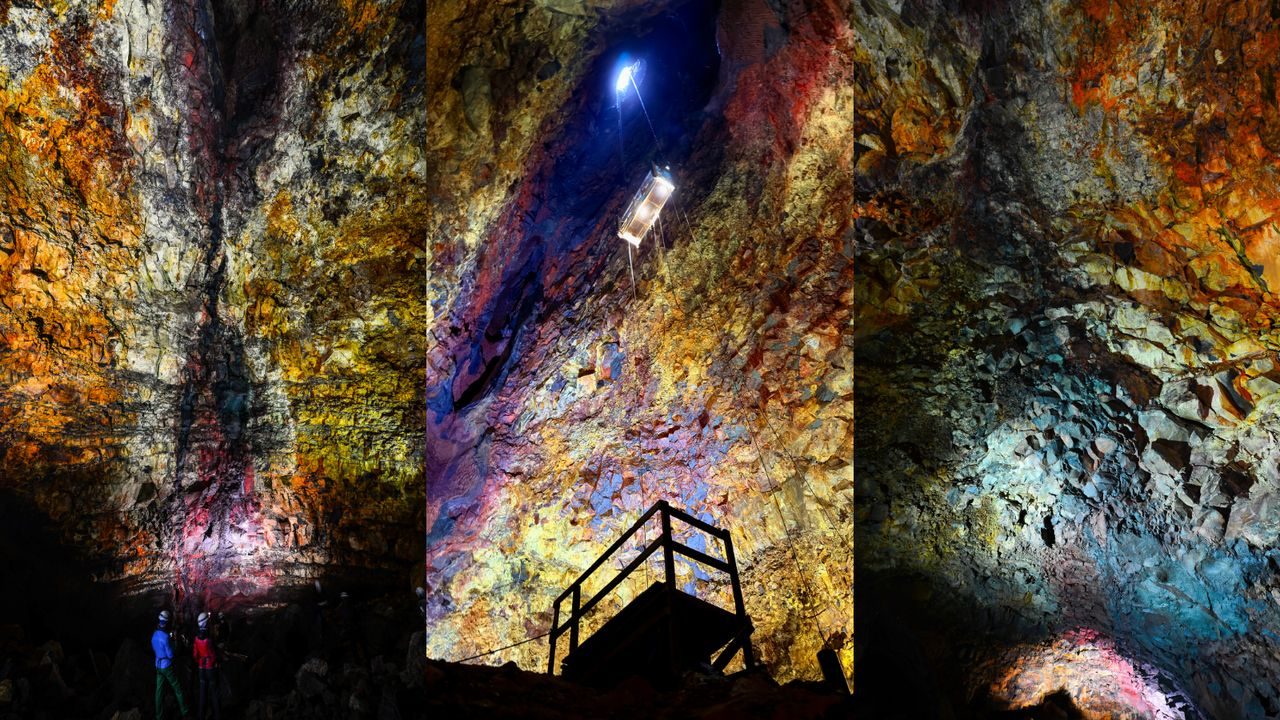
Somewhere beneath the lava fields of southwest Iceland, there is a door into the Earth that almost no other place on the planet can offer — a hollow magma chamber left behind by a volcanic eruption, fully intact, and open to human visitors. It is, by all geological accounts, a one-of-a-kind phenomenon.
The volcano is called Thríhnúkagígur, which translates from Icelandic as “Three Peaks Crater.” It sits near Reykjavík, Iceland’s capital, and it holds a distinction that no other volcano on Earth can claim: its magma chamber is accessible to people. Not through a tunnel or a viewing platform at a safe distance — but by descending directly inside it.
That alone makes it worth paying attention to, whether you’re a geology enthusiast, an adventure traveler, or simply someone who finds it extraordinary that the interior of a volcano can be visited like a natural wonder rather than feared as a hazard.
What Makes Thríhnúkagígur Unlike Any Other Volcano
Most volcanoes, when they erupt, drain their magma chambers violently and completely — leaving behind collapsed calderas, filled vents, or solidified lava plugs that seal the interior permanently. Thríhnúkagígur did something different.
When it last erupted approximately 4,500 years ago, the magma drained away and left the chamber hollow. The structure remained stable. No collapse. No infill. Just an enormous underground cavity, preserved beneath the Icelandic landscape for millennia — until people eventually discovered what was sitting beneath their feet.
The result is the only known magma chamber on Earth that humans can physically enter. That is not a marketing claim. It is a geological reality with no known equivalent anywhere else in the world.
The Colors Inside Thríhnúkagígur’s Magma Chamber
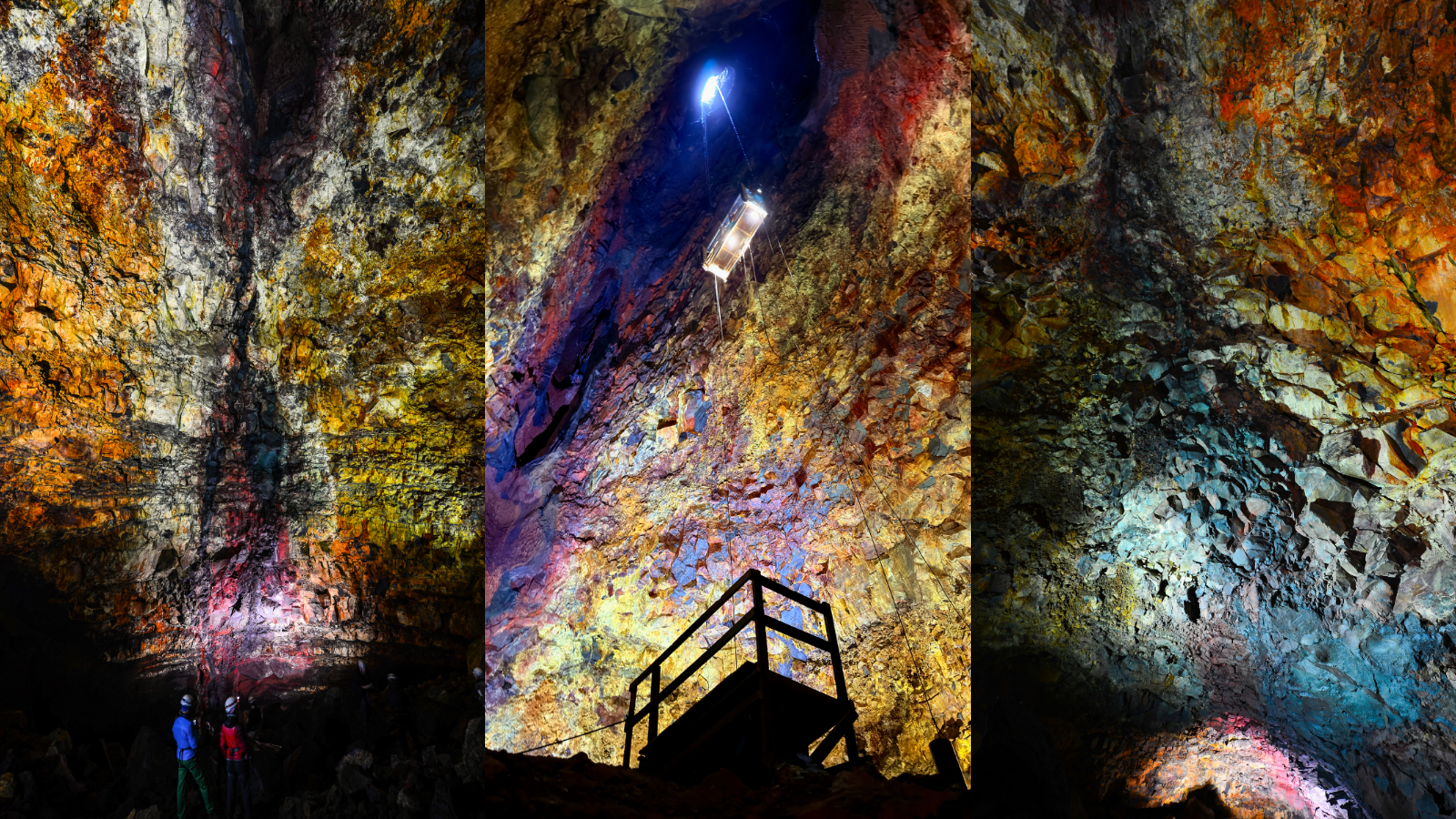
One of the most visually striking aspects of the chamber is its color. Visitors who descend into Thríhnúkagígur do not find a grey or black cave interior. Instead, the walls display an extraordinary range of reds, oranges, purples, and yellows — colors that seem almost too vivid to belong underground.
Those colors come from a combination of three sources, according to available scientific observations:
- Microbes living on the rock surfaces, which contribute biological pigmentation
- Sulfur-rich gases that have interacted with and stained the rock over thousands of years
- Rocks tumbling off the chamber walls, exposing fresh mineral surfaces beneath
The effect is unlike anything most people have ever seen underground. The chamber walls look almost painted — a geological canvas created not by any artist, but by chemistry, biology, and time.
Key Facts at a Glance
| Detail | Information |
|---|---|
| Full name | Thríhnúkagígur (Three Peaks Crater) |
| Location | Southwest Iceland, near Reykjavík |
| Coordinates | 63.9984, -21.6989 |
| Last eruption | Approximately 4,500 years ago |
| Current status | Dormant |
| Global distinction | World’s only accessible magma chamber |
| Chamber colors | Attributed to microbes, sulfur-rich gases, and exposed rock minerals |
Why This Place Matters Beyond the Spectacle
It would be easy to frame Thríhnúkagígur purely as a tourist attraction — and it is certainly that. But its scientific significance runs considerably deeper than any adventure experience can capture.
Magma chambers are the engine rooms of volcanic systems. They are where molten rock collects, pressurizes, and eventually forces its way to the surface. Understanding what they look like from the inside, how their walls behave over time, and what biological and chemical processes occur within them after an eruption are all questions that geologists rarely get the chance to study through direct observation.
Thríhnúkagígur offers that opportunity. The presence of microbial life on the chamber walls, for instance, raises questions about how organisms colonize post-volcanic environments — research that has implications not just for Earth geology, but for thinking about life in extreme environments elsewhere.
The fact that rocks continue to fall from the chamber walls also means the interior is not entirely static. It is a slow, ongoing geological process playing out in real time, visible to anyone who descends inside.
Getting There and What the Experience Involves
Thríhnúkagígur is located in southwest Iceland, close enough to Reykjavík to be accessible as a day trip. The volcano is dormant — meaning there is no active volcanic threat to visitors — but reaching the chamber requires a guided descent, typically via a small open lift that lowers visitors down through the volcanic vent.
The journey down is part of what makes the experience memorable. The transition from the open Icelandic landscape above to the vast, colorful underground chamber below is, by most accounts, genuinely disorienting in the best possible way. The scale of the interior — shaped by forces that moved millions of tons of molten rock — is difficult to comprehend until you are standing inside it.
Tours are seasonal and weather-dependent, as the approach to the volcano crosses open lava fields that can be challenging in poor conditions. Visitors should plan accordingly and book in advance, as access is limited by both the physical capacity of the descent system and the need to protect the chamber environment.
A Geological Rarity That Probably Won’t Last Forever
Dormant does not mean permanently stable. Iceland sits on one of the most volcanically active regions on Earth, and while Thríhnúkagígur has been quiet for 4,500 years, the geological forces that created it are still very much active across the broader landscape.
The ongoing process of rocks detaching from the chamber walls is a reminder that the interior is slowly changing. The colors, the microbial communities, the exact shape of the space — all of it is in a state of gradual transformation. What visitors see today is not exactly what someone would have seen a century ago, and it will not be identical to what future visitors encounter.
That impermanence is part of what makes Thríhnúkagígur genuinely compelling. It is not a static museum exhibit. It is a living geological system, accessible to humans in a way that nothing else on Earth currently allows.
Frequently Asked Questions
Where is Thríhnúkagígur located?
Thríhnúkagígur is located in southwest Iceland, near the capital city of Reykjavík, at coordinates 63.9984, -21.6989.
When did Thríhnúkagígur last erupt?
The volcano last erupted approximately 4,500 years ago and is currently classified as dormant.
Why is Thríhnúkagígur’s magma chamber accessible when others are not?
When the volcano erupted, the magma drained away and left the chamber hollow and structurally intact rather than collapsing or being sealed by solidified lava — a geological outcome with no known equivalent elsewhere on Earth.
What causes the vivid colors inside the magma chamber?
The colors are attributed to a combination of microbes living on the rock surfaces, sulfur-rich gases that have stained the walls over thousands of years, and minerals exposed by rocks tumbling off the chamber walls.
Is it safe to visit the magma chamber?
The volcano is dormant and visits are conducted through organized guided tours with a descent system, though specific safety details and current tour availability have not been confirmed in
What does the name Thríhnúkagígur mean?
The name translates from Icelandic as “Three Peaks Crater,” a reference to the volcanic formation’s distinctive shape at the surface.

Leave a Reply