
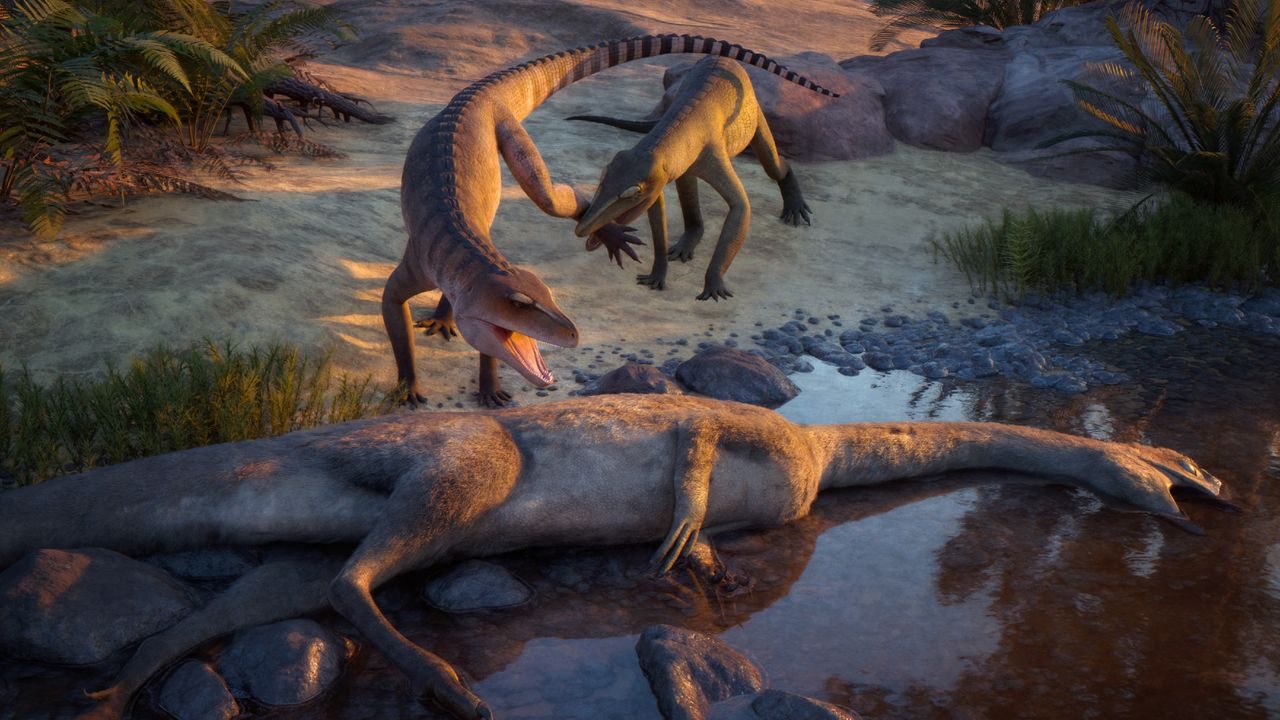
For nearly 80 years, the bones sat quietly in a museum basement — unidentified, uncatalogued, and largely forgotten. Now, scientists have finally given a name to a 205-million-year-old crocodile relative unearthed at Ghost Ranch, New Mexico, and what they’ve found challenges some long-held assumptions about how ancient croc cousins actually lived.
The newly named species, Eosphorosuchus lacrimosa, belonged to a group of prehistoric crocodile relatives that roamed the Triassic world — but not the way most people picture crocodilians today. This animal wasn’t lurking in swamps or rivers. It was hunting on dry land, moving through its environment more like a modern fox or jackal than anything resembling the water-bound crocs we know now.
The discovery is a reminder that some of paleontology’s most significant finds aren’t made in the field — they’re made on dusty shelves, in the back rooms of institutions that have held specimens for generations without fully knowing what they had.
What We Know About Eosphorosuchus lacrimosa
Ghost Ranch, New Mexico is already one of the most celebrated fossil sites in North America. It’s the same location where enormous deposits of Coelophysis — an early dinosaur — were discovered, making it a landmark destination for paleontologists. The fossils that would eventually become Eosphorosuchus lacrimosa were pulled from that same region during an earlier era of excavation, then stored away before researchers had the tools or context to properly identify them.
What makes this species particularly interesting is its lifestyle. During the Triassic period, roughly 205 million years ago, the ancestors of modern crocodiles hadn’t yet made the evolutionary leap into aquatic life. Eosphorosuchus lacrimosa was a fully terrestrial predator — a land hunter operating in an ecosystem that also included early dinosaurs like Coelophysis and other crocodile relatives such as Hesperosuchus agilis.
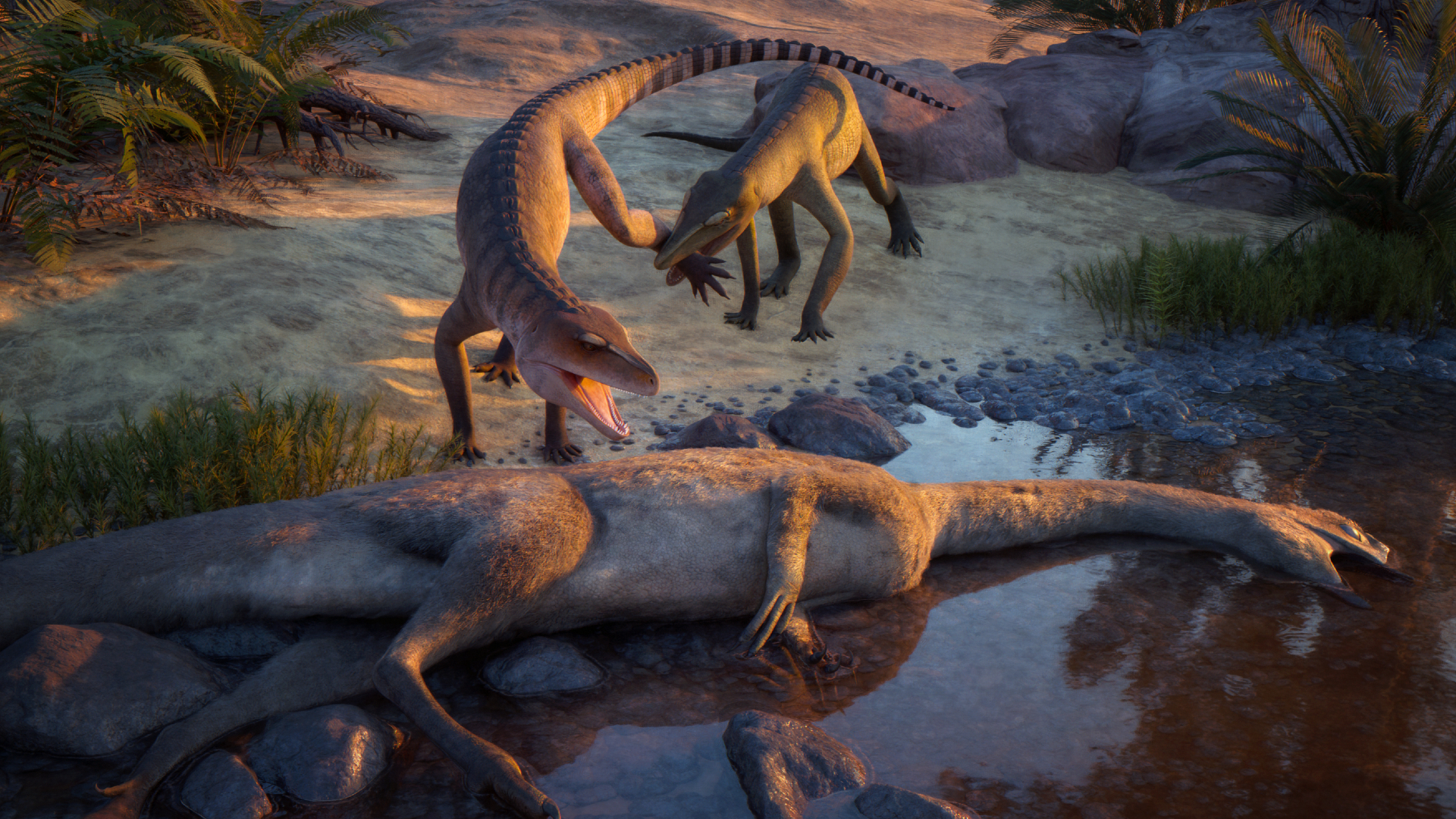
Artistic reconstructions of the period depict Eosphorosuchus lacrimosa in tense proximity to Hesperosuchus agilis, with both species competing near the carcass of a Coelophysis — a snapshot of a complex, competitive Triassic food web that scientists are only beginning to map in full detail.
The Triassic Crocodile Relatives You’ve Never Heard Of
Modern crocodiles are semi-aquatic ambush predators, but their ancient relatives were far more varied in how they lived. During the Triassic, the crocodile lineage — technically known as crocodyliformes and their close relatives — included animals that were slender, fast-moving, and built for land pursuit rather than water ambush.
Think of it this way: if you saw Eosphorosuchus lacrimosa running through a Triassic landscape, it might have looked far more like a lean, agile predator than anything resembling a modern American alligator. The shift toward water came later in evolutionary history, driven by pressures that researchers are still working to understand.
The comparison to a fox or jackal is more than just colorful language. It speaks to a specific ecological role — a mid-sized, opportunistic land predator that likely pursued prey actively rather than waiting in ambush. That’s a fundamentally different survival strategy than what we associate with crocodilians today.
Key Facts at a Glance
| Detail | Information |
|---|---|
| Species Name | Eosphorosuchus lacrimosa |
| Time Period | Triassic, approximately 205 million years ago |
| Discovery Location | Ghost Ranch, New Mexico |
| Classification | Crocodile relative (not a true crocodilian) |
| Lifestyle | Terrestrial predator — hunted on land |
| Modern Behavioral Comparison | Similar ecological role to a fox or jackal |
| Time in Storage | Nearly 80 years in a museum basement |
| Co-existing Species | Hesperosuchus agilis, Coelophysis |
- Newly named genus and species: Eosphorosuchus lacrimosa had not been formally identified until this study.
- Ghost Ranch connection: The site is already famous for its Coelophysis fossil beds, making it one of North America’s most significant Triassic localities.
- Land-based hunting: Unlike modern crocs, this animal was fully terrestrial — water was not part of its world.
- Long museum wait: The specimen spent close to eight decades stored away before being formally studied and named.
Why a Fossil Sitting in a Basement for 80 Years Actually Matters
This story isn’t just about one ancient animal. It points to something broader about how science works — and how much is still waiting to be discovered in collections that already exist.
Museums and research institutions around the world hold millions of specimens that were excavated decades ago but never fully analyzed. Limited funding, shifting research priorities, and the sheer volume of material collected during the 20th century’s fossil rush means that significant finds sometimes wait generations before anyone gets around to properly identifying them.
Eosphorosuchus lacrimosa is a case study in that reality. The fossils were physically present. They had been collected from one of the most productive fossil sites in the American Southwest. But without the research attention and modern analytical tools to examine them closely, they remained scientifically invisible for nearly eight decades.
The identification of this species adds another data point to scientists’ understanding of Triassic ecosystems — particularly the diversity of predators that shared space with early dinosaurs in what is now New Mexico.
What Comes Next for Ghost Ranch Research
The formal naming of Eosphorosuchus lacrimosa opens new questions rather than closing old ones. Researchers will likely look more closely at how this species interacted with other predators of the period, including Hesperosuchus agilis, and what its presence tells us about the competitive dynamics of Triassic food webs.
Ghost Ranch itself remains an active area of paleontological interest. Given that this identification came from specimens already in storage, it’s reasonable to expect that further analysis of existing collections from the site could yield additional surprises. The basement, so to speak, may not be empty yet.
For the broader scientific community, this find reinforces the value of revisiting old collections with fresh eyes and new methods — a practice that has quietly produced some of paleontology’s most important recent discoveries.
Frequently Asked Questions
What is Eosphorosuchus lacrimosa?
It is a newly named genus and species of Triassic crocodile relative discovered at Ghost Ranch, New Mexico, that lived approximately 205 million years ago.
Was Eosphorosuchus lacrimosa an aquatic animal like modern crocodiles?
No. Unlike modern crocodilians, this species was a terrestrial predator that hunted on land, with researchers comparing its ecological role to that of a modern fox or jackal.
Where were the fossils found and how long were they stored?
The fossils came from Ghost Ranch, New Mexico, and spent nearly 80 years in a museum basement before being formally identified and named.
What other animals lived alongside this species?
Based on
Why did it take so long to identify this species?
Is Ghost Ranch known for other fossil discoveries?
Yes — Ghost Ranch is already well known in paleontology for its significant deposits of Coelophysis fossils, making it one of North America’s most important Triassic fossil sites.


Leave a Reply