
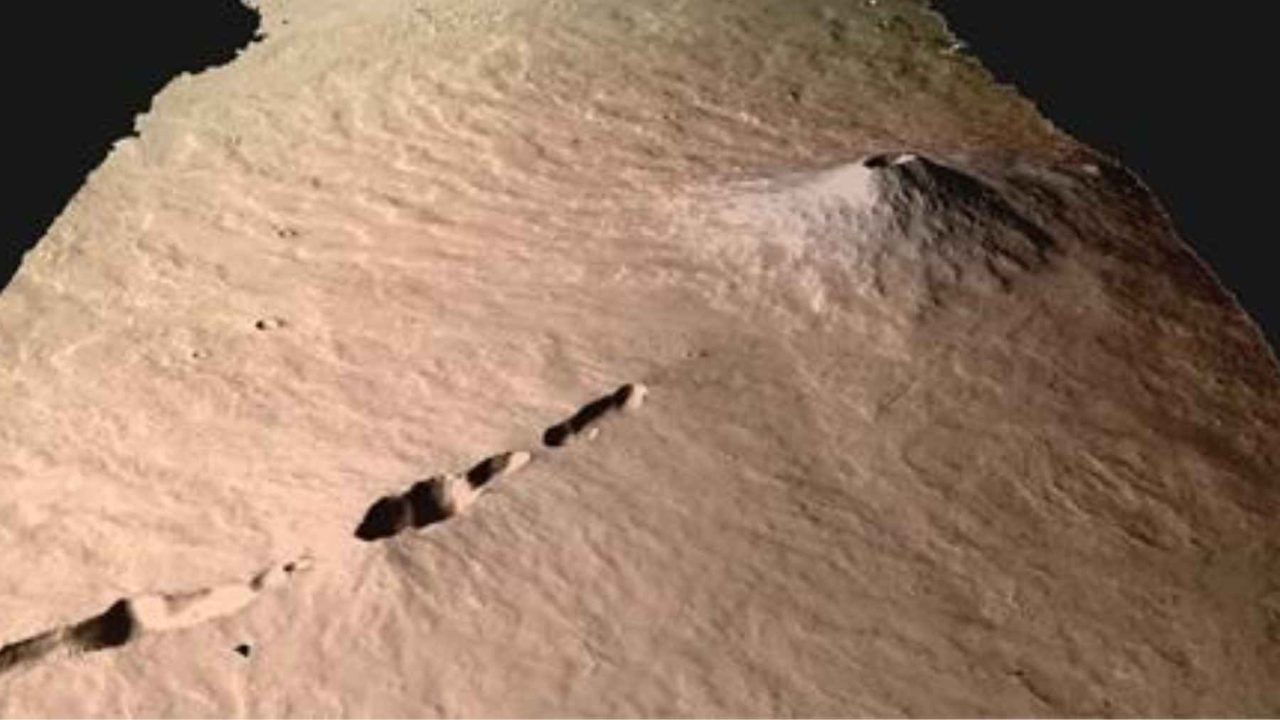
Mars has long been written off as a geologically dead world — a cold, dusty planet that burned bright early in the solar system’s history and then went quiet billions of years ago. New research is challenging that story in a meaningful way, finding that at least one volcanic region on the Red Planet stayed geologically active far longer than scientists had previously assumed.
The study focuses on a volcanic system located just south of Pavonis Mons, one of the massive shield volcanoes in Mars’s Tharsis region. Using orbital images and mineral data — rather than physical rock samples — researchers reconstructed the history of the area and found evidence that its magmatic system did not simply switch off. Instead, it continued to evolve quietly beneath the surface for millions of years after it appeared to go dormant.
Think of it like a stovetop burner that looks cold but is still radiating heat long after you’ve turned it off. That lingering warmth, in geological terms, has real consequences for how we understand Mars’s past — and possibly its potential to have supported conditions relevant to life.
What the Research Actually Found Near Pavonis Mons
Pavonis Mons sits within the Tharsis volcanic plateau, one of the most geologically significant regions on Mars. The area has been studied for decades, but the volcanic system just to its south had not received the same level of scrutiny — until now.
What researchers found there cuts against a straightforward reading of the landscape. At first glance, the lava deposits in that region look like the remnants of a single eruptive event — one big outpouring of magma that cooled and solidified. The new analysis argues that interpretation is misleading.
Instead, the evidence points to multiple eruptive phases, all fed by the same underlying plumbing system. Rather than one eruption and one cooling period, the region appears to have experienced a series of volcanic episodes drawing from a persistent magma source. That means the system was not a one-and-done event — it was a long-running geological process that kept returning to the surface in waves.
Crucially, the researchers reached these conclusions without having physical rock samples in hand. The analysis relied entirely on orbital imagery and mineral data gathered remotely, which makes the findings both impressive and worth continued scrutiny as Mars exploration advances.
Why Mars Was Supposed to Be Geologically “Done” Earlier
The traditional picture of Mars is of a planet that lost its internal heat relatively quickly compared to Earth. Smaller planets cool faster — that’s basic planetary physics. Mars has roughly half Earth’s diameter, and without the sustained internal heat that drives plate tectonics on our planet, it was expected to have largely solidified and gone quiet early in its history.
Volcanic regions like Tharsis were understood to be ancient features, products of an earlier, hotter era. The assumption was that by the time Mars entered what scientists call its “younger” geological periods, the magmatic systems driving those volcanoes had largely shut down.
This new research complicates that picture. If a magmatic system in a relatively “young” part of Mars — geologically speaking — was still actively evolving and producing eruptions over an extended period, it suggests the planet’s interior retained heat longer and in more complex ways than the standard model accounts for.
What This Means for Mars’s Environmental History
This isn’t just an abstract geological puzzle. The presence of sustained volcanic activity has direct implications for Mars’s environmental conditions over time.
- Heat sources matter for liquid water. Volcanic systems produce heat, and heat can keep water liquid — either on the surface or underground. If Mars had active magmatic systems persisting longer than thought, there may have been more opportunities for liquid water to exist.
- Volcanic gases shape atmospheres. Eruptions release gases that can thicken an atmosphere and alter surface chemistry. A longer period of volcanic activity could mean Mars’s atmosphere was influenced by these processes for an extended window of time.
- It changes where we look. If certain regions stayed geologically active longer, those areas become more scientifically interesting when assessing Mars’s potential habitability in the distant past.
The researchers note that the planet’s interior may have been “awake” deep down even when the surface appeared calm and inert. That distinction — between a quiet surface and an active interior — is exactly the kind of nuance that reshapes how planetary scientists map out Mars’s timeline.
A Snapshot of What the Evidence Shows
| Feature | Previous Understanding | New Findings |
|---|---|---|
| Cooling timeline | Relatively rapid after early volcanic period | Slower than assumed; system persisted longer |
| Eruptive history near Pavonis Mons | Likely a single eruptive event | Evidence of multiple eruptive phases |
| Magmatic system behavior | Shut down early in Mars’s history | Continued to evolve quietly for millions of years |
| Research method | Often assumed from general planetary models | Orbital images and mineral data analysis |
| Location of study | N/A | South of Pavonis Mons, Tharsis region |
What Comes Next for Mars Geology Research
One of the most important limitations of this research is also one of its most honest: everything was reconstructed remotely. Scientists used orbital data and mineral signatures to piece together a geological history that would ideally be confirmed with physical samples from the region.
That’s where future Mars missions become relevant. As sample-return efforts and more advanced rovers continue to develop, regions like the volcanic system south of Pavonis Mons become higher-priority targets. Ground-truth data — actual rock samples that can be dated and chemically analyzed in laboratories — would either confirm or refine what orbital analysis has suggested here.
For now, the findings stand as a reminder that Mars is more geologically complex than its cold, quiet surface suggests. The planet’s story didn’t end early. Parts of it, at least, kept writing new chapters long after scientists assumed the book was closed.
Frequently Asked Questions
Where exactly is the volcanic system studied in this research?
The study focuses on a volcanic system located just south of Pavonis Mons, within the Tharsis region of Mars.
How did scientists study this region without rock samples?
Researchers used orbital imagery and mineral data gathered remotely to reconstruct the geological and eruptive history of the area.
What did scientists previously believe about this region?
The lava deposits had generally been interpreted as the remnants of a single eruptive event, rather than the product of multiple phases driven by a long-lived magmatic system.
What does “magmatic system continued to evolve” actually mean?
It means the underground reservoir of molten rock didn’t simply cool and solidify quickly — instead, it remained active and produced multiple eruptions over millions of years.
Does this discovery have any implications for the possibility of life on Mars?
Will physical rock samples ever be collected from this region?
This has not yet been confirmed, but the findings make the area a more scientifically compelling target for future Mars exploration and sample-return missions.


Leave a Reply