
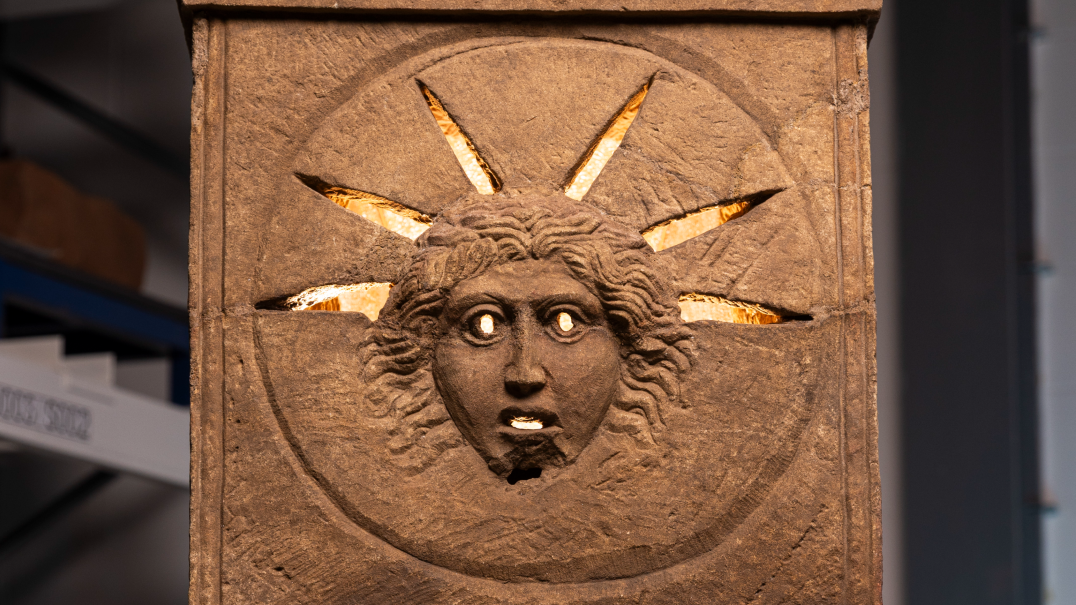
A carved sandstone altar — nearly 1,900 years old and dedicated to Sol, the Roman god of light — was pulled from the ground just east of Edinburgh, Scotland, during a 2010 archaeological survey. What made it remarkable wasn’t just its age. The altar had been deliberately pierced from behind, engineered so that light could shine directly through it. That single design detail tells a story about secret rituals, ancient belief systems, and a corner of Roman Scotland that historians are still working to understand.
The find came from Inveresk, a site near present-day Lewisvale Park, where construction crews were preparing to build a new cricket pavilion. Before the groundwork began, archaeologists were brought in to survey the land — a standard precaution in areas with known Roman-era history. What they uncovered was anything but standard.
https://vimeo.com/1161123362
The altar is now held at National Museums Scotland, and it stands as one of the rarest surviving examples of Roman religious practice from the northern frontier of the empire.
What the Altar to Sol Actually Is
The object is a carved sandstone altar dating to the second century — roughly 100 to 200 CE. It was made in the Roman tradition of religious monuments used for offerings and worship, but this one carries a highly unusual feature: it was pierced from behind so that light could pass through the stone itself.
That modification wasn’t accidental or decorative. It was functional. The altar was designed to allow a beam of light to emerge from the front face during rituals — creating a visual effect that would have been striking, even otherworldly, to anyone present. For a monument dedicated to Sol, the god of the sun and light, that design choice carries obvious symbolic weight.
Sol was a significant deity in Roman religious life, particularly during the second and third centuries when solar worship gained influence across the empire. The god was associated with clarity, power, and the life-giving force of the sun — and in some ritual traditions, with secret or mystery-cult ceremonies conducted away from public view.
The Underground Ritual Connection
The altar’s design — built to channel light in a controlled, dramatic way — strongly suggests it was used in the context of a mystery religion or secret underground ritual, rather than open public worship. Mystery cults were a well-documented feature of Roman religious life. They involved initiates, hidden ceremonies, and carefully staged sensory experiences meant to create a sense of divine encounter.
An altar that makes light appear to emanate from solid stone would have served exactly that purpose. In a darkened underground space, a shaft of light breaking through a carved stone monument dedicated to the sun god would have been a powerful, deliberately manufactured moment of awe.
The Inveresk site itself has a significant Roman history. The area was home to a Roman fort and associated civilian settlement during the occupation of southern Scotland, placing the altar firmly within a functioning Roman community — not an isolated outpost.
Key Facts About the Altar to Sol
| Detail | Information |
|---|---|
| Name | Altar to Sol |
| Object type | Carved sandstone altar |
| Origin | Inveresk, Scotland |
| Date of creation | Second century (approximately 1,900 years ago) |
| Discovery date | 2010 |
| Discovery context | Pre-construction archaeological survey, Lewisvale Park |
| Dedicated to | Sol, the Roman god of light and the sun |
| Distinctive feature | Pierced from behind to allow light to shine through |
| Current location | National Museums Scotland |
- The altar was found during a survey ahead of a cricket pavilion construction project
- Its light-channeling design is considered rare among surviving Roman altars
- The find location, Inveresk, is known to have hosted a Roman fort and civilian settlement
- The second century date places it within the period of Roman occupation of southern Scotland
Why This Discovery Matters Beyond Scotland
Roman altars are not uncommon finds across Britain and Europe. What makes the Altar to Sol stand out is the engineering behind it. The deliberate modification to channel light through the stone is rare — and it reframes how archaeologists think about ritual practice on the empire’s northern edges.
The Roman frontier in Scotland was not simply a military zone. Communities formed around forts, and those communities carried their religious lives with them. The presence of an altar this sophisticated — one built for atmospheric, staged ritual experience — suggests that mystery cult practices were active this far north, not just in Rome or the major Mediterranean cities.
For historians studying how Roman religion spread and adapted across the empire, this kind of physical evidence is invaluable. Texts describe mystery cults and solar worship in general terms, but an actual artifact engineered to produce a light effect during ceremony gives those descriptions a concrete, tangible form.
Where the Research Goes From Here
The altar is now preserved at National Museums Scotland, where it can be studied alongside other Roman-era finds from the region. The Inveresk site continues to be of archaeological interest given its confirmed Roman occupation history, and future excavations in the area could yield additional context about how this altar was used and who used it.
The broader question — what specific cult or ritual practice the altar served — has not yet been definitively answered. Solar mystery cults took several forms in the Roman world, and without additional inscriptions or associated finds from the same context, researchers are working with the physical evidence alone.
What is not in question is the rarity of what was found. An altar designed to make light pass through stone, dedicated to the god of light, recovered from a Roman community at the edge of the known world — that combination doesn’t come along often.
Frequently Asked Questions
Where was the Altar to Sol discovered?
It was found at Inveresk, near Lewisvale Park just east of Edinburgh, Scotland, during a pre-construction archaeological survey in 2010.
How old is the Altar to Sol?
The altar dates to the second century, making it approximately 1,900 years old.
What makes this altar different from other Roman altars?
It was pierced from behind so that light could shine through the stone — an unusual engineering feature believed to have been used for dramatic effect during secret rituals.
Which god was the altar dedicated to?
The altar was dedicated to Sol, the Roman god of light and the sun.
Where is the altar now?
It is currently held at National Museums Scotland.
What kind of ritual was the altar used in?
The design strongly suggests it was used in a mystery cult or secret underground ritual, though the specific cult has not yet been definitively identified from the available evidence.




Leave a Reply