
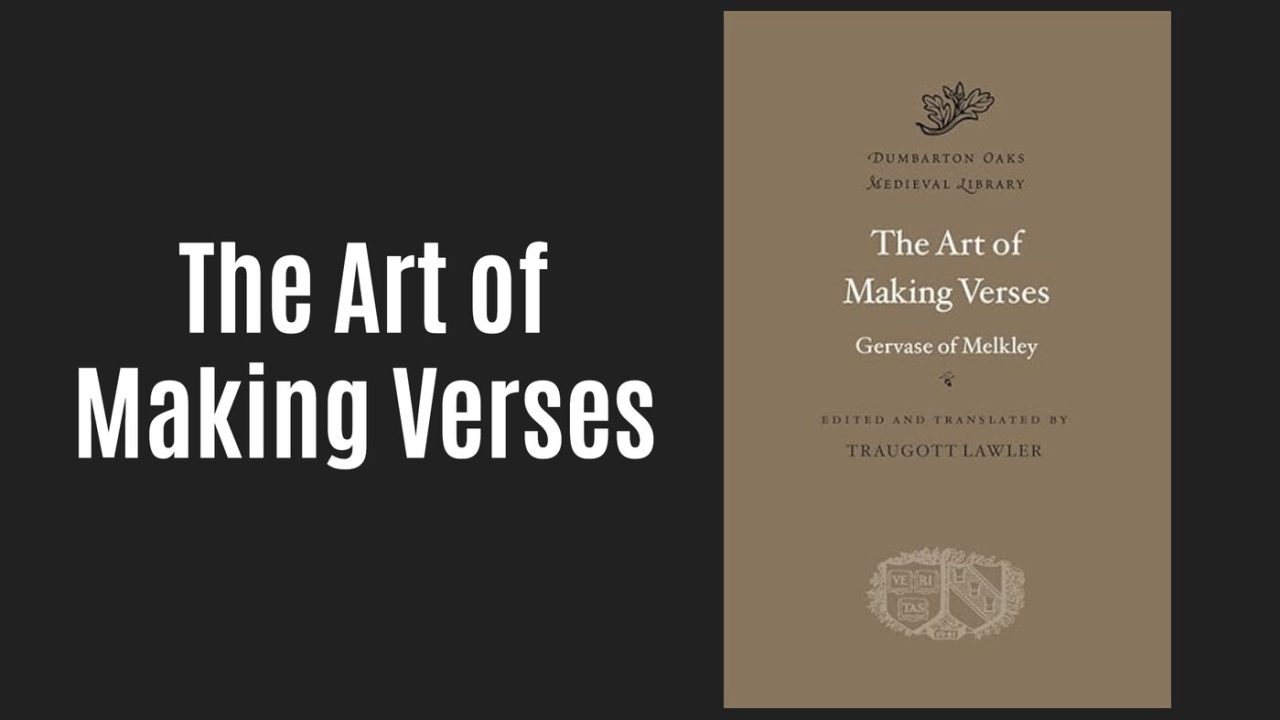
A medieval writing teacher once opened his poetry manual with a disarming promise: “This little book is for beginners!” What followed was anything but ordinary. Written in the early 13th century, The Art of Making Verses by Gervase of Melkley turns out to be one of the more inventive guides to poetic composition from the medieval period — and now, for the first time in an accessible modern edition, English-speaking readers can explore it in full.
Harvard University Press has published a new edited and translated edition of the text, prepared by scholar Traugott Lawler. For anyone interested in medieval literature, the history of education, or how poets were trained before the printing press existed, this is a genuinely rare find.
Gervase was an English writer, less celebrated than some of his contemporaries, but his manual reveals a thinker who had strong opinions about what good poetry looked like — and who wasn’t content simply to repeat the standard rules everyone else was teaching.
What Makes This Medieval Poetry Manual Different
Medieval schools produced a lot of writing guides. Most of them followed well-worn paths: repeat classical rules, cite ancient authorities, move on. Gervase takes a different approach. Rather than recycling standard doctrine, he introduces what the editor describes as a fresh method for composing verse — one that walks students from the basics of clear expression all the way through to more advanced techniques like metaphor and irony.
That progression matters. Teaching a beginner to write clearly is one thing. Teaching them how to bend language, how to say one thing and mean another, how to make an image do the work of a statement — that’s a more sophisticated ambition, and it’s one that Gervase pursues deliberately.
The manual also draws heavily on examples from ancient authors, grounding its lessons in real poetic texts rather than abstract rules. For students of the period, that would have meant encountering classical verse not as distant relics but as live models for their own writing.
The World Gervase Wrote In
To understand why this manual matters, it helps to understand the moment it came from. Gervase wrote at a time when, as the editor notes, the writing and teaching of poetry in both France and England were at a high-water mark. The intellectual culture of the late 12th and early 13th centuries was producing some of the most ambitious Latin poetry in centuries.
The two poets Gervase admired most — and quoted most frequently — were Bernard Silvester and John of Hauville. Bernard Silvester’s Cosmographia appeared in 1150. John of Hauville, who was Gervase’s own teacher, published his major work Architrenius in 1184. Alan of Lille, another writer Gervase cites with clear admiration, flourished in the second half of the 12th century and died in 1202.
Gervase thought of himself as belonging to this company — a group of serious, ambitious modern poets pushing Latin verse into new territory. His output may have been small, but his aspirations were not. At one point in the manual, in what the editor calls a remarkably personal moment, Gervase appears to express his desire to write poetry as good as Bernard Silvester’s.
That kind of candor — a teacher revealing his own longing to be a great poet — is unusual in a textbook from any era, let alone the 13th century.
Key Facts About the Book and Its Context
| Detail | Information |
|---|---|
| Author | Gervase of Melkley |
| Editor and Translator | Traugott Lawler |
| Publisher | Harvard University Press |
| ISBN | 9780674290969 |
| Original period | Early 13th century |
| Poets cited by Gervase | Bernard Silvester, John of Hauville, Alan of Lille |
| Bernard Silvester’s Cosmographia | Published 1150 |
| John of Hauville’s Architrenius | Published 1184 |
| Alan of Lille’s death | 1202 |
The edition provides both the original Latin text and a full English translation, making it accessible to readers who want to engage with the original language as well as those coming to it fresh.
Who Should Actually Read This
The most obvious audience is anyone studying medieval literature or the history of education. The Art of Making Verses sits at the intersection of both — it’s a primary source document that shows exactly how poetic craft was transmitted in medieval schools, with all the technical detail and personal voice that implies.
But the book has a broader appeal than that narrow description suggests. Gervase writes like someone who genuinely loves poetry and genuinely wants his students to love it too. The manual isn’t dry. It has opinions, preferences, and moments of real personality.
For readers interested in the craft of writing more generally, there’s something almost refreshing about a 13th-century teacher insisting that the goal isn’t just to follow rules — it’s to reach the kind of expressive power that the best poets achieve. That concern hasn’t aged at all.
Why This Edition Arrives at the Right Moment
Medieval Latin texts have historically been difficult to access for general readers. They require specialist training, and translations have often been scattered across academic journals or locked behind expensive institutional resources. A Harvard University Press edition with a full facing translation changes that equation considerably.
Traugott Lawler’s work in editing and translating the text means that Gervase’s voice — practical, ambitious, occasionally personal — can reach readers who would never have encountered him otherwise. For a writer who clearly wanted to be taken seriously as a poet and a teacher, that kind of renewed attention seems fitting.
Gervase of Melkley may not be a household name even among medieval enthusiasts. But his little book for beginners turns out to have a lot to say — about poetry, about ambition, and about what it meant to take language seriously in 13th-century England.
Frequently Asked Questions
Who was Gervase of Melkley?
Gervase of Melkley was an English writer who composed a poetry manual in the early 13th century. He is described as less well known than some of his contemporaries, though his work shows clear familiarity with the leading poets of his era.
What is The Art of Making Verses about?
It is a manual for students of poetry that introduces a method for composing verse, guiding readers from clear expression through to more advanced techniques like metaphor and irony, with examples drawn from ancient authors.
Who edited and translated this new edition?
The edition was edited and translated by Traugott Lawler and published by Harvard University Press under ISBN 9780674290969.
Which poets did Gervase most admire?
Gervase quoted and admired Bernard Silvester, whose Cosmographia appeared in 1150, and John of Hauville, his own teacher, whose Architrenius was published in 1184. He also cited Alan of Lille, who died in 1202.
Is this book suitable for readers without a medieval studies background?
Does the manual reveal anything personal about Gervase himself?
Yes — the editor highlights one passage described as a remarkably personal moment in which Gervase appears to express his desire to write poetry as accomplished as Bernard Silvester’s.

Leave a Reply