
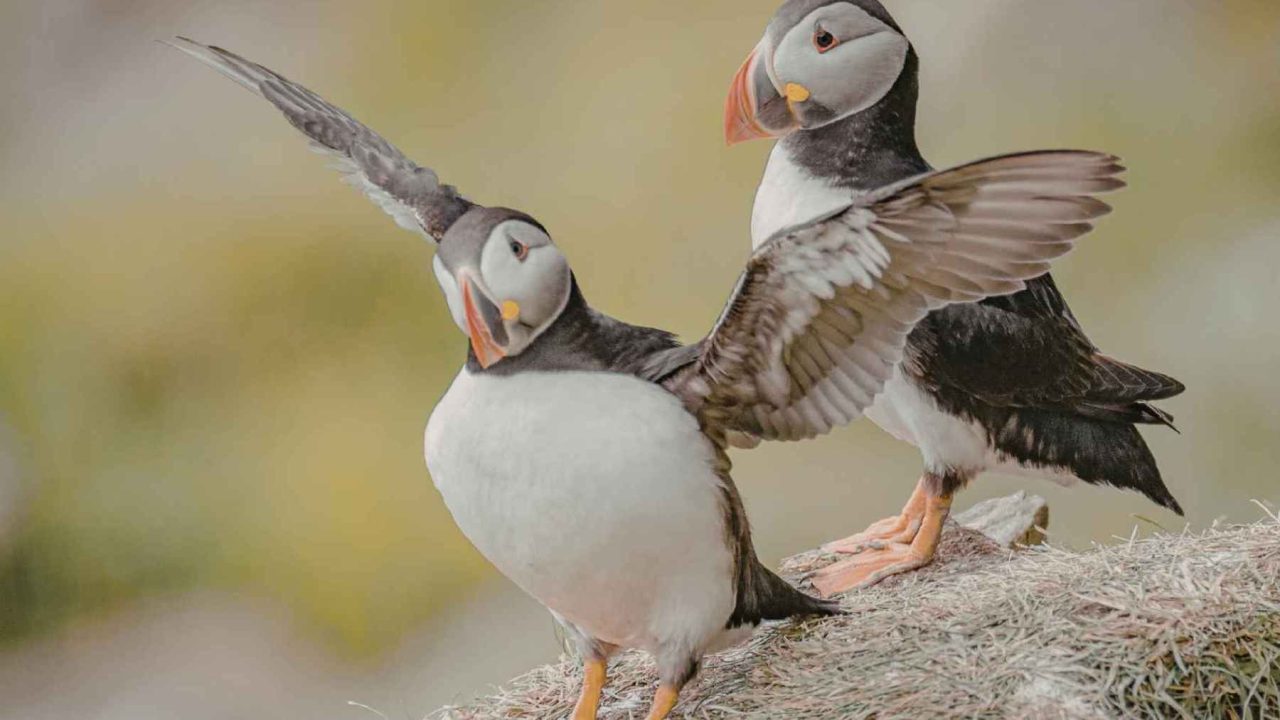
More than 3,000 baby puffins were rescued from the streets, gardens, and industrial areas of a single Icelandic town in 2024 alone — and that number tells you everything about how badly artificial light at night is disrupting one of the ocean’s most beloved seabirds.
The Atlantic puffin is already listed as Vulnerable globally, with an estimated 12 to 14 million mature individuals and a population that continues to fall. In Iceland, the situation is worse still. The country’s 2025 bird red list classifies the Icelandic breeding population as Critically Endangered — the highest threat category before extinction. Scientists and local residents are now working together to stop young birds from dying before they ever reach the sea.
And the culprit, at least in part, is something most of us leave on without a second thought: the lights.
Why Light Pollution Is Sending Puffins the Wrong Way
Every year at the end of the breeding season, young puffins — called pufflings — leave their burrows for the first time. Under natural conditions, they navigate toward the ocean using the glow of moonlight and starlight reflected off the water. It is an instinct that has worked for thousands of years.
But in coastal towns where harbor lights, street lamps, and industrial lighting flood the night sky, that instinct gets hijacked. The artificial glow pulls pufflings inland instead of toward the sea. They land on roads, in gardens, and in parking lots — confused, grounded, and vulnerable to predators, vehicles, and starvation.
This is not a rare edge case. It is happening at scale, every single season, wherever puffin colonies overlap with human settlements lit up at night.
What Is Happening in Iceland Right Now
The Icelandic town of Vestmannaeyjar — known in English as the Westman Islands — sits beside what locals describe as the world’s largest Atlantic puffin colony. With a population of roughly 4,300 people, it is a small community facing a very large problem.
Each year, residents go out after dark to search for grounded pufflings. They check gardens, pavements, and industrial zones, carefully collecting the disoriented birds. The rescue ritual ends with what looks, to an outside observer, like a disturbing act: the rescuer holds the puffling up and releases it into the wind from a clifftop or shoreline, letting it drop toward the sea.
It is not cruelty. It is correction — an attempt to undo the navigational confusion caused by artificial light and give the bird a second chance at finding the ocean.
According to National Geographic, more than 3,000 pufflings were rescued in Vestmannaeyjabær alone in 2024. In a town of 4,300 people, that works out to roughly one rescue for every person and a half in the entire community.
The Numbers Behind the Threat
| Fact | Detail |
|---|---|
| Global conservation status | Vulnerable (declining trend) |
| Estimated global mature population | 12–14 million individuals |
| Iceland breeding population status (2025) | Critically Endangered |
| Pufflings rescued in Vestmannaeyjabær (2024) | More than 3,000 |
| Population of Vestmannaeyjabær | Approximately 4,300 |
| Potential population impact of light pollution | Up to 40% of the world’s puffin population at risk |
The headline figure — that light pollution could wipe out up to 40% of the world’s puffin population — reflects the scale of the threat when you consider how many breeding colonies sit near artificially lit coastlines around the Atlantic.
Who Is Actually Affected — and How Serious This Gets
Pufflings that are not rescued face grim odds. A bird that lands inland and cannot take off from flat ground can die of exhaustion, be killed by a car, or fall prey to cats and other predators. The ones that survive long enough to be found by a human rescuer are the lucky ones.
But the problem extends beyond any single town. Atlantic puffins breed across Iceland, Norway, the Faroe Islands, the British Isles, and parts of eastern North America. Any coastal colony near significant artificial lighting faces the same disorientation risk during fledging season.
The broader concern is cumulative. Light pollution is not just a nuisance for astronomers — it is increasingly recognized as a genuine ecological threat, disrupting migration patterns, breeding cycles, and survival instincts across dozens of species. For puffins, already under pressure from overfishing, climate-driven changes to fish stocks, and habitat disturbance, it is one more compounding stress on a population that cannot easily absorb losses.
- Pufflings navigate by natural light cues — artificial light overrides those instincts
- Grounded birds face death from exhaustion, predators, or vehicles
- Iceland’s breeding population is now classified as Critically Endangered
- Light pollution affects multiple puffin colonies across the North Atlantic
- Community rescue efforts, while meaningful, cannot replace systemic change
What Needs to Happen Next
The rescue operations in Vestmannaeyjar are a community response to a structural problem. They save individual birds, and the effort involved — thousands of people walking streets at night during fledging season — reflects genuine commitment. But conservationists broadly argue that rescues alone cannot address the scale of the threat.
Reducing light pollution near breeding colonies during fledging season — through shielded lighting, timed shutoffs, or switching to amber-spectrum bulbs that are less disorienting to wildlife — represents the kind of systemic intervention that could reduce the number of birds grounded in the first place.
Iceland’s decision to classify its puffin breeding population as Critically Endangered in 2025 signals that the urgency is being formally recognized. Whether that recognition translates into policy changes around coastal lighting remains to be seen.
For now, the people of Vestmannaeyjar keep walking their streets after dark, scooping up small, bewildered birds, and giving them back to the sea — one puffling at a time.
Frequently Asked Questions
Why are puffins disoriented by artificial light?
Pufflings use natural light reflected off the water to navigate toward the sea at night. Artificial harbor and street lights mimic or overpower those cues, pulling the birds inland instead.
How many puffins are left in the world?
The Atlantic puffin has an estimated 12 to 14 million mature individuals globally, but the population is in decline and the species is listed as Vulnerable.
What is Iceland’s current conservation status for puffins?
Iceland’s 2025 bird red list classifies the country’s breeding puffin population as Critically Endangered — the most severe threat category before extinction.
How many pufflings were rescued in Vestmannaeyjar in 2024?
According to National Geographic, more than 3,000 pufflings were rescued in Vestmannaeyjabær during the 2024 fledging season.
Does releasing a puffling by dropping it actually help?
Yes — the drop-release method helps a grounded puffling become airborne from a height, correcting the disorientation caused by artificial light and giving the bird a chance to reach the ocean.
Can reducing light pollution actually protect puffins?
Conservation advocates argue that targeted reductions in coastal lighting during fledging season — such as shielded lamps or timed shutoffs — could significantly reduce the number of pufflings grounded each year, though specific policy outcomes have not yet been confirmed.

Leave a Reply