
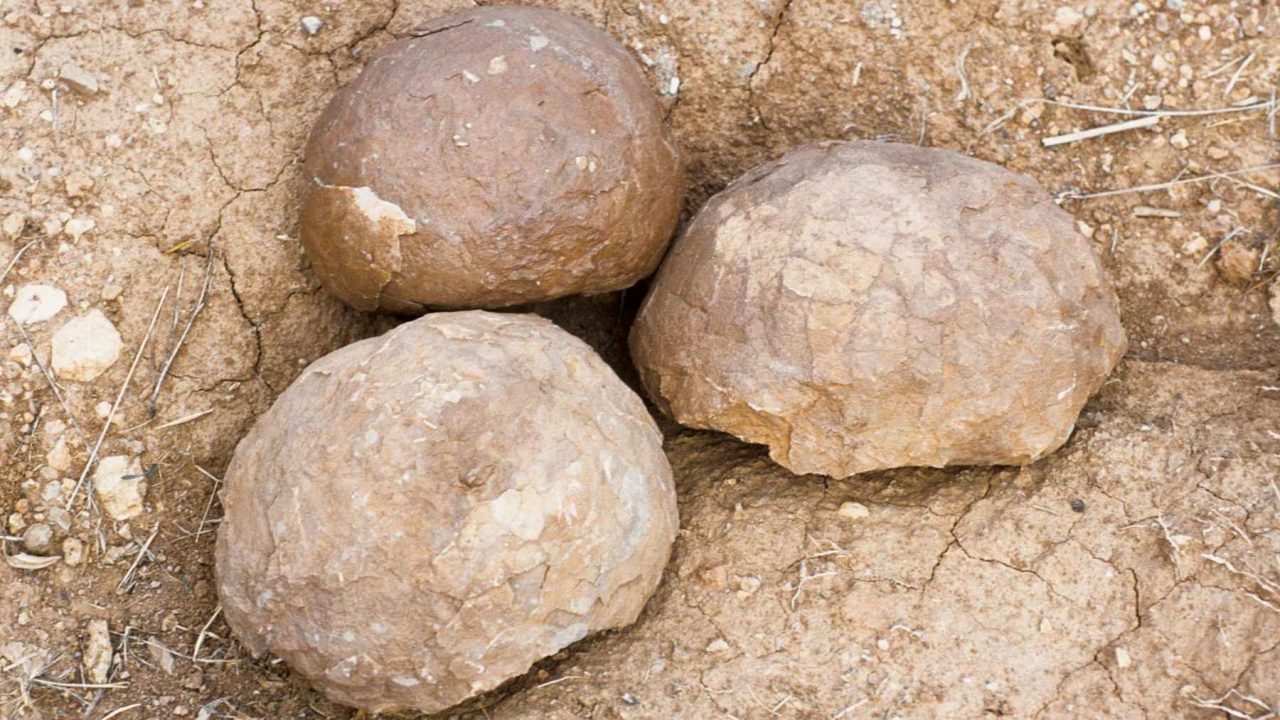
Five hundred and fifty-two dinosaur eggs, sitting in the red clay of southern France for roughly 70 million years — and it took a team of more than 160 volunteers to finally count them all. That number alone is enough to stop you in your tracks. But what makes this discovery genuinely remarkable is where these eggs were found: not deep underground in some remote excavation, but in a protected nature reserve that has been quietly guarding this prehistoric nursery since 1994.
The Sainte-Victoire National Nature Reserve, nestled in the Bouches-du-Rhône department of southern France, has long been known as a site of paleontological importance. But the scale of what has now been formally documented — 552 fossil dinosaur eggs counted during a recent conservation dig — puts this location in rare company globally. Officials have noted that only around 10 comparable nesting sites have been identified anywhere in the world.
For paleontologists and curious minds alike, this is the kind of find that rewrites the map of where dinosaurs lived, nested, and raised their young during the final chapter of their reign on Earth.
A Nesting Ground Frozen in Time
The Late Cretaceous period — the last stretch of dinosaur time before the mass extinction event roughly 66 million years ago — left behind clues in some of the most unexpected places. Sainte-Victoire is one of them. The eggs embedded in its distinctive red clays and sandstones date back approximately 70 million years, placing them squarely in that final era.
What makes a nesting site scientifically valuable goes beyond the sheer number of eggs. Concentrations like this can tell researchers how dinosaurs behaved: whether they nested communally, how close together they laid their eggs, and what kind of environment surrounded them at the time. Each egg is essentially a data point in a much larger story about dinosaur reproductive habits.
The reserve’s egg-bearing geological layers are fragile. The red clays and sandstones that preserved these fossils for tens of millions of years are also highly susceptible to erosion, which is precisely why the site requires active protection and careful, methodical excavation rather than open public access.
What the Dig Actually Found — By the Numbers
The conservation dig was carried out by teams working with the Natural History Museum of Aix-en-Provence, supported by the Department of Bouches-du-Rhône. The volunteer-driven effort brought in more than 160 participants to assist with the count and documentation.
| Detail | Figure |
|---|---|
| Total fossil dinosaur eggs counted | 552 |
| Volunteers involved in the dig | 160+ |
| Reserve size | 140 hectares (approx. 346 acres) |
| Year the reserve was established | 1994 |
| Year eggs at the site were first recorded | 1947 |
| Comparable sites identified worldwide | Approximately 10 |
| Estimated age of the eggs | ~70 million years |
The reserve itself is structured in two zones: a closed core area called Grands Creux, where the most sensitive fossil layers are located, and a surrounding protective perimeter that helps buffer the core from outside disturbance. This layered approach to conservation is standard for sites where the geological material is as fragile as it is irreplaceable.
Why This Site Is One of the Rarest on the Planet
The eggs at Sainte-Victoire were first identified in 1947, making this a site with a documented history spanning nearly eight decades. But formal protection only came in 1994, when the National Nature Reserve was established specifically to safeguard these fossil layers.
The rarity of the site cannot be overstated. With only around 10 similar nesting sites known across the entire world, every egg counted here represents something genuinely irreplaceable. These aren’t isolated specimens — they’re evidence of a nesting ground, a place where dinosaurs returned, laid eggs, and presumably tended to their young during a period that predates human existence by an almost incomprehensible margin.
The involvement of the Department of Bouches-du-Rhône as a managing authority signals that this isn’t just a scientific curiosity. It’s treated as a cultural and natural heritage asset, one that requires ongoing investment and careful stewardship.
The Question Every Paleontologist Wants Answered
Among all the scientific possibilities this site presents, one question stands above the rest: could any of these eggs still contain an embryo?
Fossilized embryos are extraordinarily rare. When they do survive, they offer a level of biological detail that no adult skeleton can match — bone structure at its earliest stages, hints at growth rates, and clues about what hatchling dinosaurs actually looked like. The possibility, however remote, that one of these 552 eggs might preserve embryonic material is exactly the kind of prospect that keeps paleontologists working through seasons of careful excavation.
That question has not yet been answered, and confirming or ruling it out will require detailed analysis well beyond what a surface count can provide.
What Comes Next for Sainte-Victoire
The current dig represents a conservation effort, not a full excavation. The priority at a site like this is documentation and protection — understanding what is there before deciding how best to study it without causing damage.
The Natural History Museum of Aix-en-Provence is the primary institutional partner in this work, and the ongoing support of the Department of Bouches-du-Rhône suggests the site will continue to receive the resources needed for long-term preservation. Given that the eggs were first recorded in 1947 and the reserve wasn’t formally established until 1994, the pace of progress here tends to be measured in decades rather than months.
What is clear is that Sainte-Victoire is not finished revealing its secrets. With 552 eggs now formally counted and the geological layers still largely intact, the reserve remains one of the most significant — and most carefully protected — windows into dinosaur prehistory anywhere on Earth.
Frequently Asked Questions
How many dinosaur eggs were found at the Sainte-Victoire reserve?
A total of 552 fossil dinosaur eggs were counted during the conservation dig, carried out with the help of more than 160 volunteers.
How old are the dinosaur eggs at Sainte-Victoire?
The eggs are estimated to be approximately 70 million years old, placing them in the Late Cretaceous period.
When were the eggs at Sainte-Victoire first discovered?
The eggs at the site were first identified in 1947, though the National Nature Reserve was not established to formally protect them until 1994.
How rare is a nesting site like this?
Officials have noted that only around 10 comparable dinosaur nesting sites have been identified anywhere in the world, making Sainte-Victoire exceptionally rare.
Could the eggs still contain embryos?
This is one of the central scientific questions surrounding the site, but it has not yet been confirmed. Detailed analysis beyond the current count would be required to determine this.
Who manages the Sainte-Victoire reserve?
The reserve is supported by the Department of Bouches-du-Rhône, and conservation work is carried out in partnership with the Natural History Museum of Aix-en-Provence.

Leave a Reply