
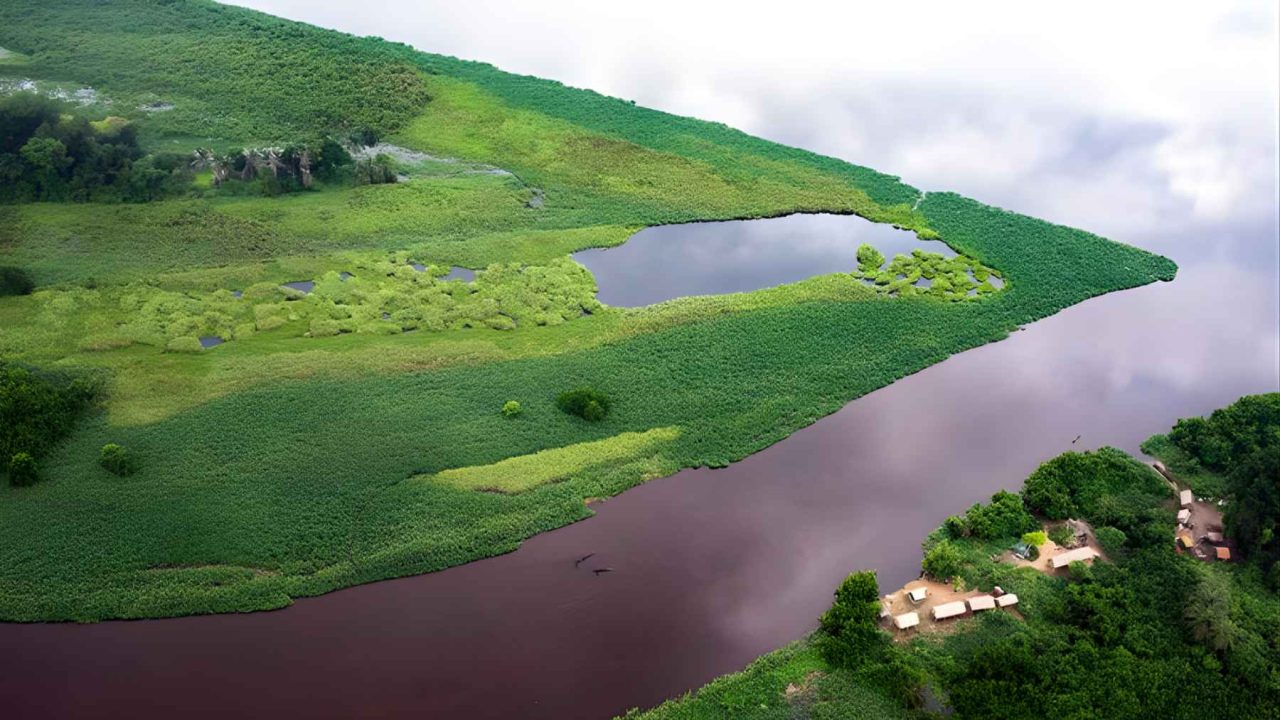
Carbon that has been locked away in the earth for thousands of years may be quietly escaping back into the atmosphere — and researchers say the warning signs are already visible in two remote, dark-watered lakes deep inside the Congo Basin.
This isn’t a distant, theoretical threat. Scientists studying Lake Mai Ndombe and Lake Tumba in the Democratic Republic of the Congo have found that a significant share of the carbon dioxide rising from the water is not freshly cycled carbon from recent plant life. It is ancient carbon — the kind that has been sitting undisturbed in peat for millennia. That distinction matters enormously, because it suggests one of the planet’s most important natural climate buffers may be shifting from storing carbon to releasing it.
The findings were published in the journal Nature Geoscience on February 23, 2026, and they add a new layer of urgency to what scientists already knew about the Congo Basin’s fragile role in the global carbon cycle.
Why the Congo Basin Matters So Much to the Climate
The Congo Basin is frequently described as one of Earth’s great natural climate buffers. Its vast swamp forests and peatlands have spent centuries — sometimes millennia — doing something remarkably valuable: pulling carbon out of the atmosphere and locking it away in waterlogged soils, where slow decay rates allow organic material to accumulate as peat.
Peatlands are among the most carbon-dense ecosystems on the planet. When soils stay wet and oxygen-starved, decomposition slows dramatically, and carbon builds up layer by layer over long periods of time. The Congo Basin’s peatland complex is one of the largest of its kind in the world, making it a critical piece of the global carbon puzzle.
The two lakes at the center of this study — Lake Mai Ndombe and Lake Tumba — sit directly inside this central Congo Basin peatland complex. Their water looks almost like black tea, stained dark brown by the enormous amounts of dissolved organic material washing in from the surrounding swamp forests. That striking color is a clue to just how chemically active these lakes really are.
What Researchers Actually Found in the Water
The study’s core finding is both subtle and alarming. Measurements of the lake water showed it holds far more carbon dioxide than the surrounding atmosphere — a condition that naturally drives CO2 out of the water and into the air above. That alone would make these lakes significant carbon sources rather than sinks.
But the more troubling discovery was the age of that carbon. A significant portion of the CO2 escaping from the lakes is not modern carbon from recently decomposed plant matter. It is ancient carbon that was stored in peat thousands of years ago — carbon that, under stable conditions, would have remained buried and out of the atmosphere indefinitely.
The fact that this old carbon is now showing up in lake water and escaping as CO2 suggests that the surrounding peatlands are beginning to break down in ways that release their long-stored reserves. Researchers describe this as exactly the kind of quiet, easy-to-miss shift that can go unnoticed — until it starts registering in the atmosphere at scale.
Key Facts About the Lakes and the Study
| Detail | Information |
|---|---|
| Lakes studied | Lake Mai Ndombe and Lake Tumba |
| Location | Democratic Republic of the Congo, central Congo Basin |
| Study published | Nature Geoscience, February 23, 2026 |
| Lake appearance | Dark brown (“blackwater”), stained by dissolved organic material from surrounding swamp forests |
| Carbon finding | A significant share of CO2 escaping the lakes is ancient peat carbon, not modern plant-derived carbon |
| Lake CO2 status | Both lakes classified as major CO2 sources — releasing more than they absorb |
- The Congo Basin peatlands lock away carbon accumulated over centuries and millennia
- Waterlogged, low-oxygen soils slow decomposition and allow peat to build up over time
- The lakes act as chemical reactors, processing organic material from surrounding swamp forests
- Lake water CO2 concentrations are high enough that gas naturally escapes into the atmosphere
- The presence of ancient carbon in lake water indicates peat destabilization in the surrounding landscape
Why This Should Concern People Far Beyond the Congo
The Congo Basin doesn’t exist in isolation. It functions as a global carbon buffer — one that billions of people around the world depend on, whether they realize it or not, to slow the pace of climate change. When peatlands store carbon, they are effectively removing it from the climate equation. When they begin to release it, the math changes for everyone.
Ancient peat carbon is particularly significant because it represents carbon that was removed from the atmosphere long before industrialization. Releasing it now adds to the atmospheric carbon load in a way that is separate from — and compounding — the emissions produced by human activity today. It is, in a sense, a debt coming due.
The concern among researchers is that this process, once set in motion, is not easy to reverse. Peatlands that dry out or destabilize can transition from carbon stores to carbon sources over timescales that are difficult to manage. The Congo Basin’s sheer size means even a partial shift in that direction carries consequences at a planetary level.
What Scientists Are Watching for Next
The February 2026 study represents an important early signal, but researchers acknowledge that understanding the full scale of what is happening requires continued monitoring. The Congo Basin remains one of the least studied major ecosystems on Earth, partly due to its remoteness and partly due to the logistical challenges of conducting fieldwork in the region.
The presence of ancient carbon in these two lakes provides a measurable indicator that scientists can track over time. If the proportion of old peat carbon in lake emissions increases, it would suggest the destabilization is accelerating. If it stabilizes, that could indicate the system is holding — for now.
What is clear from the current findings is that the Congo Basin’s role as a carbon sink cannot be taken for granted. The dark lakes of Mai Ndombe and Tumba are sending a signal, and the scientific community is paying attention.
Frequently Asked Questions
What are Lake Mai Ndombe and Lake Tumba?
They are two large blackwater lakes located in the Democratic Republic of the Congo, sitting within the central Congo Basin peatland complex. Their water appears dark brown due to dissolved organic material from surrounding swamp forests.
Why is the Congo Basin considered a major carbon sink?
Its swamp forests and peatlands trap and store carbon in waterlogged soils over centuries and millennia, making it one of the most carbon-dense ecosystems on the planet.
What did the Nature Geoscience study find?
Published on February 23, 2026, the study found that both lakes are significant sources of CO2, and that a notable share of that carbon dioxide is ancient — originating from peat stored thousands of years ago rather than from recent plant matter.
Why does the age of the carbon matter?
Ancient peat carbon has been locked out of the atmosphere for thousands of years. Its release now adds to the climate burden on top of current human emissions, and the process is difficult to reverse once it begins.
Does this mean the Congo Basin has stopped being a carbon sink entirely?
The study does not make that broad claim, but it does identify these two lakes as active CO2 sources and flags the presence of ancient carbon as a warning sign of potential peatland destabilization.</p




Leave a Reply