
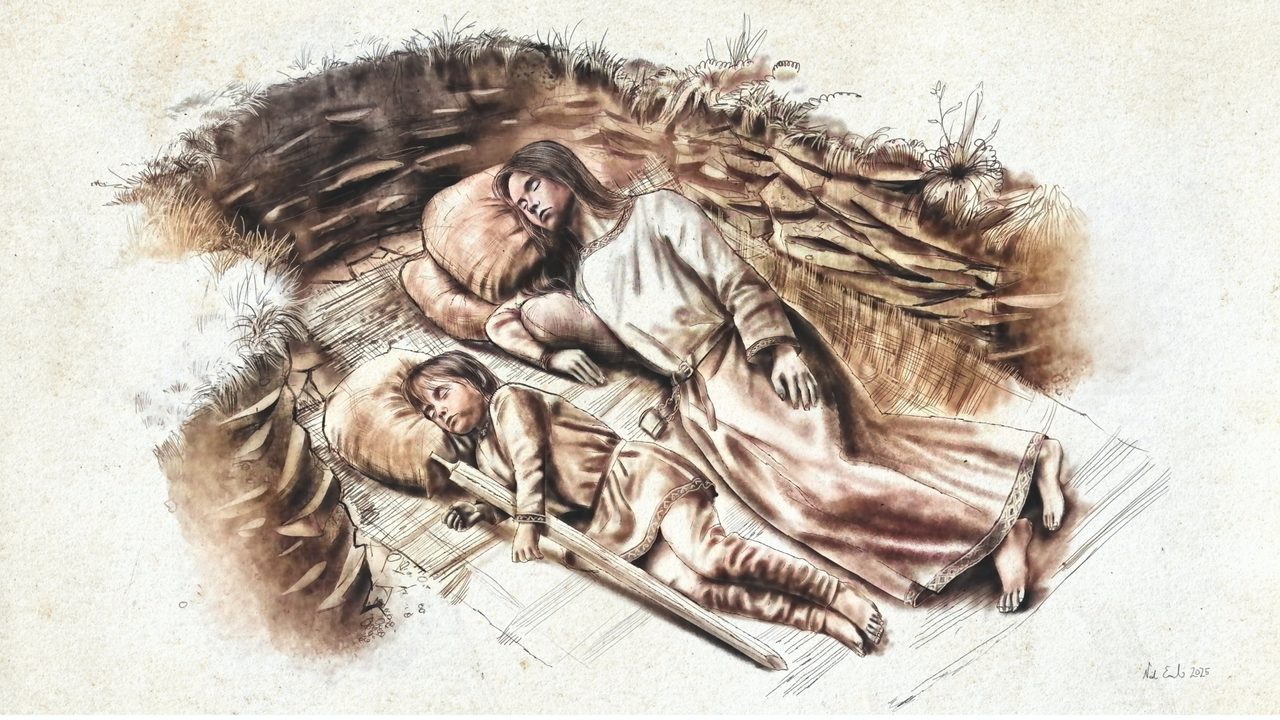
Fourteen hundred years ago, two children were laid to rest together in the English countryside — an older sister holding her little brother in what researchers now describe as one of the most emotionally striking burial arrangements ever found in an Anglo-Saxon cemetery. DNA analysis has confirmed what the position of their bones seemed to suggest all along: they were family.
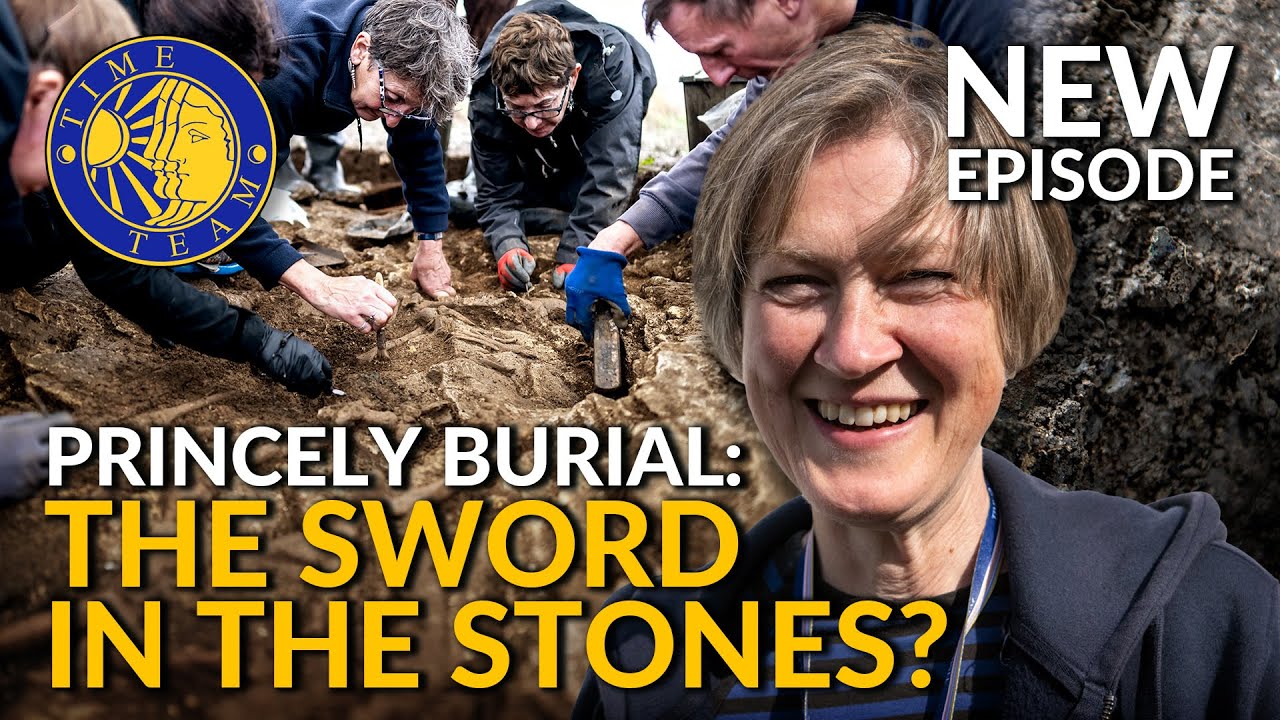
The discovery, made at a cemetery in Cherington, a village in England, was featured by the British archaeology show Time Team. What makes the find especially rare is not just the double burial itself, but the scientific confirmation of a sibling relationship — something that has seldom been documented with genetic certainty in Anglo-Saxon archaeological contexts.
Researchers believe the two children may have died around the same time, possibly from a fast-acting infectious disease. The nature of the burial — one child cradling the other — raises profound questions about grief, family bonds, and the realities of life and death in early medieval Britain.
What Archaeologists Found at the Cherington Cemetery
The burial was uncovered at an Anglo-Saxon cemetery in Cherington, a village with deep historical roots. Double burials from this period are uncommon on their own, but a confirmed sibling pairing makes this discovery particularly significant within the archaeological record.
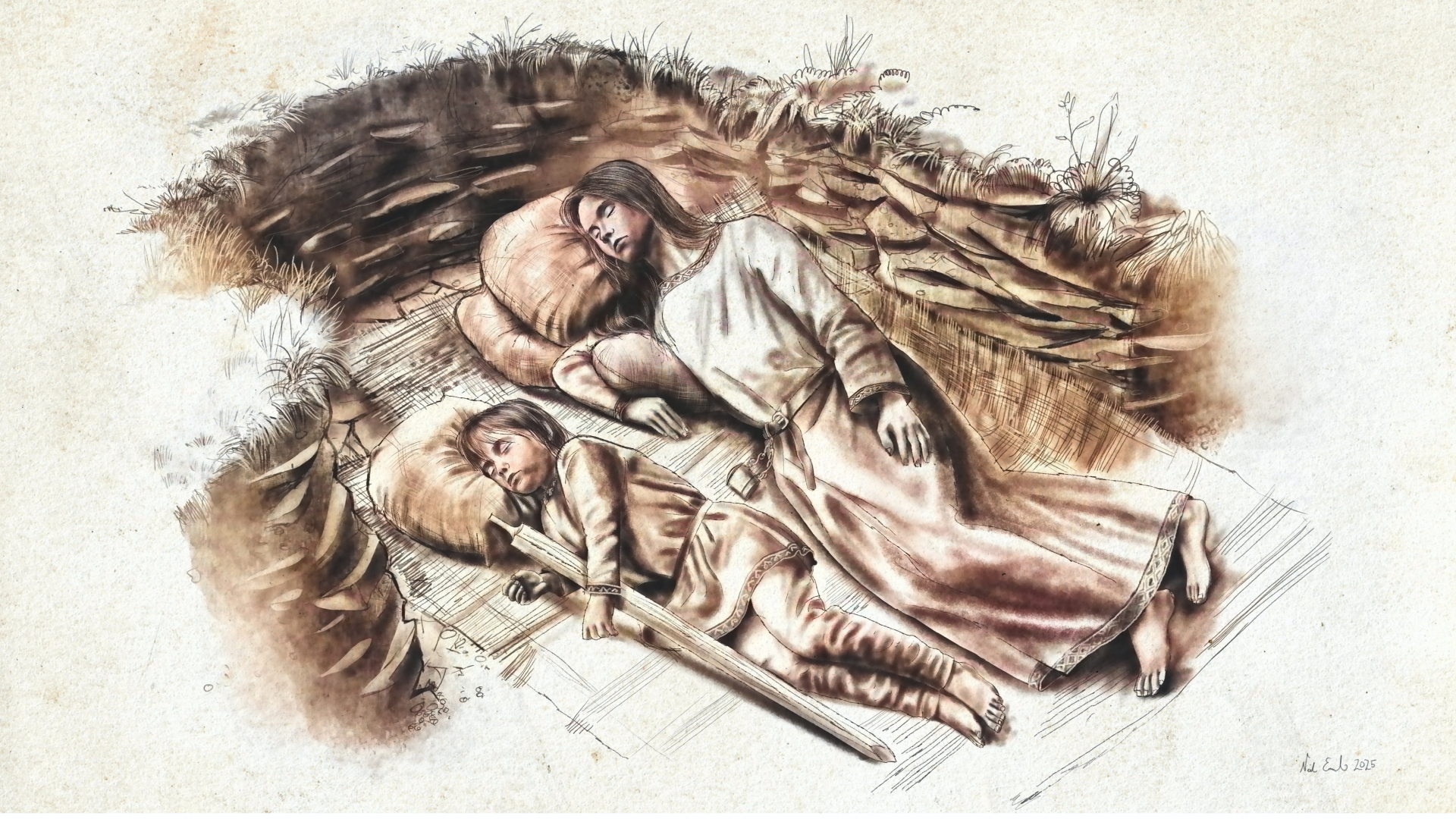
The skeletal remains show the older child positioned around the younger one — a posture that strongly implies the arrangement was deliberate and meaningful to whoever prepared the burial. It speaks to a community that understood loss, that mourned children, and that chose to send two siblings into death together rather than apart.
DNA extracted from the skeletons confirmed the two were brother and sister. According to Time Team’s statement, this kind of verified familial link is rare in Anglo-Saxon burial studies, where genetic analysis is not always possible or pursued.
Why the Siblings May Have Died Together
The leading theory, according to researchers associated with the find, is that the two children died at roughly the same time — and that an infectious disease may have been responsible. A fast-moving illness spreading through a small community could plausibly claim multiple members of the same household in a short window of time.
Early medieval England was not insulated from epidemic disease. Communities in the Anglo-Saxon period faced periodic outbreaks that could devastate families and villages with little warning and no effective treatment. The simultaneous or near-simultaneous death of two young siblings would be consistent with that kind of scenario.
While no specific disease has been identified in this case, the burial context — two children interred together, apparently at the same time — lends weight to the theory that their deaths were connected rather than coincidental.
What Makes This Anglo-Saxon Burial So Unusual
Double burials are not unheard of in early medieval archaeology, but they are far from routine. When two individuals are found together, it raises immediate questions: Did they die at the same time? Were they related? Was the arrangement intentional?
In this case, researchers can answer several of those questions with confidence. The key confirmed details are summarized below:
| Detail | What Is Known |
|---|---|
| Location | Anglo-Saxon cemetery in Cherington, England |
| Relationship | Confirmed siblings (brother and sister) via DNA analysis |
| Approximate age of burial | Approximately 1,400 years ago |
| Burial arrangement | Older sister positioned cradling younger brother |
| Suspected cause of death | Possibly a fast-acting infectious disease |
| Rarity | Confirmed familial links are rare in Anglo-Saxon burials |
The genetic confirmation is what elevates this find beyond a curiosity. Without DNA evidence, archaeologists can speculate about relationships based on burial proximity or skeletal similarity — but they cannot be certain. Here, the science backs up what the bones appeared to show.
A Window Into Early Medieval Family Life
Beyond the forensic details, this burial offers something harder to quantify: a glimpse into the emotional world of people who lived over a millennium ago.
The deliberate positioning of the older sister around her younger brother suggests that whoever arranged the burial — family members, community members, or both — wanted to preserve some semblance of the bond these children shared in life. That impulse, to keep siblings together even in death, is one that crosses cultures and centuries.
- The burial reflects a community that marked childhood death with care and intention
- The cradling position implies emotional significance was placed on the siblings’ relationship
- DNA confirmation adds a scientific layer to what was already a humanly resonant discovery
- The possible infectious disease cause points to the vulnerability of early medieval communities to epidemic illness
Anglo-Saxon burial practices varied considerably across time and region, but double burials involving children are among the most poignant finds in the archaeological record. This one, with its confirmed family connection and its haunting arrangement, stands out even within that category.
What Researchers Are Still Working to Understand
The discovery was brought to wider public attention through Time Team, the long-running British archaeology program known for making complex historical finds accessible to general audiences. The involvement of the show suggests ongoing work at or around the Cherington site, and further analysis may yet yield additional details.
The specific infectious disease — if that is indeed what killed the children — has not been identified. Ancient pathogen analysis is a growing field, and future work on the skeletal remains could potentially narrow down what illness swept through this family roughly 14 centuries ago.
For now, what the evidence confirms is enough to make this one of the more memorable Anglo-Saxon finds in recent years: two children, related by blood, buried together in a pose of comfort and closeness, in a village that still exists today.
Frequently Asked Questions
Where was the Anglo-Saxon double burial discovered?
The burial was found at an Anglo-Saxon cemetery in Cherington, a village in England.
How do researchers know the children were siblings?
DNA analysis of the skeletal remains confirmed that the two children were brother and sister, according to a statement from Time Team.
How old is the burial?
The children were interred approximately 1,400 years ago, placing the burial in the early medieval Anglo-Saxon period.
What may have caused their deaths?
Researchers believe the siblings may have died at the same time from a fast-acting infectious disease, though no specific illness has been identified.
Why is a confirmed sibling link considered rare?
According to Time Team’s statement, genetically confirmed familial relationships are uncommon in Anglo-Saxon burial studies, making this find particularly significant.
Who brought this discovery to public attention?
The find was featured by Time Team, the British archaeology television show known for documenting historical excavations across the United Kingdom.



Leave a Reply