
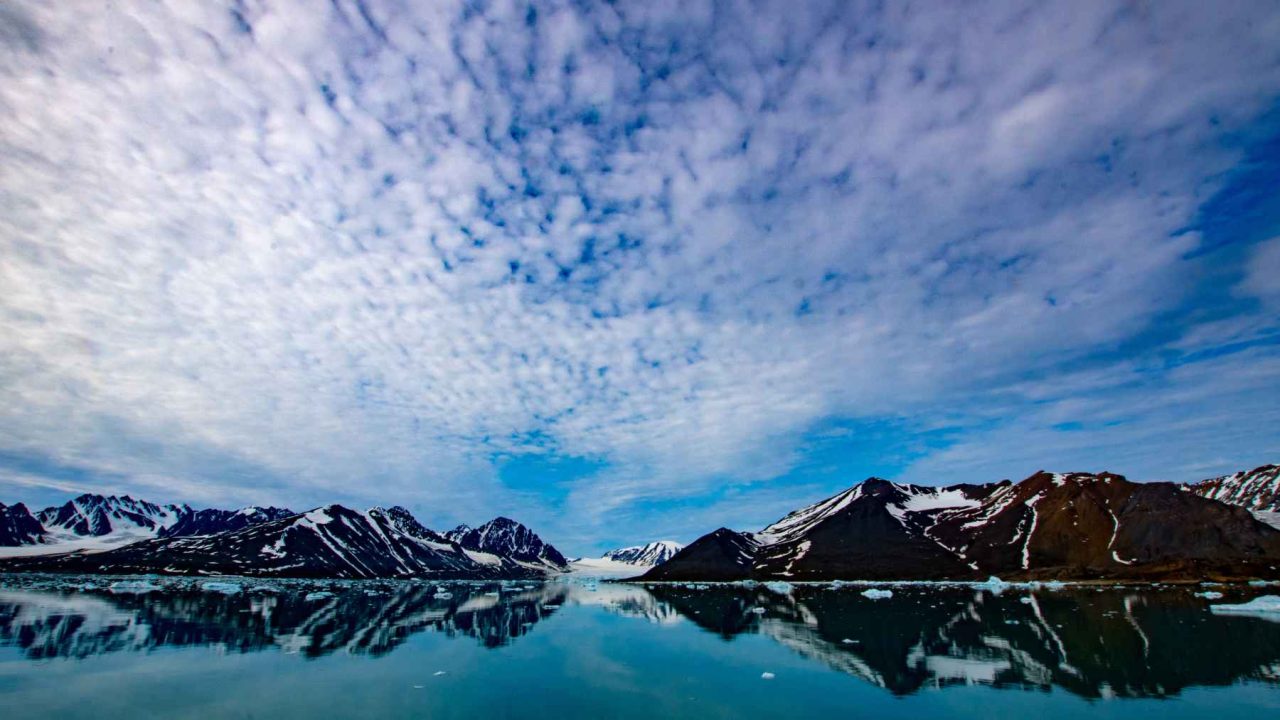
For roughly 40 years, oceanographers watched warm, salty Atlantic water push deeper and deeper into the Arctic — and they could not fully explain why. The winds were the obvious suspect. But a study published on January 2, 2026, points to something far more subtle: it is not how hard the wind blows, but how often low-pressure storm systems sweep across the Nordic Seas that appears to be driving the change.
That distinction matters more than it might first seem. The atmosphere is not simply turning up the volume on existing forces — it appears to be changing the rhythm entirely. And that shift is letting more Atlantic water pour through one of the Arctic’s most critical gateways.
The research combined ocean modeling with a deep-learning system, examining hourly atmosphere and ocean data gathered over approximately 40 years. The result is the most detailed picture yet of a phenomenon scientists have been trying to understand for decades.
What “Atlantification” Actually Means for the Arctic
The term atlantification refers to the growing influence of Atlantic water on the Arctic Ocean — warmer, saltier water that is steadily reshaping conditions in a region that has historically been defined by cold and ice.
The Barents Sea serves as one of the main doorways through which this Atlantic water enters the Arctic. There are two primary routes. One runs through Fram Strait, which sits west of the Svalbard archipelago. The other — and the one at the center of this new research — runs through the Barents Sea Opening, the passage between mainland Norway and Bear Island.
As more Atlantic water flows through these openings, the effects ripple outward. Sea-ice cover shrinks. Ecosystems that evolved around cold, stable conditions face disruption. The Arctic, in short, becomes a little less Arctic.
Scientists have been tracking this process for decades, but the driving mechanism behind the accelerating inflow through the Barents Sea Opening has remained frustratingly unclear. Wind force was the leading theory — the assumption being that stronger or more persistent winds were simply pushing more Atlantic water northward. The new study challenges that assumption directly.
The Real Driver: Storm Frequency, Not Wind Strength
What the research team found was that the key variable is not the strength of the winds themselves, but the frequency of low-pressure systems moving across the Nordic Seas. More frequent storm passages appear to be altering the conditions that allow Atlantic water to flow more readily into the Arctic gateway.
Think of it this way: rather than a single fan blowing harder, it is more like a series of fans switching on and off more often. The cumulative effect changes the flow — not because any individual event is more powerful, but because the pattern itself has shifted.
The team used a combination of ocean modeling and deep-learning analysis to trace this link through roughly 40 years of hourly atmosphere and ocean data. That level of temporal detail — hour by hour, rather than month by month — was essential to catching a signal that cruder analyses had missed.
Key Facts About the Research and the Barents Sea
| Detail | What the Source Confirms |
|---|---|
| Study publication date | January 2, 2026 |
| Data examined | Hourly atmosphere and ocean data over approximately 40 years |
| Methods used | Ocean modeling combined with a deep-learning system |
| Key finding | Storm frequency, not wind strength, drives increased Atlantic inflow |
| Primary gateway studied | Barents Sea Opening (between mainland Norway and Bear Island) |
| Secondary Arctic gateway | Fram Strait, west of Svalbard |
| Broader phenomenon | Atlantification — growing Atlantic influence on the Arctic Ocean |
- The Barents Sea is one of the Arctic’s primary entry points for warm Atlantic water.
- Atlantification has been linked to sea-ice loss and wider ecosystem change across the Arctic.
- The mystery had gone unresolved for approximately 40 years before this research identified storm frequency as a key driver.
- The deep-learning component allowed the team to detect atmospheric patterns that traditional modeling approaches had previously missed.
Why This Finding Changes How We Understand Arctic Change
If the wind-strength theory had been correct, the implication would be relatively straightforward: stronger winds equal more Atlantic water, and you could track and model that relationship with standard tools. The storm-frequency explanation is more complex — and in some ways more concerning.
Changes in how often low-pressure systems cross the Nordic Seas are connected to broader shifts in atmospheric circulation patterns. Those patterns are themselves influenced by large-scale climate dynamics. In other words, the mechanism driving atlantification may be more deeply embedded in global climate change than previously understood.
The practical consequences are already visible. Atlantification has been tied to measurable sea-ice loss in the Barents Sea region and to changes in marine ecosystems that depend on colder, less saline conditions. Fish populations, marine mammals, and the communities that depend on Arctic fisheries all feel the downstream effects of a warmer, saltier Arctic.
Researchers argue that understanding the correct mechanism is not just an academic exercise. Accurate models of how Atlantic water enters the Arctic are essential for projecting future sea-ice conditions, planning for shipping route changes, and anticipating ecological shifts in one of the world’s most rapidly changing environments.
What Comes Next in Arctic Oceanography
The publication of this study in early 2026 opens new questions as much as it closes old ones. If storm frequency is the key lever, researchers will need to better understand what controls storm-track patterns over the Nordic Seas — and how those patterns are likely to evolve as global temperatures continue to rise.
The deep-learning methodology used in this study also signals a broader shift in how oceanographers are approaching complex, multi-decade datasets. Hourly resolution data analyzed through machine learning can surface patterns that decades of traditional analysis overlooked. That approach is likely to be applied to other unresolved questions in Arctic and climate science going forward.
The 40-year mystery may now have an answer — but the story of what that answer means for the Arctic’s future is still being written.
Frequently Asked Questions
What is atlantification?
Atlantification refers to the growing influence of warm, salty Atlantic water on the Arctic Ocean, a process linked to sea-ice loss and ecosystem changes in the region.
Why did scientists previously think wind was the main cause?
Wind force was the leading hypothesis for driving increased Atlantic water inflow into the Arctic, but the new research suggests the frequency of low-pressure storm systems is a more significant factor than wind strength alone.
What are the two main gateways for Atlantic water entering the Arctic?
The two primary routes are the Barents Sea Opening, between mainland Norway and Bear Island, and Fram Strait, located west of Svalbard.
How was this study conducted?
The research team combined ocean modeling with a deep-learning system and analyzed approximately 40 years of hourly atmosphere and ocean data to trace the link between storm frequency and Atlantic water inflow.
When was this study published?
The study was published on January 2, 2026.
Does this finding affect sea-ice loss predictions?
Understanding the correct mechanism behind atlantification is considered essential for more accurately projecting future sea-ice conditions, though specific updated projections have not yet been confirmed in the available source material.


Leave a Reply