
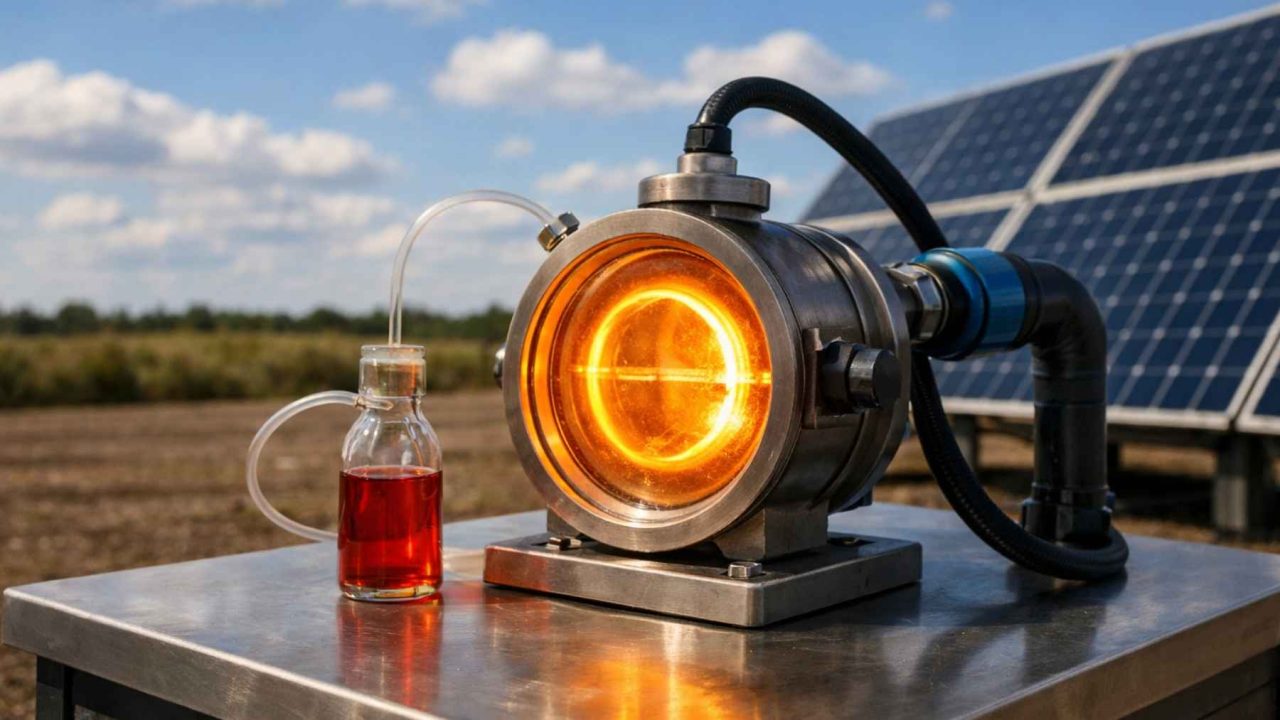
The chemical industry is responsible for roughly 6% of global greenhouse gas emissions, according to the Royal Society — and a solar-powered device the size of a leaf could be one of the most unexpected tools we have to start chipping away at that number.
Researchers at the University of Cambridge have developed what they call an “artificial leaf” — a device that uses sunlight to convert carbon dioxide into formate, a simple chemical compound that can store energy and feed further industrial reactions. In experiments published on November 19, 2025, the device ran continuously for more than 24 hours, producing enough formate to power a follow-on chemistry step used in pharmaceutical manufacturing.
It’s the kind of result that sounds modest until you understand what it could replace: fossil fuels, and the carbon-intensive industrial processes that depend on them to make everything from detergents to plastics.
What the Artificial Leaf Actually Does
The name “artificial leaf” isn’t just poetic. Real leaves take in sunlight, water, and CO2, and convert them into energy-storing molecules through photosynthesis. This device does something similar — but instead of producing glucose, it produces formate, a chemical that can be used as a building block for other reactions.
Formate is relatively simple, but that simplicity is part of the point. It’s stable, it stores chemical energy, and it can be fed into other industrial processes — including, as this study demonstrated, steps used in making pharmaceutical ingredients.
What makes the artificial leaf compelling isn’t just what it makes. It’s what it avoids. The device runs on sunlight and uses captured CO2 as its raw material, which means it sidesteps the fossil fuel inputs that make conventional chemical manufacturing so carbon-intensive.
Professor Erwin Reisner, who led the research at the University of Cambridge, put the challenge plainly:
“If we’re going to build a circular, sustainable economy, the chemical industry is a big, complex problem that we must address.”
Why the Chemical Industry Is Such a Stubborn Climate Problem
Most conversations about reducing emissions focus on electricity generation and transportation. The chemical industry gets far less attention — but the numbers are significant.
The Royal Society estimates that the chemical sector accounts for approximately 6% of global greenhouse gas emissions. A major reason is that most chemicals are built from carbon extracted from oil and gas. That carbon doesn’t just provide energy — it provides the actual molecular building blocks that end up in the finished products.
That’s what makes this research different from simply switching a factory to renewable electricity. The artificial leaf approach doesn’t just change the energy source. It changes the carbon source, pulling CO2 from the air and using it as a raw material rather than digging up fossil carbon to start with.
The products you encounter every day — the plastic casing on your phone, the detergent under your sink, the pills in your medicine cabinet — all trace back to this kind of industrial carbon chemistry. Finding a way to run that chemistry on sunlight and captured CO2 instead of oil is one of the harder problems in the energy transition, and it’s one that often gets overlooked.
Key Facts at a Glance
| Detail | What the Source Confirms |
|---|---|
| Study publication date | November 19, 2025 |
| Lead researcher | Professor Erwin Reisner, University of Cambridge |
| Device type | Solar-powered “artificial leaf” |
| Input materials | Sunlight, water, and captured CO2 |
| Output produced | Formate (a simple energy-storing chemical compound) |
| Continuous operation time | More than 24 hours |
| Downstream application demonstrated | Pharmaceutical manufacturing chemistry step |
| Chemical industry emissions share (Royal Society) | Approximately 6% of global greenhouse gas emissions |
- The device converts CO2 into formate using only solar energy — no fossil fuel inputs required
- Formate can act as a feedstock for further chemical reactions, not just as an end product
- The 24-hour continuous operation milestone suggests the device has practical stability, not just lab-flash results
- The pharmaceutical manufacturing application shows the formate produced is of usable quality for real industrial processes
What This Could Mean for Everyday Products
The immediate practical impact of this research is still in the early stages — this is laboratory science, not a factory ready to ship tomorrow. But the direction it points matters.
Right now, the carbon atoms inside most plastics, detergents, and synthetic materials started their journey underground as oil or gas. Extracting, refining, and processing those materials generates emissions at every step. An approach that instead captures CO2 already in the atmosphere and converts it into useful chemicals would fundamentally alter that chain.
The pharmaceutical application is particularly worth noting. Drug manufacturing relies on precise chemistry, and the fact that the artificial leaf produced formate of sufficient quality to drive a pharmaceutical synthesis step suggests this isn’t just a proof-of-concept curiosity. It’s formate that actually works in a real downstream process.
For consumers, the long-term implication is a potential path toward industrial products that carry a much lighter carbon footprint — not because companies switched their power source, but because the carbon in the product itself came from the air rather than from a well.
What Comes Next for This Research
The study published in November 2025 represents a significant demonstration, but scaling this kind of technology from a laboratory device to industrial-level production involves substantial engineering challenges that
What is clear is that the research team’s ambitions extend beyond formate alone. The framing from Professor Reisner — addressing the chemical industry as part of building a circular, sustainable economy — suggests this work is intended as a foundation for broader solar-driven chemistry, not a single-molecule solution.
The 24-hour continuous operation result is an important benchmark. Many promising laboratory devices fail quickly under sustained conditions. Demonstrating stability over a full day is a necessary step toward any larger-scale application, even if significant work remains ahead.
Whether this specific device reaches commercial scale, or whether it becomes one building block in a larger research effort, the underlying principle — using sunlight and CO2 to make the chemicals industry currently takes from oil — is a direction that researchers and policymakers are watching closely.
Frequently Asked Questions
What is an artificial leaf?
An artificial leaf is a solar-powered device that mimics photosynthesis by using sunlight, water, and CO2 to produce useful chemical compounds, in this case formate.
What is formate and why does it matter?
Formate is a simple chemical compound that can store energy and serve as a raw material for further industrial reactions, including steps used in pharmaceutical manufacturing.
Who led this research?
The research was led by Professor Erwin Reisner at the University of Cambridge, with the study published on November 19, 2025.
How long did the device operate continuously?
The device ran for more than 24 hours in the experiments described in the study, producing formate throughout that period.
How much does the chemical industry contribute to greenhouse gas emissions?
According to the Royal Society, the chemical industry is responsible for approximately 6% of global greenhouse gas emissions.</p




Leave a Reply