
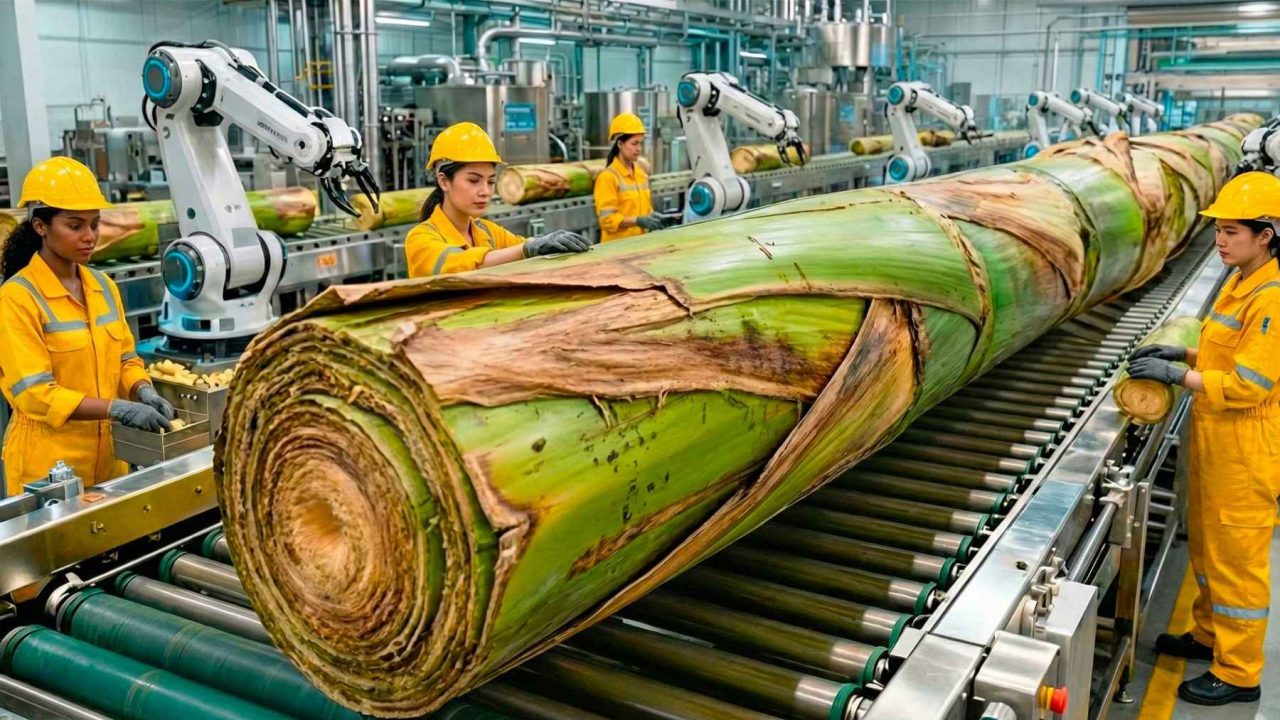
Every time a banana is harvested, the entire plant — trunk and all — is cut down and left behind. Multiply that across millions of hectares of tropical farmland, and you end up with a staggering amount of biological material that most people never think about. Researchers estimate that banana pseudostems generate tens of millions of tons of waste every year in producer countries like Brazil alone.
Now, factories and researchers are figuring out how to turn that forgotten trunk into something far more valuable: fiber for clothing, pulp for paper, and raw material for bio-based composites. And the technology to do it at industrial scale is catching up fast.
This isn’t a distant experiment. Mechanical extraction methods and controlled drying processes are already accelerating the move from small-scale trials to real industrial production — which means the banana plant you see at the grocery store may soon have a second life in your wardrobe or on your desk.
Why Banana Trunks Are Sitting on Fields Instead of Factory Floors
Here’s something most people don’t realize about banana farming: the fruit is only a tiny fraction of what the plant actually produces. Studies of circularity in banana agriculture confirm that only a small share of the plant ever becomes food. Everything else — the massive, water-dense pseudostem, the leaves, the roots — is left in the field or hauled away as agricultural waste.
The numbers are hard to ignore. In some production systems, residue from banana plants can reach around 220 tons per hectare. That’s an enormous volume of biomass sitting largely unused, field after field, harvest after harvest.
For decades, this waste was treated as a disposal problem. The stems are heavy, wet, and awkward to transport. But as industries search for sustainable alternatives to synthetic fibers and wood-based pulp, that same bulky trunk is starting to look like an opportunity rather than a burden.
What Makes Banana Fiber Worth the Trouble
The reason industry is paying attention comes down to the fiber itself. Banana pseudostems contain strong cellulosic fibers — and researchers have found that their tensile strength can actually surpass classic natural fibers like jute and sisal.
That’s a significant finding. Jute and sisal have been commercial staples for centuries, used in everything from rope and sacking to reinforcement materials in construction. If banana fiber can match or exceed their performance, it opens up a wide range of applications that were previously off the table.
Those applications include:
- Textiles and clothing — yarns spun from banana fiber can be woven into fabric for garments and accessories
- Paper and packaging — the cellulose content makes pseudostems a viable source of pulp for paper and cardboard production
- Bio-based composites — banana fiber can reinforce composite materials used in manufacturing and construction
- Fruit trays and food packaging — molded fiber products made from banana biomass can replace plastic and polystyrene packaging
The versatility is part of what makes this material so attractive to researchers and manufacturers alike.
Banana Fiber vs. Traditional Natural Fibers — How They Compare
| Material | Primary Use | Tensile Strength vs. Banana Fiber | Source |
|---|---|---|---|
| Banana pseudostem fiber | Textiles, paper, composites, packaging | Can surpass jute and sisal | Agricultural waste |
| Jute | Rope, sacking, reinforcement | Lower than banana fiber (per research) | Cultivated crop |
| Sisal | Rope, twine, composites | Lower than banana fiber (per research) | Cultivated crop |
The key difference worth noting: jute and sisal are grown specifically as fiber crops, meaning land and resources are dedicated to producing them. Banana fiber, by contrast, comes entirely from material that would otherwise be discarded. That distinction matters enormously when evaluating the environmental case for switching.
The Industrial Bottleneck — and How It’s Being Solved
If banana fiber is this promising, why isn’t it already everywhere? The honest answer is that processing pseudostems at scale has historically been difficult and expensive. The stems contain a large amount of water, which makes them heavy to transport and slow to process. Extracting consistent, high-quality fiber from that wet, fibrous mass requires equipment and energy.
That’s where mechanical extraction and controlled drying are making a real difference. Advances in both areas are allowing processors to pull standardized fiber from pseudostems more efficiently — reducing moisture content in a controlled way that preserves fiber quality rather than degrading it.
Advocates of the technology argue that these process improvements are the critical link between laboratory promise and factory reality. Without reliable, scalable extraction, even the strongest fiber in the world stays in the field. With it, tens of millions of tons of annual waste becomes a feedstock for multiple industries simultaneously.
What This Means for Farmers, Manufacturers, and Consumers
For banana-growing regions — particularly in countries like Brazil, where the waste volumes are especially large — this shift could create entirely new revenue streams. Pseudostems that currently cost money to dispose of could instead be sold to fiber processors, paper mills, or composite manufacturers.
For manufacturers, banana fiber offers a bio-based alternative that doesn’t require clearing new land or growing dedicated fiber crops. The raw material is already being produced as a byproduct of food agriculture. That circular logic is increasingly attractive as companies face pressure to reduce their environmental footprint.
For consumers, the practical impact may show up in the form of more sustainable clothing options, paper products with lower deforestation links, or packaging that replaces single-use plastics — all potentially traceable back to a plant that started its life as someone’s breakfast.
Where the Industry Goes From Here
The momentum behind banana fiber is building, but industrialization is still in its early stages. Mechanical extraction and controlled drying are accelerating the timeline, and producer countries are sitting on a raw material supply that dwarfs current demand. The challenge now is building the processing infrastructure to match that supply with consistent output that meets commercial standards.
Researchers and industry observers note that standardization is the next major hurdle — ensuring that fiber extracted from pseudostems in one country meets the same specifications as fiber processed elsewhere, so that manufacturers can rely on it the same way they rely on cotton or wood pulp today.
The scale of the opportunity is already there. What comes next is turning a proven material into a dependable supply chain.
Frequently Asked Questions
What part of the banana plant is used to make fiber?
The pseudostem — the thick, trunk-like structure of the banana plant — is the primary source of cellulosic fiber used in textiles, paper, and composite materials.
How much banana waste is produced each year?
Researchers estimate that banana pseudostems generate tens of millions of tons of waste annually in producer countries, with residue in some systems reaching around 220 tons per hectare.
Is banana fiber stronger than jute or sisal?
According to research cited in
What products can be made from banana pseudostem fiber?
Confirmed applications include clothing and yarn, paper and packaging, bio-based composite materials, and fruit trays or food packaging products.
Why hasn’t banana fiber been used industrially before now?
Processing the water-heavy pseudostems at scale has historically been difficult. Advances in mechanical extraction and controlled drying are now making industrial-scale production more feasible.</p


Leave a Reply