
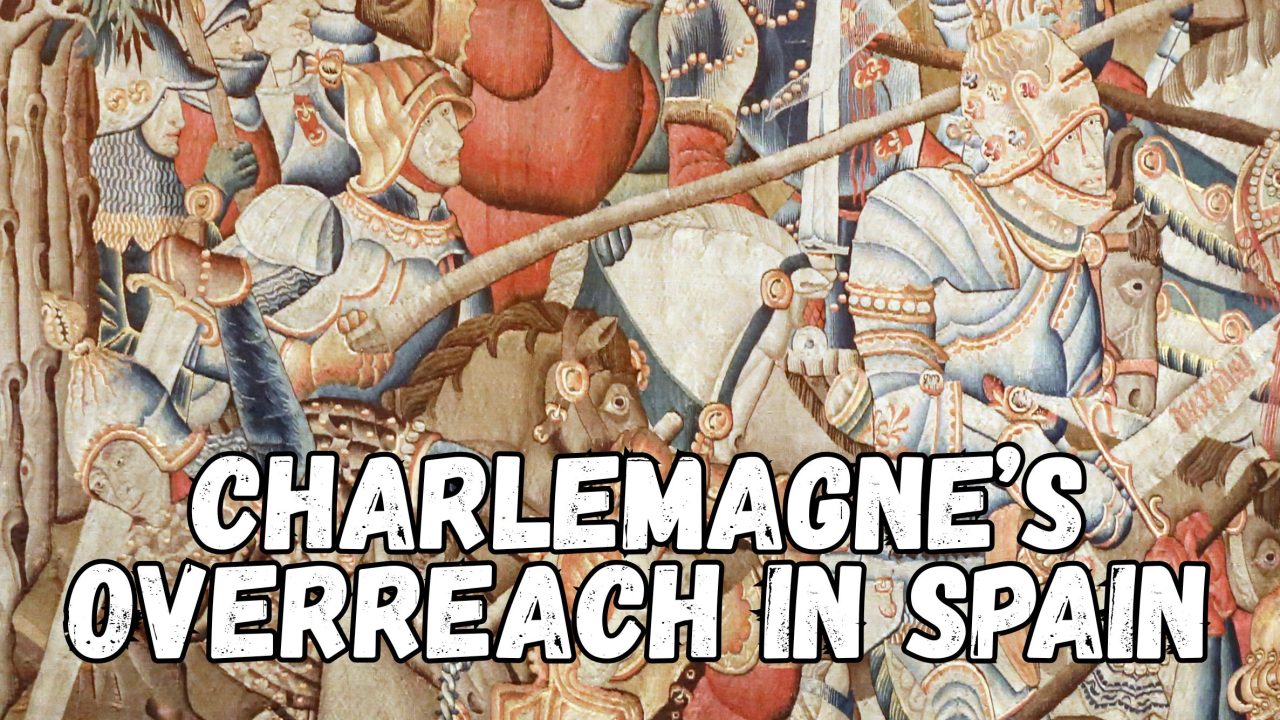
In 46 years of near-constant warfare, Charlemagne lost almost every battle he never fought — except one. The 778 campaign into Muslim-controlled Spain stands as the single undeniable military failure of his entire reign, a rare moment when the most powerful ruler in Western Europe achieved none of his objectives, suffered serious losses, and watched his army’s rearguard get annihilated in a mountain pass.
That ambush, at a place called Roncevaux Pass, would go on to inspire one of the most celebrated epic poems in medieval literature. But behind the legend lies a real military catastrophe — one that historians argue tells us as much about Charlemagne’s ambitions and vulnerabilities as any of his famous victories.
The story of how the Frankish king marched south of the Pyrenees with enormous expectations and returned with a shattered rearguard is worth understanding on its own terms, separate from the myths that grew around it.
A King Who Almost Never Lost — Until Spain
To understand why the 778 campaign was so significant, you have to appreciate just how exceptional Charlemagne’s military record was. According to historian David Bachrach, who has studied the campaign in detail, Charlemagne enjoyed consistent, indeed almost uniform military success throughout his 46-year reign, which lasted from 768 to 814.
Even his prolonged wars in Saxony — a grinding, decades-long conflict — ended with Carolingian military victories at each stage and the submission of various Saxon factions. That’s not a small thing. Saxony was one of the most stubborn military challenges of the early medieval period.
In the decade leading up to the Spanish campaign, Charlemagne had gone from strength to strength. He had secured Carolingian rule in Aquitaine following his father Pippin I’s death in 768. He conquered the Lombard Kingdom. He believed he had achieved a decisive victory over the Saxons. By the late 770s, his momentum seemed unstoppable.
Spain, then, was meant to be the next logical expansion of Frankish power — a push south of the Pyrenees into territory controlled by Muslim rulers along the Ebro River valley.
What Charlemagne Was Actually Trying to Do
The 778 campaign was not a random act of aggression. Charlemagne’s objective was specific: to secure control over a chain of fortress cities along the Ebro River valley in what is now northeastern Spain.
The cities he targeted included:
- Pamplona
- Saragossa
- Huesca
- Lérida
These were not minor outposts. They were significant urban centers, and controlling them would have extended Frankish influence dramatically into the Iberian Peninsula. The campaign had been in the planning stages since 777, making it a deliberate strategic operation rather than a reactive one.
The ambition was real. The execution, however, did not go as planned. Charlemagne achieved none of his military goals in the region, and the army’s withdrawal became a disaster when Basque forces ambushed the Frankish baggage train at Roncevaux Pass in the Pyrenees.
The Ambush That Made History
The attack at Roncevaux Pass is the moment everyone remembers — or at least the version of it that literature preserved. But the historical reality is starker than the legend.
It was not a glorious last stand against a Muslim army, as later storytellers would frame it. The attackers were Basque forces, and their target was the Frankish baggage train — the supply column and rear element of the withdrawing army. Among the commanders of the rearguard who died in the ambush was a man named Roland, identified in historical records as the praefectus of the Breton March.
Roland was a real person, not a fictional creation. But the epic poem that bears his name — the Song of Roland — transformed him into something far larger than his historical role, recasting the ambush as a heroic battle against Muslim forces rather than a Basque raid on a retreating army’s supply line.
| Element | Historical Reality | Legend (Song of Roland) |
|---|---|---|
| Attackers at Roncevaux | Basque forces | Muslim army |
| Target of the attack | Frankish baggage train / rearguard | Heroic last stand battle |
| Roland’s actual role | Praefectus of the Breton March | Legendary knight and paladin |
| Campaign outcome | Complete military failure | Framed as tragic heroism |
| Campaign dates | Spring and summer 778 | Timeless, mythologized |
Why This Failure Matters Beyond the Legend
The Ebro campaign of 778 is historically significant for several reasons that have nothing to do with Roland or poetry.
First, it reveals the limits of Carolingian power at its apparent peak. Charlemagne was at a high point militarily and politically when he launched this campaign. If even he could not hold together an operation of this complexity against determined opposition, it says something important about the logistical and strategic constraints facing early medieval armies.
Second, it demonstrates that the Pyrenees were a genuine strategic barrier — not just geographically, but politically. The populations south of the mountains, including the Basques, had their own interests and were not simply waiting to be absorbed into the Frankish world.
Third, the romanticization of the defeat tells its own story about how medieval societies processed military failure. Rather than acknowledge a straightforward catastrophe, later generations rebuilt the event into a myth of sacrifice and heroism — one that would resonate across centuries of European literature and culture.
What the Campaign’s Failure Left Behind
Charlemagne did not abandon his interest in Spain entirely after 778. The Frankish presence south of the Pyrenees would eventually develop into what became known as the Spanish March — a buffer zone of territories that Carolingian forces gradually established in later years. But the dream of quickly seizing the Ebro fortress cities died in that summer campaign.
Roland, the man who died in the rearguard at Roncevaux, became immortal in ways he could not have anticipated. The Song of Roland, composed centuries after the battle, turned a tactical disaster into one of the foundational texts of French literature. His actual rank — praefectus of the Breton March — suggests he was a significant but not supreme commander, one of several leaders in the rearguard column.
The gap between what happened and what the legend says happened is itself a lesson in how history gets made — and remade — over time.
Frequently Asked Questions
When did Charlemagne’s Spanish campaign take place?
The campaign was launched in the spring and summer of 778, following diplomatic planning that began in 777.
Which cities was Charlemagne trying to capture in Spain?
His targets were fortress cities along the Ebro River valley, specifically Pamplona, Saragossa, Huesca, and Lérida.
Who attacked the Frankish rearguard at Roncevaux Pass?
According to historical accounts, it was Basque forces — not a Muslim army, as the later legend of the Song of Roland portrayed.
Was Roland a real historical person?
Yes. Roland was a real commander identified in historical records as the praefectus, or prefect, of the Breton March, who died in the ambush at Roncevaux Pass.
Was the 778 campaign Charlemagne’s only major military failure?
According to historian David Bachrach, it stands out as the single abject failure of Charlemagne’s 46-year reign — a reign otherwise marked by near-uniform military success.
Did Charlemagne ever succeed in establishing a presence in Spain?




Leave a Reply