
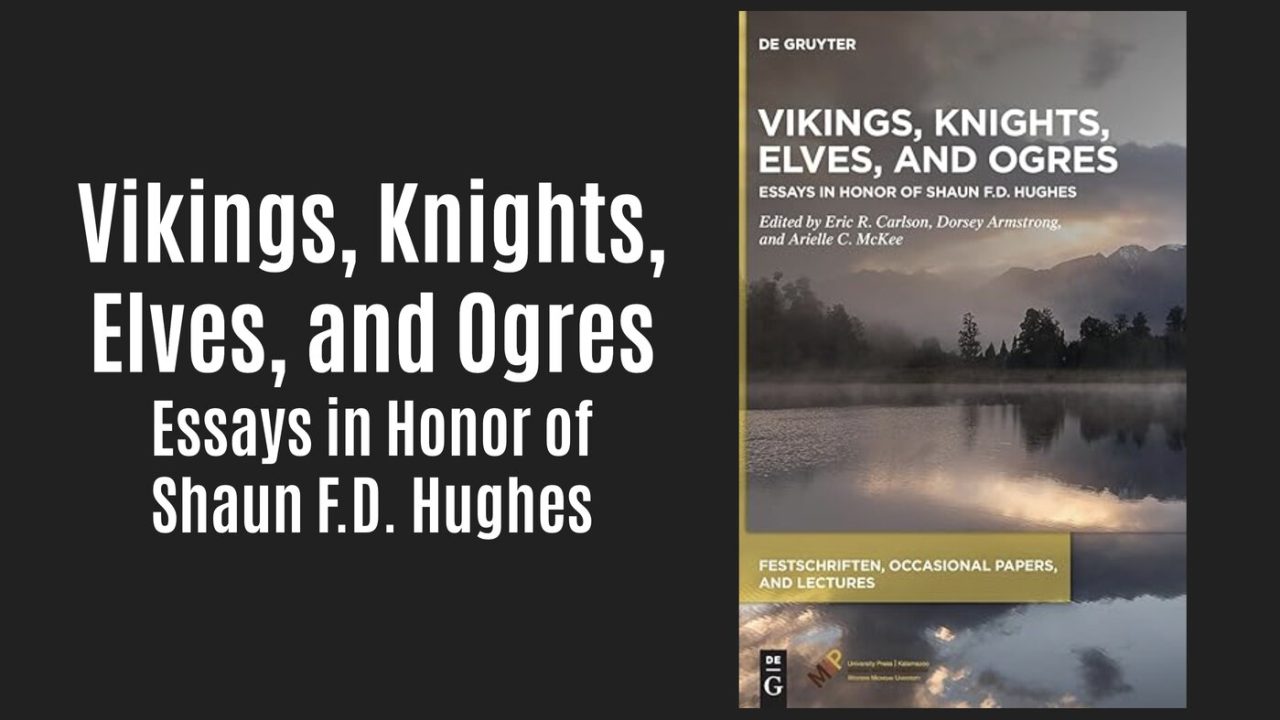
What happens when a scholar spends decades immersed in the worlds of Viking warriors, Arthurian knights, and mythological monsters — and then his colleagues decide to honor that work? You get a book with one of the most attention-grabbing titles in recent medieval scholarship: Vikings, Knights, Elves, and Ogres.
Published by Medieval Institute Publications in association with De Gruyter, this new collection of nine essays brings together some of the most compelling corners of medieval literature — from the Old English epic Beowulf to the Norse wolf-god Fenrir, and even the literary legacy of J.R.R. Tolkien. It’s a festschrift, the academic tradition of honoring a distinguished scholar through a collection of original research, and it pays tribute to Purdue University Professor Shaun F.D. Hughes.
For anyone interested in the literature of the medieval world — whether that means Anglo-Saxon England, the Icelandic sagas, or the modern writers those traditions inspired — this volume covers remarkable ground.
Who Is Shaun F.D. Hughes and Why Does This Book Exist?
Shaun F.D. Hughes is a Professor at Purdue University whose research sits at a rare crossroads: Old Norse and Icelandic literature on one side, Old and Middle English language and literature on the other. That’s an unusually broad scholarly range, and it’s reflected directly in the essays gathered here.
The editors describe the collection as honoring Hughes by sharing scholarship that “engages deeply with the traditions of Middle English, Old English, Icelandic, Old Norse, Tolkien Studies, and more.” They also note that the essays “break exciting new ground in these fields,” in part by following Hughes’s own approach — what the editors call his “readiness to offer controversial yet convincing views on scholarly issues.”
That last phrase is worth pausing on. Academic books in medieval studies don’t often advertise controversy. The fact that the editors chose to highlight it suggests this collection isn’t just a polite tribute — it’s a genuinely engaged set of arguments about texts that still spark real disagreement among scholars.
What the Nine Essays Actually Cover
The nine essays in the collection span two major literary traditions: the medieval literature of England and the medieval literature of Scandinavia. Several focus on texts that remain central to the study of English literature as a whole.
- Beowulf — the Old English epic that remains one of the oldest and most studied works in the English language
- Sir Gawain and the Green Knight — the Middle English Arthurian poem celebrated for its blend of chivalric romance and moral complexity
- The writings of Langland — referring to William Langland, the medieval poet best known for Piers Plowman
- Icelandic sagas — the prose narratives of medieval Iceland that document Viking-age history, family feuds, and heroic legend
- Skaldic poetry — the highly formal Old Norse court poetry known for its intricate structure and dense allusions
- Fenrir — the monstrous wolf of Norse mythology, bound by the gods and fated to break free at the end of the world
- Tolkien — the modern author whose work was deeply shaped by his scholarly expertise in Old English and Norse myth
The inclusion of Tolkien alongside genuinely medieval texts reflects a growing trend in medieval studies: taking seriously the ways that twentieth-century writers engaged with, transformed, and popularized ancient traditions.
The Editors and the Institutions Behind the Book
The volume was edited by three scholars with strong ties to the field of medieval English literature.
| Editor | Title | Institution |
|---|---|---|
| Eric R. Carlson | Associate Professor of English | University of South Carolina |
| Dorsey Armstrong | Professor of English | Purdue University |
| Arielle C. McKee | Visiting Assistant Professor of English | Wake Forest University |
Armstrong’s position at Purdue — the same institution where Hughes has built his career — gives the collection a personal dimension. These aren’t distant admirers assembling a formal tribute; this is scholarship produced by people who know the honoree’s work from the inside.
Why Medieval Literature Still Matters to Modern Readers
It’s easy to wonder whether a collection of essays on Beowulf and skaldic poetry has anything to offer outside a university library. But the texts covered here have had an outsized influence on the stories modern culture tells itself.
Tolkien’s The Lord of the Rings — now a global franchise — is almost incomprehensible without understanding the Norse myths and Old English poetry that shaped it. Fenrir, the wolf destined to swallow the sun, echoes through dozens of modern fantasy novels, video games, and films. The Arthurian tradition, including Sir Gawain, gave Western literature some of its most enduring ideas about honor, temptation, and what it means to be a hero.
Scholarship like this collection does the work of tracing those connections — showing where the stories came from, what they meant to their original audiences, and how they’ve been reinterpreted across centuries. For general readers curious about those origins, a book like this can be a doorway as much as a destination.
Who Should Read Vikings, Knights, Elves, and Ogres
The book is published by Medieval Institute Publications and distributed through De Gruyter, both of which primarily serve academic audiences. The ISBN is 978-1-5015-1892-8. This is, at its core, a scholarly work aimed at researchers and advanced students in medieval literature, Old Norse studies, and Tolkien Studies.
That said, readers with a serious interest in any of the texts covered — particularly Beowulf, Sir Gawain and the Green Knight, or Tolkien’s mythological sources — will find the subject matter accessible even if the academic register requires some patience.
Frequently Asked Questions
What is Vikings, Knights, Elves, and Ogres about?
It is a collection of nine scholarly essays exploring medieval literature from England and Scandinavia, covering texts including Beowulf, Sir Gawain and the Green Knight, Icelandic sagas, skaldic poetry, the Norse figure Fenrir, and Tolkien.
Who is the book honoring?
The collection is a festschrift honoring Shaun F.D. Hughes, a Professor at Purdue University whose research spans Old Norse, Icelandic, Old English, and Middle English literature.
Who edited the book?
The volume was edited by Eric R. Carlson of the University of South Carolina, Dorsey Armstrong of Purdue University, and Arielle C. McKee of Wake Forest University.
Who published the book?
It was published by Medieval Institute Publications in association with De Gruyter, with ISBN 978-1-5015-1892-8.
Why is Tolkien included in a medieval studies collection?
Tolkien’s work was deeply rooted in Old English and Old Norse traditions, and Tolkien Studies has become a recognized area of scholarly inquiry closely connected to medieval literature research.
Is this book suitable for general readers?
The book is primarily an academic publication, but readers with a strong interest in Beowulf, Arthurian literature, Norse mythology, or Tolkien’s sources may find value in the subject matter it covers.



Leave a Reply