
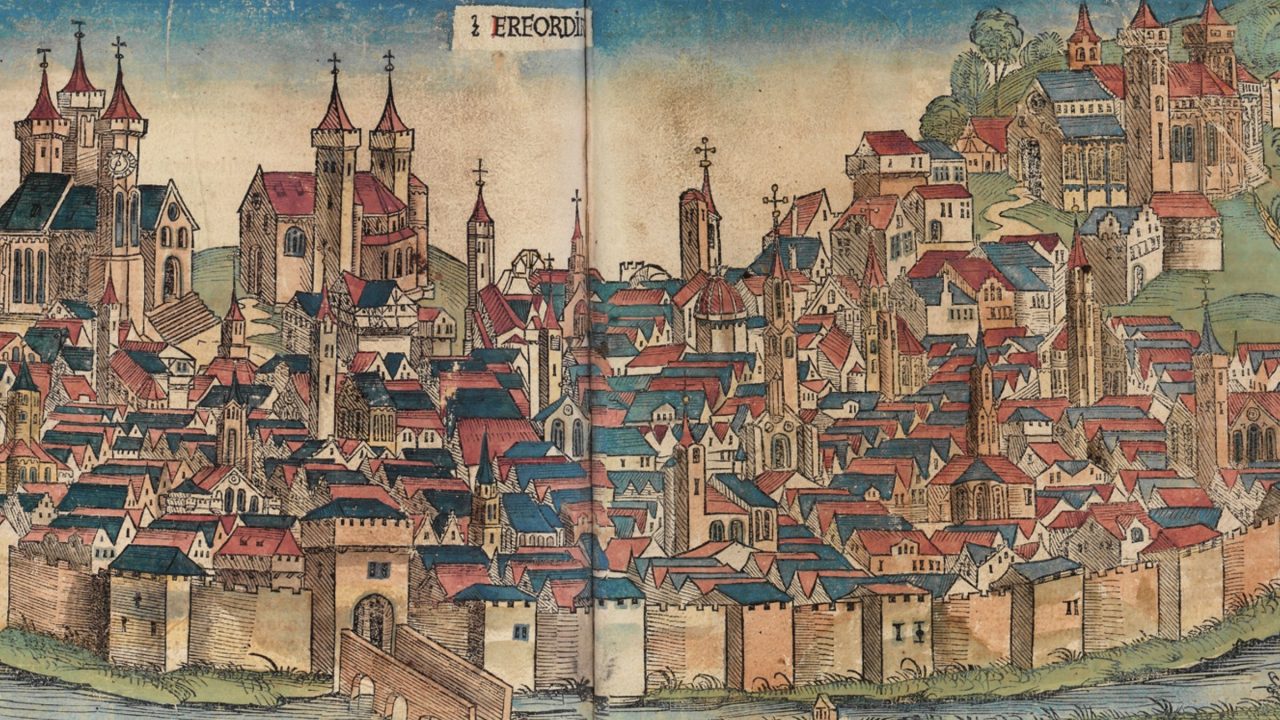
Around 12,000 people were buried in eleven large pits outside the city of Erfurt during a single plague outbreak in 1350 — and for nearly seven centuries, no one knew exactly where those pits were. Now, researchers believe they may have found one.
An interdisciplinary team of scientists has identified what appears to be a Black Death mass grave near the deserted medieval village of Neuses, just outside Erfurt in central Germany. The discovery, recently published in the journal PLOS One, combines historical records, geophysical survey techniques, and sediment coring to pinpoint a large buried feature that matches centuries-old descriptions of plague burial sites.
The researchers describe it as the first systematically identified burial site in Europe associated with plague burials from the Black Death — a finding that could reshape how historians and archaeologists approach the study of medieval pandemics.
How the Black Death Hit Central Germany
The Black Death swept across Europe between 1346 and 1353, killing an estimated 30 to 50 percent of the continent’s population. The toll varied sharply by region, and central Germany — specifically the area of Thuringia — marked one of the easternmost zones struck by the pandemic.
Erfurt, a major medieval city in the heart of Thuringia, was hit hard. Medieval sources record that during the outbreak of 1350, the city’s churchyards were overwhelmed almost immediately. The dead were arriving faster than they could be properly buried, and emergency burial grounds had to be established outside the city walls.
One of the key written records describing this crisis is the Chronicon Sampetrinum, a medieval chronicle that documents how Erfurt’s churchyards overflowed and how large pits had to be dug to accommodate the dead. According to these historical sources, approximately 12,000 people were interred in eleven such pits during the 1350 outbreak alone.
Those numbers, if accurate, are staggering — and for a long time, they existed only as text on a page, with no physical evidence to confirm them.
What the Research Team Actually Did
The study was led primarily by Leipzig University, the Leibniz Institute for the History and Culture of Eastern Europe (GWZO), and the Helmholtz Centre for Environmental Research (UFZ). Rather than relying on a single method, the team combined multiple disciplines to narrow down and then confirm the location of a potential burial site.
Their approach involved three main tools:
- Historical source analysis — Reviewing medieval chronicles and documents, including the Chronicon Sampetrinum, to understand where burials were likely located relative to the city and the village of Neuses.
- Geophysical survey — Using non-invasive ground-scanning techniques to detect subsurface anomalies consistent with large-scale burial activity.
- Sediment coring — Physically extracting sediment samples from the ground to examine soil composition and stratigraphy, helping confirm what lay beneath the surface.
Study co-authors Nik Usmar and Dr. Michael Hein were photographed carrying out the sediment coring work in the field near Erfurt. The combination of desk research and hands-on fieldwork is what makes this study stand out — it is not simply a reinterpretation of old documents, but a physical investigation grounded in modern science.
Key Facts About the Discovery
| Detail | Information |
|---|---|
| Location | Near the deserted medieval village of Neuses, outside Erfurt, central Germany |
| Plague outbreak date | 1350 |
| Estimated deaths buried in Erfurt pits | Approximately 12,000 people |
| Number of reported burial pits | Eleven large pits |
| Black Death death toll (Europe-wide) | 30–50% of the population (1346–1353) |
| Lead institutions | Leipzig University, GWZO, Helmholtz Centre (UFZ) |
| Published in | PLOS One |
| Primary historical source | Chronicon Sampetrinum |
Why This Find Matters Beyond the History Books
Plague burial sites from the Black Death era are surprisingly rare in the archaeological record — not because the deaths didn’t happen, but because identifying them with scientific certainty has proven enormously difficult. Many suspected sites have never been confirmed. This study’s methodology offers a potential blueprint for locating others across Europe.
The researchers describe this as the first systematically identified burial site in Europe associated with Black Death plague burials. That framing matters. It suggests that previous identifications were either incomplete, unverified, or relied on a single line of evidence rather than the kind of cross-disciplinary confirmation used here.
For historians, the find offers a rare opportunity to connect written medieval records with physical reality. The Chronicon Sampetrinum and other Erfurt sources have long been known, but they remained abstract — numbers and descriptions without a location you could stand on. That may be changing.
For archaeologists and scientists, the site near Neuses could yield biological and demographic data about the victims of the 1350 outbreak — information that simply cannot be extracted from a manuscript.
What Comes Next for the Neuses Site
The study published in PLOS One represents the identification phase of this research — the systematic process of locating and characterizing the buried feature. Excavation, if it proceeds, would be a separate and considerably more complex undertaking, involving ethical, logistical, and regulatory considerations.
The deserted village of Neuses itself adds another layer of historical intrigue. Villages abandoned in the medieval period are often associated with catastrophic events, including plague, and the proximity of this site to Erfurt makes it a particularly significant location for understanding how the Black Death reshaped settlement patterns in central Germany.
Researchers have not yet publicly confirmed whether a full excavation is planned, but the methodology developed for this study — combining archival research with geophysical and sediment analysis — is already being noted as a model for future investigations at similar sites across Europe.
Frequently Asked Questions
Where is the Black Death mass grave located?
The site is near the deserted medieval village of Neuses, just outside Erfurt in central Germany’s Thuringia region.
How many people were reportedly buried in Erfurt’s plague pits?
Medieval sources record that approximately 12,000 people were buried in eleven large pits outside the city during the 1350 outbreak.
What makes this discovery different from previous plague burial identifications?
The researchers describe it as the first systematically identified burial site in Europe associated with Black Death plague burials, combining historical sources, geophysical survey, and sediment coring rather than relying on a single line of evidence.
Which institutions led the research?
The study was led primarily by Leipzig University, the Leibniz Institute for the History and Culture of Eastern Europe (GWZO), and the Helmholtz Centre for Environmental Research (UFZ).
What historical source describes the Erfurt burials?
One of the key sources is the Chronicon Sampetrinum, a medieval chronicle that describes how Erfurt’s churchyards overflowed and emergency burial pits had to be created outside the city.
Will the site be excavated?
This has not yet been confirmed. The published study covers the identification and survey phase; any excavation would be a separate process with its own ethical and regulatory requirements.



Leave a Reply