
A sealed cave, untouched for thousands of years, was cracked open not by archaeologists with expensive equipment — but by a teenager chasing his dog through the woods of southwestern France. What those boys found on September 12, 1940, would become one of the most significant archaeological discoveries in human history.
The Lascaux cave, hidden beneath a wooded hill near the town of Montignac, held more than 2,000 images of animals and figures painted roughly 17,000 years ago. The art had survived in near-perfect isolation for millennia. Within decades of discovery, that isolation was gone — and the race to save what ancient hands had created began.
The story of Lascaux is really two stories running in parallel: one about what prehistoric humans left behind, and another about how modern humans have struggled — and often failed — to protect it.
How Four Teenagers Stumbled Into 17,000 Years of History
The date was September 12, 1940. Four local teenagers widened a small opening in the earth and slipped underground carrying a hastily made lamp. According to France’s Ministry of Culture, they walked along a passage roughly 98 feet long before spotting the first paintings in what is now called the Axial Gallery.
You may have heard the version of this story that involves a dog named Robot. Some accounts say the dog led the boys toward the opening in the first place — a dog disappearing into a gap in the trees, a boy following, and a civilization’s artwork waiting on the other side. Other sources treat that detail with more caution, and the official Ministry of Culture account focuses primarily on the boys’ own exploration rather than the dog’s role.
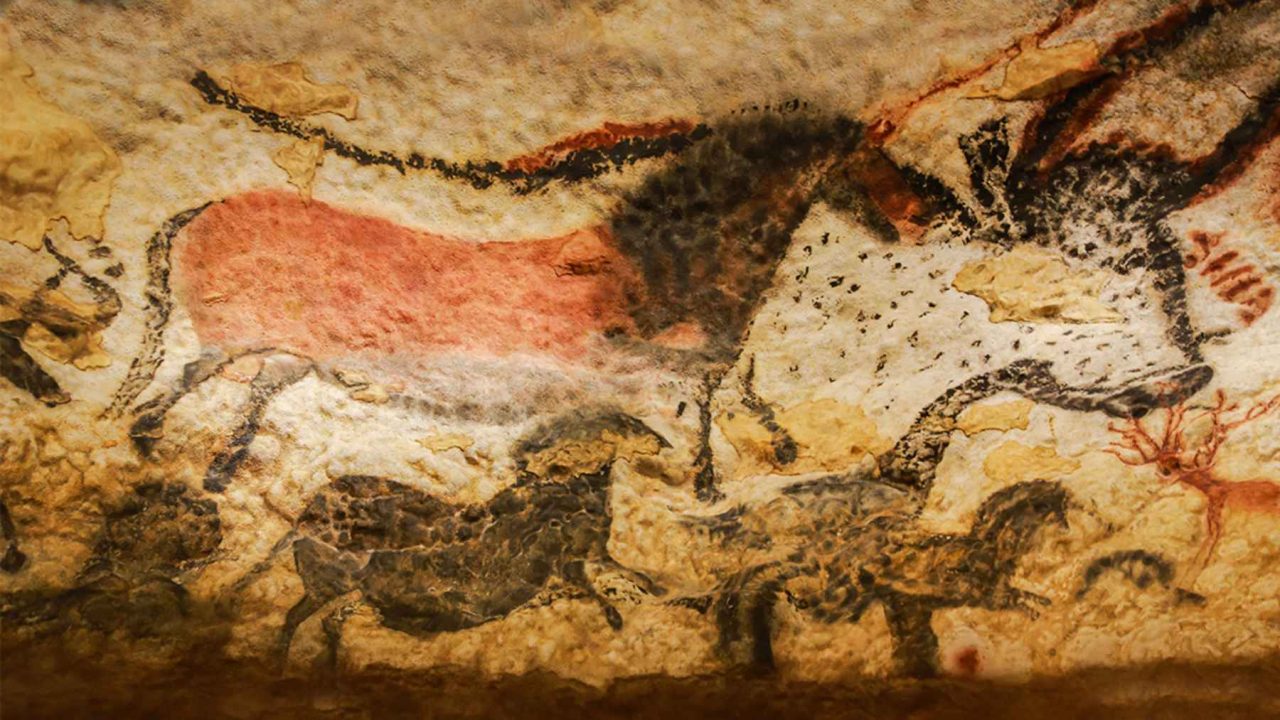
What is not in dispute is what they found. The cave paintings at Lascaux represent one of the most complete and visually striking examples of Paleolithic art ever discovered — thousands of images covering the walls and ceilings of interconnected chambers, depicting horses, bulls, deer, and other animals with a level of skill and detail that still astonishes researchers today.
What the Lascaux Paintings Actually Are
The scale of what was preserved inside that hill near Montignac is difficult to fully absorb. More than 2,000 individual images. Animals, figures, and symbols created approximately 17,000 years ago by people who had no written language, no metal tools, and no way of knowing their work would still be visible tens of thousands of years later.
The paintings are concentrated across several connected chambers and galleries within the cave system. The Axial Gallery — where the teenagers first encountered the art — is among the most celebrated sections.
| Key Detail | Confirmed Information |
|---|---|
| Discovery date | September 12, 1940 |
| Location | Near Montignac, southwestern France |
| Discoverers | Four local teenagers |
| Estimated age of paintings | Approximately 17,000 years |
| Number of images | More than 2,000 |
| Length of initial passage | Approximately 98 feet |
| First gallery reached | The Axial Gallery |
| Cave closed to public | 1963 |
The cave sits beneath a wooded hill — unremarkable from the outside, extraordinary from within. That ordinariness was, in a sense, what protected the paintings for so long.
Why the Cave Had to Be Closed — and What That Cost
Lascaux was opened to the public after the Second World War, and visitors came in enormous numbers. That was the problem. People do not just look at a place — they change it. Every breath adds carbon dioxide. Every body raises humidity. Every footstep disturbs the air.
By 1963, the damage was undeniable. France’s Ministry of Culture closed the cave to general visitors that year, and it has remained closed ever since. The original Lascaux is now off-limits to almost everyone.
What conservators have been dealing with ever since sounds, in many ways, like a modern environmental crisis in miniature. Officials are managing carbon dioxide levels, moisture, and microscopic biological life inside the cave — essentially treating it the way environmental scientists monitor the health of a fragile ecosystem like a wetland or coral reef. The threats are invisible, slow-moving, and potentially irreversible.
How the World Still Gets to See Lascaux
Closing the original cave did not mean abandoning public access entirely. Replicas and digital tools have taken on the work of bringing Lascaux to the world when the world can no longer come to Lascaux.
These reproductions allow visitors to experience the scale, the color, and the atmosphere of the original galleries without adding another breath of carbon dioxide to a space that has already absorbed far more human presence than it was ever meant to handle. The approach reflects a broader shift in how heritage conservation works — the idea that protecting something sometimes means keeping people away from it entirely, and finding other ways to share what it means.
For the paintings themselves, sealed again from casual contact, the hope is that what 17,000 years preserved, careful modern stewardship can continue to protect.
What This Discovery Still Tells Us
The Lascaux paintings matter for reasons that go beyond their age or their beauty. They are evidence that the human impulse to record, to represent, to make meaning out of the world — is ancient. These were not primitive scratchings. They were considered, skilled, deliberate works of art made by people who looked at the animals around them and decided those animals were worth remembering.
The fact that a teenager following a dog through a gap in the trees is what finally brought them back to light makes the story feel almost too perfect. But that is how it happened, on a September afternoon in 1940, in the woods near Montignac — one of the most significant moments in the history of human self-discovery, triggered by a boy and his dog.
Frequently Asked Questions
When was the Lascaux cave discovered?
The cave was discovered on September 12, 1940, by four local teenagers near Montignac in southwestern France.
How old are the Lascaux cave paintings?
The paintings are estimated to be approximately 17,000 years old, making them among the most significant examples of Paleolithic art ever found.
How many images are in the Lascaux cave?
The cave contains more than 2,000 individual images, depicting animals, figures, and symbols created by prehistoric humans.
Why is the Lascaux cave closed to the public?
The cave was closed to general visitors in 1963 because human presence — including the carbon dioxide and moisture people bring — was causing measurable damage to the ancient paintings.
Is the story about the dog named Robot true?
Some sources include the account of a dog named Robot leading the boys to the cave opening, but other sources treat this detail with uncertainty. The official Ministry of Culture account focuses on the teenagers’ exploration rather than confirming the dog’s role.
Can anyone visit the original Lascaux cave today?
The original cave remains closed to general visitors. Replicas and digital tools have been developed to give the public access to the paintings without risking further damage to the originals.



Leave a Reply