
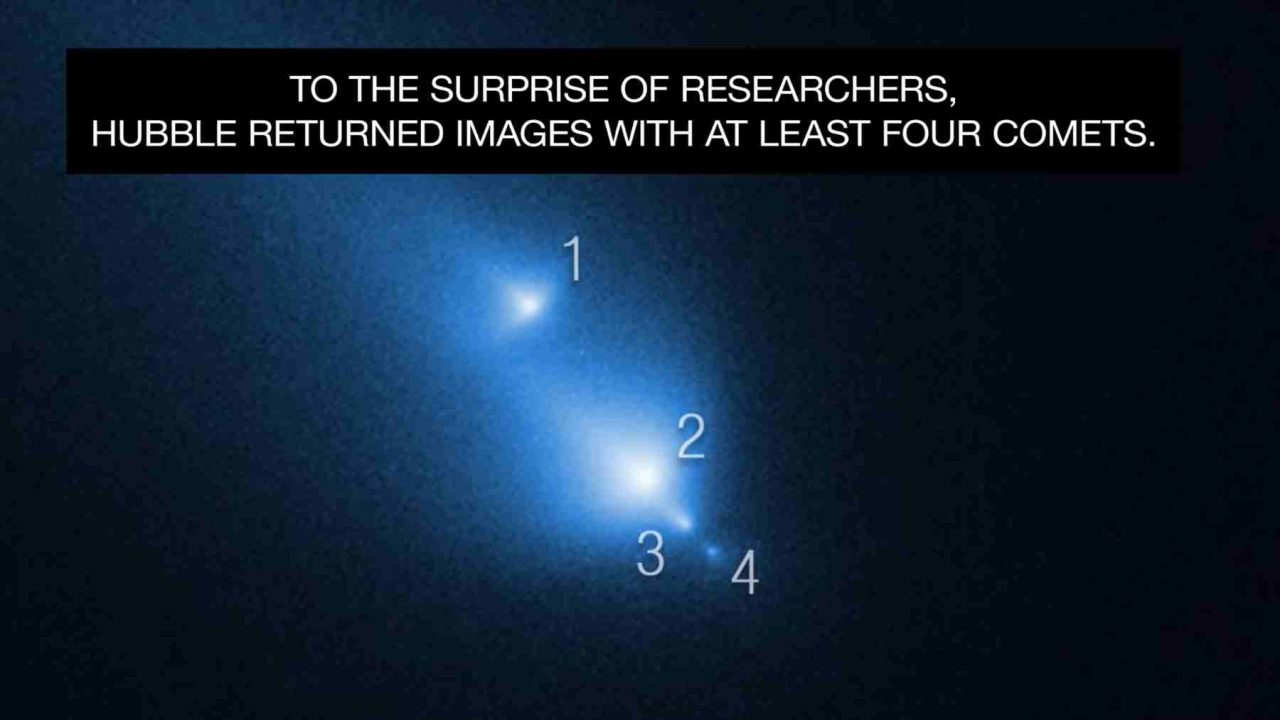
What are the odds of a space telescope accidentally witnessing a comet tearing itself apart in real time? Astronomers now know the answer: extraordinarily slim — and yet that is exactly what happened when the Hubble Space Telescope turned its gaze toward Comet C/2025 K1 (ATLAS) in November 2025.
The images Hubble captured didn’t just offer a dramatic show. They gave scientists something far more valuable: a detailed record of a comet’s disintegration as it unfolded, frame by frame. And buried in that record is a mystery that researchers at Auburn University are still working to explain.
The comet didn’t brighten when they expected it to. That 48-hour delay is now forcing scientists to rethink what they thought they understood about how comets fall apart.
How Hubble Ended Up Watching Comet C/2025 K1 (ATLAS) Break Apart
This wasn’t a planned observation. The Hubble team had originally scheduled time to observe a different comet entirely, but new technical constraints forced them to switch targets. Comet C/2025 K1 (ATLAS) became the backup choice — and it turned out to be one of the most fortuitous substitutions in recent astronomical history.
While Hubble was already trained on K1, the comet began fragmenting. The telescope captured the breakup as it happened, producing a sequence of images that researchers could use to reconstruct a precise timeline of the disintegration.
John Noonan and Dennis Bodewits, researchers at Auburn University, described the timing as “the slimmest of slim chances.” Scientists have long struggled to catch comets in the act of breaking up — these events are unpredictable, often brief, and easy to miss entirely. Having Hubble already pointed at K1 when it started to crack open was, by any measure, a stroke of extraordinary luck.
What Hubble Actually Found: Four Fragments and a Strange Delay
The Hubble images revealed that Comet C/2025 K1 had split into four distinct icy fragments, each continuing to travel through space along its own trajectory. Tracking those fragments separately gives scientists a rare opportunity to study how different pieces of a broken comet behave as they move closer to the Sun.
But the more puzzling discovery wasn’t the fragments themselves — it was the timing of what happened after the comet cracked open.
When a comet breaks apart, the conventional expectation is that its brightness increases relatively quickly. The newly exposed interior material — ice and dust that had been sealed inside — begins sublimating rapidly, reflecting more sunlight and causing a visible surge in brightness. That’s the standard model.
With K1, that surge didn’t come on schedule. There was a roughly 48-hour delay between the breakup and the expected increase in brightness. That gap doesn’t fit neatly into existing theories about comet disintegration timelines, and it has pushed the Auburn University team to reassess their assumptions about what triggers the brightening and when.
| Detail | What Was Observed |
|---|---|
| Comet name | C/2025 K1 (ATLAS) |
| Number of fragments detected | Four icy fragments |
| Observation period | November 2025 |
| Telescope used | Hubble Space Telescope |
| Key anomaly | ~48-hour delay in brightness increase after breakup |
| Research institution | Auburn University |
| Named researchers | John Noonan, Dennis Bodewits |
Why the 48-Hour Delay Changes the Picture
Comet science relies heavily on predictive models. When astronomers spot a comet showing signs of stress — unusual brightness fluctuations, changes in shape, or structural instability — those models help them estimate what comes next and when. The accuracy of those predictions matters, especially as interest grows in understanding how comets behave when they pass close to the Sun.
The delay observed with K1 suggests that the internal structure of a comet, or the way fresh material is exposed during a breakup, may be more complex than current models account for. It’s possible that newly exposed material doesn’t immediately begin sublimating at the rate scientists expect — or that some kind of lag in the physical or chemical processes involved is slowing the response.
Whatever the cause, the implication is significant: if brightness doesn’t surge immediately after a comet breaks apart, then using brightness as a real-time indicator of disintegration timing could lead researchers to the wrong conclusions. The timeline scientists reconstruct from brightness data alone might consistently be off by two days or more.
The Auburn University team, according to NASA’s official reporting, is now working to revise their hypotheses to account for this gap. The Hubble data gives them a rare fixed point — a verified moment of breakup captured visually — against which they can test new theoretical frameworks.
What This Means for Future Comet Research
The K1 observation is already being described as a significant contribution to the field, not just because of what it showed, but because of how it was obtained. Scientists have long wanted to catch a comet fragmenting in real time under high-resolution observation. The difficulty isn’t just pointing a telescope at the right object — it’s being there at exactly the right moment.
That accidental timing has produced a dataset that researchers can use to:
- Verify or challenge existing models of comet disintegration timelines
- Study the behavior of individual fragments after a breakup event
- Investigate the 48-hour brightness delay as a potentially recurring phenomenon
- Refine the methods used to interpret brightness changes as indicators of structural events
The European Space Agency has also noted interest in the findings, reflecting the broader scientific significance of what Hubble captured. A report from ESA acknowledged that researchers have tried for years to observe a comet breakup at this level of detail.
The Next Steps in Tracking Comet C/2025 K1
With four fragments now moving independently through space, astronomers have multiple targets to follow. Each piece of the original comet carries its own history and will respond differently as it continues its journey — potentially offering further clues about the internal composition of K1 before it broke apart.
The Auburn University team’s theoretical work is ongoing. Revising models to incorporate the brightness delay will take time, and the full implications of the K1 data are unlikely to be settled quickly. But the dataset itself is already in hand, and that alone puts researchers in a stronger position than they’ve been before when it comes to understanding how comets unravel.
For now, the four icy fragments of Comet C/2025 K1 continue their path through the solar system — each one a piece of a puzzle that Hubble, entirely by chance, was watching at exactly the right moment.
Frequently Asked Questions
What is Comet C/2025 K1 (ATLAS)?
It is a comet that was observed fragmenting in November 2025, breaking into four distinct icy pieces that Hubble tracked through space.
Why was Hubble watching this comet in the first place?
The observation was unplanned — Hubble had originally been scheduled to observe a different comet, but technical constraints forced a target switch to C/2025 K1 (ATLAS).
What is the 48-hour brightness delay, and why does it matter?
After the comet broke apart, its brightness did not increase as quickly as existing models predicted, with a roughly 48-hour gap that doesn’t fit current theories about comet disintegration timelines.
Who are the researchers studying this comet?
John Noonan and Dennis Bodewits at Auburn University are among the scientists analyzing the Hubble data and revising their theoretical models in response to the findings.
How many fragments did Comet C/2025 K1 break into?
Hubble detected four icy fragments continuing to travel through space after the comet’s disintegration.
Will the brightness delay finding change how scientists study future comets?
Researchers are actively revising their models based on this data, which could affect how brightness changes are interpreted as indicators of structural events in future comet observations.



Leave a Reply