
The earthquakes that rattle your windows and set off emergency alerts on your phone are easy to track. But a new study suggests the quakes you never feel — the ones too small and too deep to register in daily life — may actually tell scientists far more about the seismic dangers lurking beneath Northern California.
By tracking swarms of low-frequency earthquakes deep offshore, researchers have uncovered signs of hidden, moving structures beneath one of the most geologically complex spots on the planet: the Mendocino Triple Junction, where the San Andreas fault system collides with the Cascadia subduction zone off the coast of Humboldt County.
What they found challenges the simplified picture most people — and even many hazard maps — have relied on for years.
What the Mendocino Triple Junction Actually Is
Most people have heard of the San Andreas fault. Fewer know about the place where it effectively ends — or rather, where it meets two other massive tectonic systems at a single offshore point.
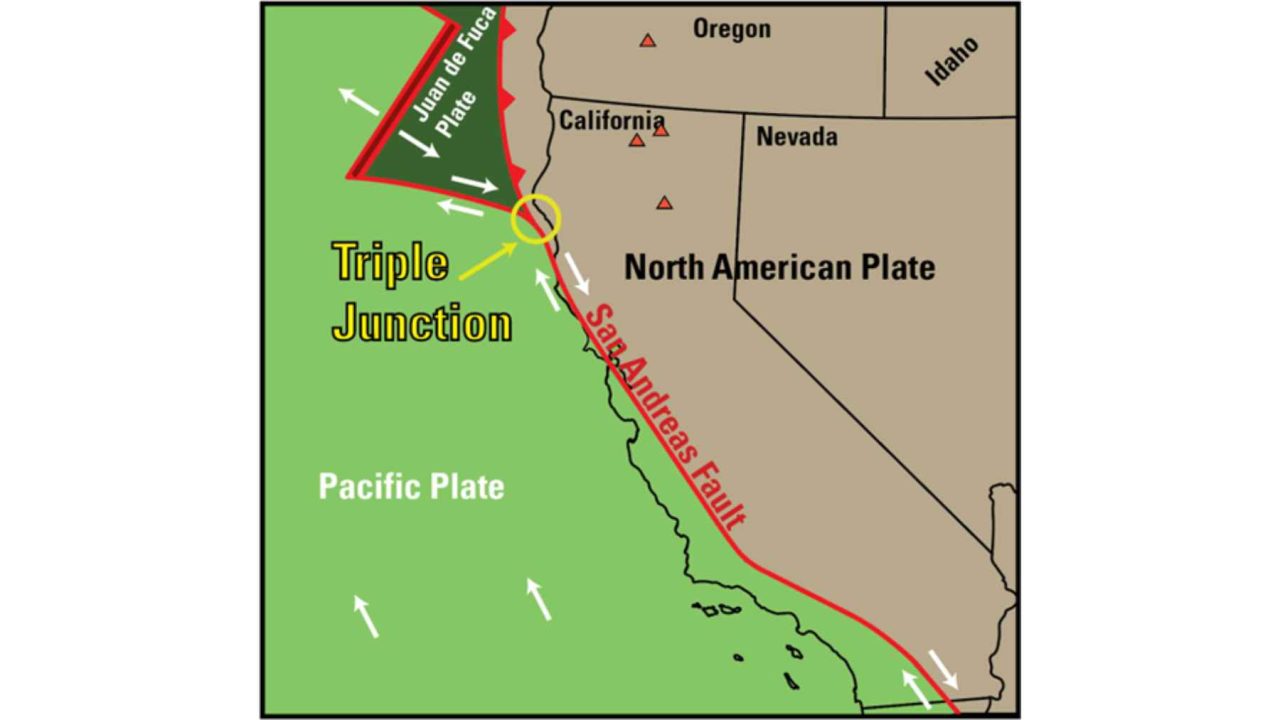
The Mendocino Triple Junction sits off the coast of Humboldt County in Northern California. It is the meeting point of three major tectonic plates, the giant slabs of Earth’s outer shell that are constantly shifting, even when the ground above them feels perfectly still.
Here is how those three plates interact at that junction:
- To the south, the Pacific plate slides roughly northwest past the North American plate — the movement that drives the San Andreas fault system.
- To the north, the Gorda plate moves northeast and sinks beneath the North American plate in a process called subduction — the engine behind the Cascadia subduction zone.
- The North American plate itself sits above both, spanning the continent.
On a standard tectonic map, this looks relatively clean: three plates, three boundaries, one junction point. The new research suggests that picture is far too tidy.
What the Tiny Earthquakes Revealed
The study focused on low-frequency earthquakes — seismic events so small and deep that the people living above them never feel a thing. These micro-tremors are not random noise. Scientists can use them as a kind of underground imaging tool, tracing where movement is occurring far below the surface.
When researchers tracked swarms of these low-frequency quakes deep offshore near the Mendocino Triple Junction, the data pointed to something unexpected. Rather than three tectonic pieces interacting at depth, the evidence suggested at least five moving structures operating beneath the surface.
That is not a minor revision. It means the zone is significantly more fragmented and dynamic than current models account for — and that the forces generating earthquake risk in this region are more complex than seismic hazard estimates have traditionally reflected.
| Feature | Previous Understanding | New Research Suggests |
|---|---|---|
| Number of moving pieces at depth | 3 tectonic plates | At least 5 moving structures |
| System complexity | Relatively straightforward triple junction | Hidden, chaotic subsurface system |
| Detection method | Standard seismic mapping | Low-frequency earthquake swarm tracking |
| Location of key activity | At surface plate boundaries | Deep offshore, below the junction |
Why This Changes the Earthquake Risk Conversation
Northern California is already one of the most seismically watched regions in the United States. Humboldt County sits in the shadow of both the San Andreas fault and the Cascadia subduction zone — two systems capable of producing devastating earthquakes.
The Cascadia subduction zone, in particular, has long been identified as capable of generating magnitude 9 or greater earthquakes, with the potential to affect communities from Northern California to British Columbia. The San Andreas system, meanwhile, has produced some of the most destructive quakes in American history.
What this new research adds is a layer of complexity that existing hazard models may not fully capture. If there are at least five moving pieces operating at depth — not three — then the interactions between them, the stresses they create, and the faults they could activate are all more varied than current maps suggest.
Researchers say this could shift how seismic hazard is estimated in the region. That matters for building codes, emergency planning, and the millions of people who live and work in Northern California communities that have long been told to prepare for the next big quake.
The Part of This Story Most Reports Are Missing
There is something quietly significant about the method itself. The fact that unfelt, low-frequency earthquakes were the key to this discovery says something important about how seismic science is evolving.
For decades, earthquake research was largely driven by the quakes people could feel — the ones big enough to register clearly on seismometers and make headlines. Smaller, deeper, lower-frequency tremors were harder to detect and often harder to interpret.
As detection technology improves, scientists are increasingly able to use these micro-events as a kind of natural probe, illuminating structures and movements that no drilling program or surface survey could easily reach. The Mendocino findings are a direct product of that shift.
It also raises a broader question: how many other fault systems around the world look simple on the surface but hide something far more complicated at depth?
What Comes Next for Seismic Research in This Region
The findings point toward a need to revisit seismic hazard assessments for the Mendocino Triple Junction region and potentially for the broader Northern California coast. Researchers will likely need to account for the additional moving structures identified at depth when modeling how stress accumulates and releases in this zone.
For residents of Humboldt County and surrounding communities, the practical takeaway is that the ground beneath them is even more dynamic than previously understood. That does not mean a major earthquake is imminent — tectonic processes unfold over very long timescales — but it does mean the systems that could produce one are more complex than the standard three-plate picture suggests.
The research underscores why continuous monitoring of low-frequency seismic activity in this region is not just scientifically interesting. It may be one of the most important tools available for understanding what is building, slowly and silently, far below the surface.
Frequently Asked Questions
What is the Mendocino Triple Junction?
It is the point off the coast of Humboldt County, California, where three major tectonic plates meet: the Pacific plate, the North American plate, and the Gorda plate.
What did the new study find?
By tracking swarms of low-frequency earthquakes deep offshore, researchers found evidence of at least five moving structures at depth beneath the junction — not just the three plates shown on standard maps.
What are low-frequency earthquakes?
They are very small, deep seismic events that people on the surface cannot feel, but which scientists can track to understand movement and structure far underground.
Why does this matter for earthquake risk?
The research suggests the subsurface system is more complex and fragmented than current seismic hazard models account for, which could affect how risk is estimated for Northern California communities.
Does this mean a major earthquake is coming soon?
How were these findings made possible?
Advances in seismic detection allowed researchers to track low-frequency earthquake swarms that were previously difficult to monitor, revealing hidden structures that standard surface mapping could not identify.



Leave a Reply