
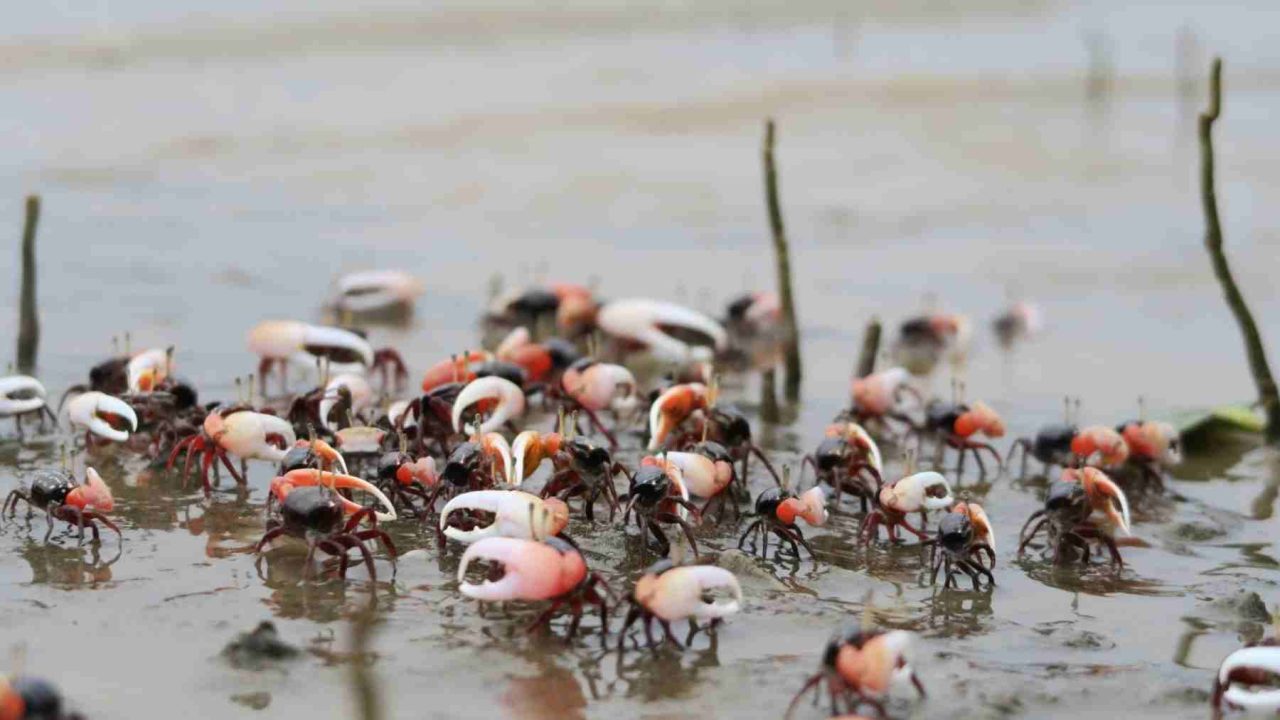
A crab barely longer than your thumb is doing something scientists did not fully expect: pulling microplastics out of coastal mud at concentrations 13 times higher than what is found in the surrounding sediment — and then breaking some of those particles into an even more dangerous form. A study published on December 17, 2025, focused on mangroves in the Colombian Caribbean has put fiddler crabs at the center of a growing concern about how plastic pollution moves through coastal ecosystems.
The findings are striking not because crabs eating plastic is entirely new science, but because of the scale of accumulation and what happens next. Roughly 15 percent of the microplastic particles these crabs ingest appear to be ground down into nanoplastics — fragments so small they are nearly impossible to track and far easier for living tissue to absorb.
For anyone who eats seafood, lives near a coastline, or simply cares about where plastic ends up after it washes off city streets, this research offers an uncomfortable new piece of the puzzle.
What Fiddler Crabs Are Actually Doing in the Mud
Fiddler crabs are small shoreline crabs instantly recognizable by one oversized claw that looks perpetually raised in a wave. They are not passive residents of the mangrove floor. Scientists describe them as ecosystem engineers — animals that actively reshape their environment by digging burrows and constantly turning over sediment.
That burrowing behavior is exactly what makes them such an efficient vehicle for plastic accumulation. As they shuffle through the mud, they ingest sediment along with organic material they are feeding on. In mangrove environments, where plastic debris tends to collect and concentrate, that sediment is increasingly laced with microplastic particles.
The crabs are not selectively eating plastic. They are eating everything in the mud, and the plastic comes with it. The problem is that their bodies appear to hold onto those particles at a rate far exceeding what the surrounding environment contains — creating what researchers observed as a 13-to-1 concentration ratio between the crabs and the nearby sediment.
The Microplastics-to-Nanoplastics Conversion Nobody Saw Coming
Microplastics — generally defined as plastic fragments smaller than 5 millimeters — have been documented across virtually every environment on Earth. But nanoplastics, which are orders of magnitude smaller, are a newer and murkier concern. They are harder to detect, harder to study, and believed to penetrate biological systems more easily than their larger counterparts.
The study found evidence that approximately 15 percent of the microplastic particles passing through fiddler crabs were being broken down into nanoplastic fragments. The mechanical grinding action of the crabs’ digestive processes appears to be responsible — essentially turning larger plastic pieces into a finer, more biologically mobile form.
Researchers have described this as something that superficially resembles natural filtering or cleaning, but the reality is more complicated. The crabs are not removing plastic from the ecosystem. They are concentrating it, fragmenting it, and positioning it to move up the food chain.
Key Findings at a Glance
| Finding | Detail |
|---|---|
| Study publication date | December 17, 2025 |
| Study location | Mangroves, Colombian Caribbean |
| Species studied | Fiddler crabs (approximately 1.2 inches in size) |
| Microplastic concentration vs. sediment | Up to 13 times higher in crabs than in surrounding mud |
| Nanoplastic conversion rate | Approximately 15 percent of ingested microplastics |
| Crab role in ecosystem | Ecosystem engineers; burrow and turn sediment constantly |
- Fiddler crabs measure just 1.2 inches — yet their impact on plastic distribution appears disproportionately large
- Their feeding method involves ingesting sediment directly, making plastic uptake difficult to avoid in contaminated areas
- The conversion of microplastics into nanoplastics inside the crabs’ bodies represents a new pathway researchers are still working to fully understand
- Mangrove ecosystems are already under pressure from coastal development, climate change, and pollution — this adds another layer of concern
Why This Matters Beyond the Mangrove
Mangroves are not isolated systems. They are nurseries for fish, feeding grounds for birds, and buffer zones that protect coastlines. Animals that feed in mangroves carry whatever they have accumulated into wider food webs — into fish that humans catch, into birds people watch, and ultimately into the broader marine environment.
The concern researchers point to is not simply that crabs contain plastic. It is that the crabs are functioning as biological concentrators and processors — taking diffuse contamination from sediment and packaging it into a more potent, more mobile form. When a fish eats a fiddler crab, it is not just eating the crab. It is potentially consuming a concentrated dose of microplastics alongside nanoplastic fragments that the crab’s own digestive system produced.
Nanoplastics are particularly worrying because their tiny size allows them to cross biological barriers that larger particles cannot. Researchers studying nanoplastic toxicity in other contexts have noted their potential to enter cells and accumulate in organs, though the full picture of their health effects — in marine animals or in humans — is still being studied.
What Researchers Are Still Working to Understand
The December 2025 study represents a field observation from a specific location — the Colombian Caribbean mangroves — and while its findings are significant, researchers acknowledge there is more work to do. Questions that remain open include how consistently this pattern appears across different fiddler crab populations, whether other sediment-feeding crustaceans show similar accumulation rates, and what the downstream effects on fish and bird populations feeding in these mangroves actually look like over time.
The nanoplastic conversion finding is particularly new territory. Documenting that living animals can mechanically break microplastics into nanoplastics through digestion opens a line of research that scientists are only beginning to map. Tracking nanoplastics in the environment is technically difficult, which means the full extent of this process in coastal ecosystems may be larger than current data can confirm.
What the study does establish clearly is that small animals in overlooked environments are playing a measurable role in how plastic pollution behaves — and that role is not neutral.
Frequently Asked Questions
What did the study about fiddler crabs and microplastics find?
The study, published December 17, 2025, found that fiddler crabs in Colombian Caribbean mangroves accumulate microplastics at concentrations up to 13 times higher than the surrounding mud, and that approximately 15 percent of those particles are broken down into nanoplastics inside the crabs.
How big are the fiddler crabs involved in this research?
The crabs studied measure approximately 1.2 inches — small animals with a surprisingly large impact on plastic distribution in their environment.
What is the difference between microplastics and nanoplastics?
Microplastics are plastic fragments generally smaller than 5 millimeters. Nanoplastics are far smaller fragments, harder to detect, and believed to penetrate biological systems more easily than microplastics.
Does this mean seafood is unsafe to eat?
The study does not make direct claims about seafood safety for humans. It documents plastic accumulation and conversion in fiddler crabs specifically, and the broader implications for the food chain are still being researched.
Why are mangrove ecosystems particularly vulnerable?
Mangroves tend to trap debris and sediment, concentrating plastic pollution in the mud where fiddler crabs feed. They also serve as nurseries and feeding grounds for a wide range of marine species, making contamination there relevant to broader food webs.
Will this study lead to policy changes or new regulations?
This has not been confirmed in the available source material. The study’s findings contribute to the scientific understanding of plastic pollution pathways, but any regulatory response would depend on further research and governmental action.

Leave a Reply