
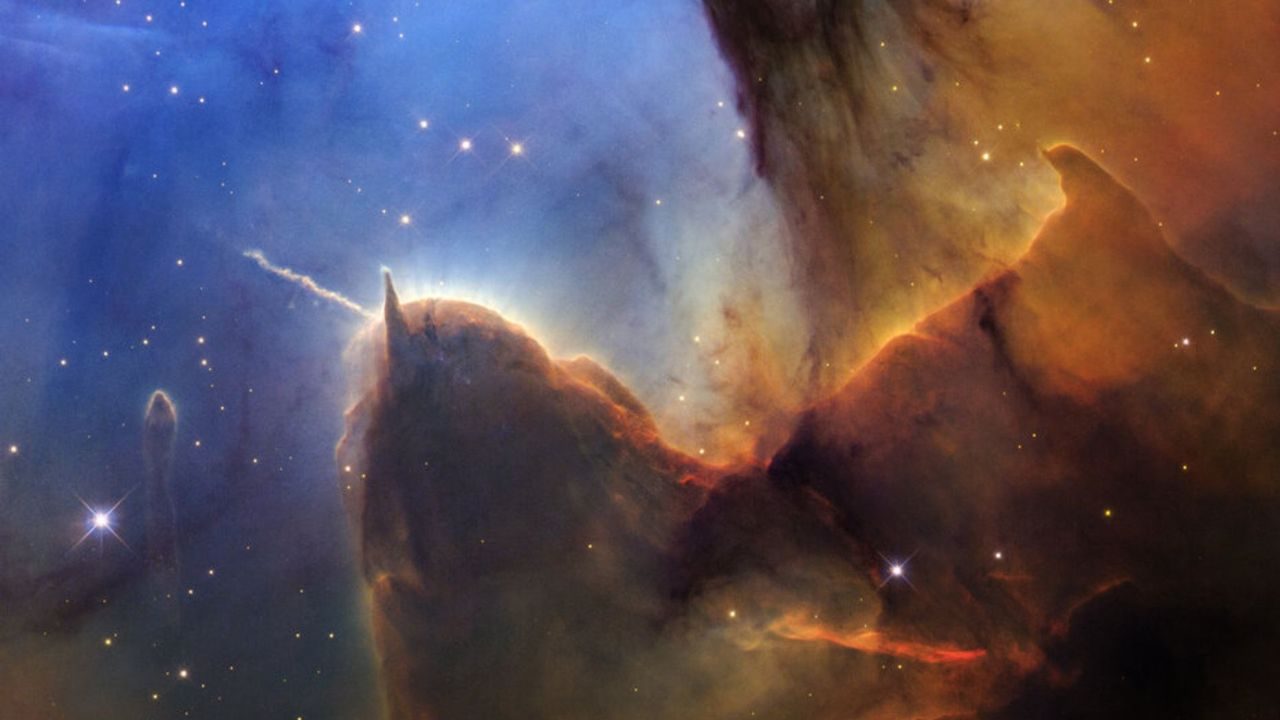
Five thousand light-years away, in the constellation Sagittarius, a cloud of gas and dust is doing something extraordinary — and the Hubble Space Telescope just caught it happening in real time.
NASA’s Hubble has returned to the Trifid Nebula, also catalogued as Messier 20, roughly 30 years after its original observations of this cosmic landmark. The new portrait, shared on April 20, 2026, reveals something the earlier images couldn’t — a growing jet of energy shooting through the nebula’s colorful, churning interior.
The image itself is striking enough to stop a scroll. Speckles, horn-like protrusions, and a series of glowing, multicolored ridges make the nebula look less like deep space and more like something pulled from the ocean floor. But what makes this revisit scientifically significant isn’t just the beauty — it’s what 30 years of change can reveal about how stars and nebulae evolve.
What the Trifid Nebula Actually Is
The Trifid Nebula is a well-known emission nebula — a vast cloud of ionized gas that glows because of the intense radiation pouring out of young, hot stars forming within it. The name “Trifid” comes from the Latin for “divided into three lobes,” a reference to the dark dust lanes that split the nebula’s glowing core into distinct sections when viewed through a telescope.
It sits approximately 5,000 light-years from Earth in the constellation Sagittarius, making it a relatively close neighbor in galactic terms. Astronomers have studied it for generations precisely because it offers a front-row view of star formation in action — a messy, energetic, and ongoing process.
Hubble’s original observations of the Trifid gave scientists a detailed snapshot of its structure. But a snapshot is just that — a single moment. Returning three decades later transforms that snapshot into something more like a time-lapse, letting researchers measure real physical changes across a human-scale timeframe.
The Growing Energy Jet Hubble Spotted
The headline discovery from this revisit is a jet of energy that has visibly grown since Hubble’s earlier look at the nebula. Jets like this are typically associated with young stellar objects — protostars still in the process of forming — that expel material along their rotational poles as they pull in surrounding gas and dust.
Spotting measurable growth in such a jet over a 30-year window is a rare observational achievement. Space operates on timescales that usually dwarf human lifespans, so detecting visible change within a few decades highlights just how dynamic and turbulent the Trifid’s interior environment really is.
The image was processed by J. DePasquale at the Space Telescope Science Institute (STScI), using data from NASA, ESA, and STScI. The processing brings out the nebula’s layered structure — the ridges, the glowing gas clouds, the dark dust lanes — in a level of detail that makes the energy activity easier to trace and study.
Key Facts About the Trifid Nebula and This Observation
| Detail | Information |
|---|---|
| Object Name | Trifid Nebula (Messier 20) |
| Distance from Earth | 5,000 light-years |
| Location | Constellation Sagittarius |
| Image Shared | April 20, 2026 |
| Time Since Original Hubble Observations | Approximately 30 years |
| Key Discovery | A visibly growing jet of energy within the nebula |
| Image Processing Credit | J. DePasquale (STScI) |
| Agencies Involved | NASA, ESA, STScI |
What stands out about this observation isn’t just a single finding — it’s what the comparison between old and new data makes possible:
- Measuring actual physical changes in nebular structure over a 30-year baseline
- Tracking the development of stellar jets associated with young forming stars
- Studying the interaction between ionized gas, dust lanes, and outflowing energy in real time
- Capturing one of the most visually distinctive nebulae in the Milky Way at a new level of image clarity
Why This Matters Beyond the Pretty Picture
It’s easy to look at an image like this and appreciate it purely as art. The colors, the shapes, the sheer scale of it — all of that is genuinely remarkable. But the scientific weight behind this revisit goes deeper than aesthetics.
Star formation is one of the fundamental processes shaping the universe, and nebulae like the Trifid are where it happens. Understanding how jets form, grow, and interact with surrounding material helps astronomers build more accurate models of how stars — including our own Sun — come into existence.
The 30-year gap between observations also speaks to something rarely discussed: the long institutional memory required to do this kind of comparative astronomy. Hubble launched in 1990, and its sustained operation across decades is precisely what makes observations like this possible. You can’t compare then and now if you didn’t carefully document then.
For the broader public, images like this also serve a different but equally important function — they make the scale and complexity of the universe tangible in a way that raw data rarely can.
What Comes Next for Hubble and the Trifid
Hubble continues to operate as one of the most productive scientific instruments ever built, and revisits like this one to well-known objects are a deliberate part of how astronomers use its remaining operational life. Returning to previously studied targets with decades of additional data allows for the kind of longitudinal science that newer telescopes — however powerful — simply cannot yet replicate.
Whether future observations will track further development of the energy jet spotted in this latest image has not been confirmed. But given what 30 years of change has already revealed inside the Trifid Nebula, there’s every reason to keep watching.
Frequently Asked Questions
What is the Trifid Nebula?
The Trifid Nebula, also known as Messier 20, is a glowing cloud of gas and dust located approximately 5,000 light-years from Earth in the constellation Sagittarius.
What did Hubble discover on its return visit to the Trifid Nebula?
Hubble spotted a growing jet of energy within the nebula that has visibly changed since the telescope’s original observations roughly 30 years ago.
When was the new Trifid Nebula image shared?
The image was shared on April 20, 2026, and was processed by J. DePasquale at the Space Telescope Science Institute.
Why does the Trifid Nebula look like it has three sections?
The name “Trifid” refers to the dark dust lanes that divide the nebula’s glowing core into three distinct lobes when observed through a telescope.
Who is responsible for producing the new Hubble image of the Trifid Nebula?
The image was produced using data from NASA, ESA, and STScI, with image processing carried out by J. DePasquale of the Space Telescope Science Institute.
How far away is the Trifid Nebula from Earth?
The Trifid Nebula is approximately 5,000 light-years from Earth, placing it within our own Milky Way galaxy.


Leave a Reply