
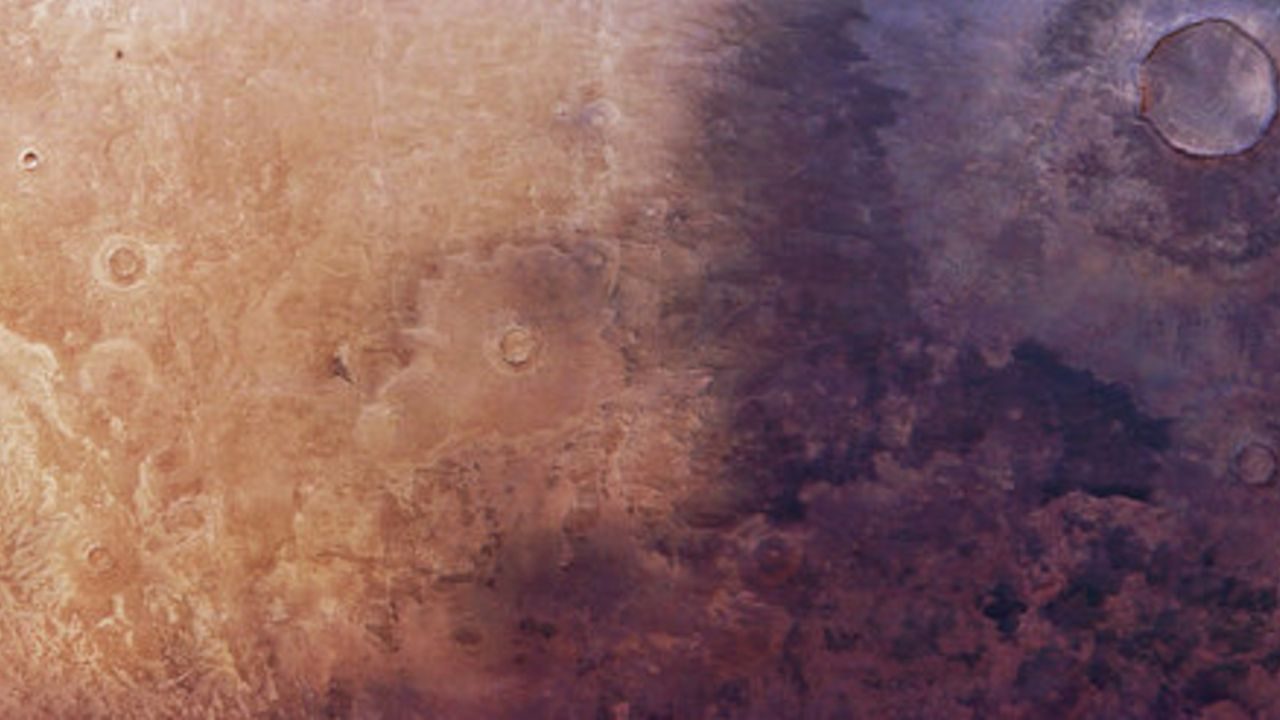
Something dark is moving across Mars — and it has been for half a century. A massive shadowy patch lurking inside a giant Martian crater has been slowly spreading across the Red Planet’s surface since scientists first detected it roughly 50 years ago, and new photographs have brought the phenomenon back into sharp focus. The unsettling part? Researchers still aren’t entirely sure why it’s happening.
The feature sits within a region of Mars called Utopia Planitia, one of the largest impact basins in the solar system. What looks like a creeping shadow is actually a section of ground blanketed in dark volcanic materials — ash and rocks including minerals known as olivine and pyroxene — left behind by ancient volcanic eruptions. Over decades of observation, this dark patch has been observed expanding, edging further across the Martian surface in a way that scientists are working to understand.
It sounds like something out of a science fiction film. But the mystery is entirely real, and it raises genuinely interesting questions about the geological and atmospheric forces still at work on a planet most people assume is completely dormant.
What Is Actually Happening on the Martian Surface
Mars is often described as a dead world — cold, dry, and geologically quiet. But the expanding dark patch in Utopia Planitia suggests the planet’s surface is still changing, even if the mechanisms driving that change remain debated.
The dark material itself is volcanic in origin. Ash deposits and volcanic rock types like olivine and pyroxene are significantly darker than the reddish dust that gives Mars its familiar color. When these materials accumulate on or near the surface, they create a stark visual contrast that is easily visible from orbit.
What makes this particular feature unusual isn’t just its darkness — it’s the fact that it appears to be growing. New images have confirmed what earlier observations suggested: the patch has been expanding across the crater floor and surrounding terrain since it was first identified roughly five decades ago. Scientists are not yet certain whether this expansion is being driven by wind redistributing volcanic material, by some form of ongoing geological activity, or by a combination of surface processes unique to the Martian environment.
The Dark Patch at a Glance: What We Know So Far
| Feature | Detail |
|---|---|
| Location | Utopia Planitia, Mars |
| Nature of the dark material | Ash and volcanic rocks including olivine and pyroxene |
| How long it has been observed | Approximately 50 years |
| Observed behavior | Slowly expanding across the Martian surface |
| Current scientific consensus | Cause of expansion not yet fully explained |
| Image source | ESA/DLR/FU Berlin |
Key confirmed details about the phenomenon include:
- The dark material is composed of volcanic ash and rocks, specifically olivine and pyroxene
- The feature is located within Utopia Planitia, one of Mars’ most prominent geological regions
- The expansion has been ongoing for approximately 50 years based on available observations
- New photographs have provided fresh visual evidence of the patch’s continued growth
- Scientists have not yet reached a definitive conclusion about what is driving the expansion
Why Utopia Planitia Makes This Even More Interesting
Utopia Planitia isn’t just any patch of Martian real estate. It’s one of the largest known impact basins in the entire solar system, and it has a history of scientific significance — NASA’s Viking 2 lander touched down there in 1976. More recently, researchers have identified the region as a potential reservoir of subsurface water ice.
The presence of volcanic material in this basin points to a complex geological history. Olivine and pyroxene are minerals that form during volcanic activity and are commonly found in basaltic rock. On Earth, these minerals weather relatively quickly when exposed to water. On Mars, their survival at the surface suggests an extremely dry environment — and their dark color means they absorb more solar heat than the surrounding terrain, which could itself influence local wind patterns and surface processes.
That heat absorption is one reason some researchers consider wind redistribution a plausible driver of the expansion. Darker surfaces warm up faster, potentially generating small-scale convective activity that could mobilize loose volcanic particles and carry them further across the landscape over time.
What This Means for Our Understanding of Mars
For anyone following Mars science, this story matters beyond the visual spectacle of a spreading dark shadow. It’s a reminder that Mars is not a static, frozen-in-time world. Surface processes — whether driven by wind, residual geological activity, or other forces — are actively reshaping parts of the planet right now.
That has implications for future human and robotic missions. Understanding how surface materials move and accumulate affects everything from landing site selection to the long-term habitability assessments scientists conduct when evaluating Mars as a destination. Dark volcanic deposits also carry information about the planet’s eruptive past, and studying how they behave today can help reconstruct what Mars looked like billions of years ago when it was volcanically active.
The fact that this particular feature has been growing for 50 years — across the entire span of modern Mars exploration — and still hasn’t been fully explained says something important: Mars continues to surprise us.
What Researchers Are Watching For Next
With new images already revealing fresh detail about the expanding patch, scientists are expected to continue monitoring the feature using orbital assets. The European Space Agency, whose imaging teams produced the photographs credited in this story, has long-term observation capabilities around Mars that make sustained tracking of slow surface changes possible.

Pinning down the exact mechanism behind the expansion will likely require comparing images taken across multiple Martian seasons and years, analyzing how the dark material moves in relation to wind patterns, and potentially correlating the changes with data on subsurface conditions in the Utopia Planitia region.
For now, the shadow keeps moving — quietly, slowly, and without a clear explanation sitting 140 million miles away from the scientists trying to figure it out.
Frequently Asked Questions
Where exactly is the dark patch located on Mars?
The feature is located in Utopia Planitia, a large impact basin on Mars that is one of the biggest of its kind in the solar system.
What is the dark material made of?
The patch consists of volcanic ash and rocks, including minerals known as olivine and pyroxene, deposited by ancient volcanic eruptions.
How long has the dark patch been expanding?
Scientists have been observing the feature for approximately 50 years, and new photographs confirm it has continued to spread across the Martian surface during that time.
Do scientists know why it is expanding?
Not yet. Researchers are aware that the patch is growing, but the exact cause of the expansion has not been definitively confirmed.
Who captured the new images of the feature?
The images were produced by ESA/DLR/FU Berlin, the imaging team associated with the European Space Agency’s Mars observation program.
Does this mean Mars is still volcanically active?
The dark material itself is from ancient eruptions, but whether any ongoing geological activity is contributing to the expansion has not been confirmed by the available source material.


Leave a Reply