
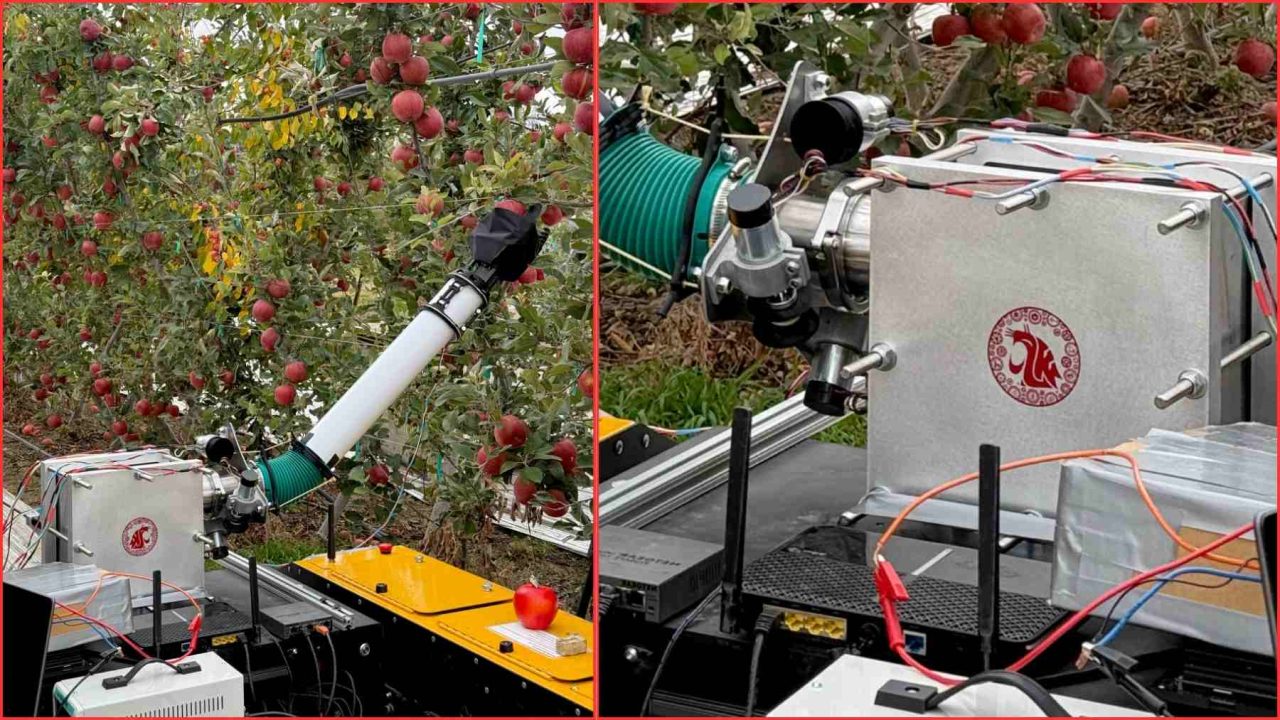
What if the next person to pick your apples was never a person at all? Researchers at Washington State University are building robotic farm workers designed to handle some of the most physically demanding jobs in agriculture — and the technology is moving faster than most people realize.
The driving force behind this push isn’t just curiosity. Washington’s agricultural industry is worth billions of dollars, and for years the pipeline of seasonal workers available for pruning, thinning, and harvesting has been shrinking. Researchers say that pressure is pushing growers toward a future where humans and machines divide the workload in ways that would have seemed far-fetched a decade ago.
The latest prototypes coming out of WSU include a soft, inflatable robotic arm built to pick apples and an AI-powered vision system that can locate strawberries hiding under leaves — then clear a path to reach them using gentle puffs of air. These aren’t concept drawings. They’re working prototypes being developed and tested right now.
Why Farms Are Running Out of Human Hands
Agriculture has always depended on large numbers of seasonal workers showing up at exactly the right time. Harvest windows are narrow. Miss them, and the crop is lost. For decades, farms across Washington State and the broader American West have relied on day laborers and migrant workers to fill that gap during peak season.
But that labor supply has been tightening for years. Researchers at WSU describe a situation where growers simply cannot count on having enough workers available when they need them most. The economics of farming don’t leave much room for uncertainty — which is exactly why automation has started to look less like a luxury and more like a necessity.
The goal, as researchers frame it, isn’t to eliminate farmworkers entirely. It’s to fill the gaps that the current workforce can no longer reliably cover. Humans and machines sharing the workload is the model they’re working toward.
The Robots Being Built Right Now
The two most notable systems coming out of WSU’s research address very different challenges, but both are designed around the same core problem: agricultural work is physically complex, unpredictable, and surprisingly easy to get wrong with a rigid machine.
- Soft inflatable apple-picking arm: Rather than using a hard metal arm that risks damaging fruit or breaking tree limbs, WSU engineers built an arm that is inflatable and soft by design. The goal is to reduce damage to both the trees and the apples during the picking process. According to university reporting, the arm weighs under a threshold that makes it practical for field use.
- AI strawberry vision system: Strawberries present a different problem — they hide. Leaves cover them, and a robot that can’t find the fruit can’t pick it. WSU’s AI vision system is designed to locate strawberries beneath foliage, then use small, controlled puffs of air to move leaves out of the way before attempting to harvest.
Both systems reflect a broader design philosophy: agricultural robots need to be gentle, adaptable, and smart enough to handle the messy reality of a living, growing environment.
How These Systems Compare to Traditional Harvesting
| Factor | Traditional Manual Harvesting | WSU Robotic Systems |
|---|---|---|
| Worker availability | Dependent on seasonal labor supply | Not affected by labor shortages |
| Physical fatigue | Workers tire over long shifts | No fatigue factor |
| Sick days / absences | Common during peak seasons | Not applicable |
| Fruit damage risk | Varies by worker skill | Reduced through soft-arm design |
| Hidden fruit detection | Relies on human eyesight | AI vision system with air-clearing |
| Water usage potential | Standard irrigation practices | Research suggests possible water savings |
What This Means for Growers, Workers, and Consumers
For growers in Washington State, where agriculture represents a multibillion-dollar industry, the appeal of reliable automation is straightforward. A robot doesn’t call in sick two days before the apple harvest. It doesn’t need housing, transportation, or a return flight home. And if it can reduce fruit damage during picking, that translates directly into less product lost before it ever reaches a store shelf.
The water angle is also worth noting. Researchers suggest that some of these robotic systems could help farms use water more efficiently — a significant consideration in a region where irrigation demands are substantial and water resources are under increasing pressure.
For farmworkers, the picture is more complicated. Automation in agriculture has historically raised concerns about job displacement, particularly for seasonal and migrant laborers whose livelihoods depend on harvest work. Researchers frame the technology as filling gaps rather than replacing workers outright, but the long-term labor implications remain an open and genuinely contested question.
For consumers, the practical effect may eventually show up in produce consistency and price. Crops harvested more efficiently and with less damage have a better chance of making it to market in good condition.
Where This Research Goes From Here
WSU’s robotic harvesting work is still in the prototype stage, which means the path from research lab to widespread commercial use involves significant additional development, testing, and cost reduction. Agricultural robotics is a field that has promised a great deal over the years, and scaling these systems to work reliably across different farm sizes, crop varieties, and weather conditions remains a genuine engineering challenge.
Still, the direction of travel is clear. With labor shortages showing no sign of reversing and the cost of lost harvests continuing to climb, the pressure on researchers and technology companies to deliver practical solutions is only growing. WSU’s soft robotics and AI vision work represents one serious effort to answer that pressure with something that actually works in the field — not just in a laboratory.
Whether robots become a standard fixture on American farms within five years or fifteen, the research underway right now is laying the groundwork for a harvest season that looks very different from the one farmers have relied on for generations.
Frequently Asked Questions
What kinds of robots are WSU researchers developing for farms?
WSU researchers are building a soft, inflatable robotic arm for picking apples and an AI vision system that locates strawberries hidden under leaves and clears a path using gentle puffs of air.
Why are farms turning to robots instead of hiring more workers?
The supply of seasonal farm laborers in Washington State has been tightening for years, making it increasingly difficult for growers to reliably staff pruning, thinning, and harvest operations.
Will these robots damage fruit or trees during harvesting?
The inflatable apple-picking arm is specifically designed to be soft and flexible in order to reduce damage to both fruit and tree limbs, which is a key limitation of traditional rigid robotic arms.
Could farm robots also help save water?
Researchers have noted that some of these robotic systems carry the potential to help farms use water more efficiently, though detailed specifics on how that would work have not been confirmed in the available source material.
Are these robots ready to use on commercial farms right now?
No — the systems described are currently working prototypes developed at Washington State University and have not yet been confirmed as commercially available products.
Does this research mean farmworkers will lose their jobs?
Researchers frame the technology as filling labor gaps that the current workforce cannot reliably cover, though the long-term impact on farmworker employment has not been fully addressed in the available reporting.

Leave a Reply