
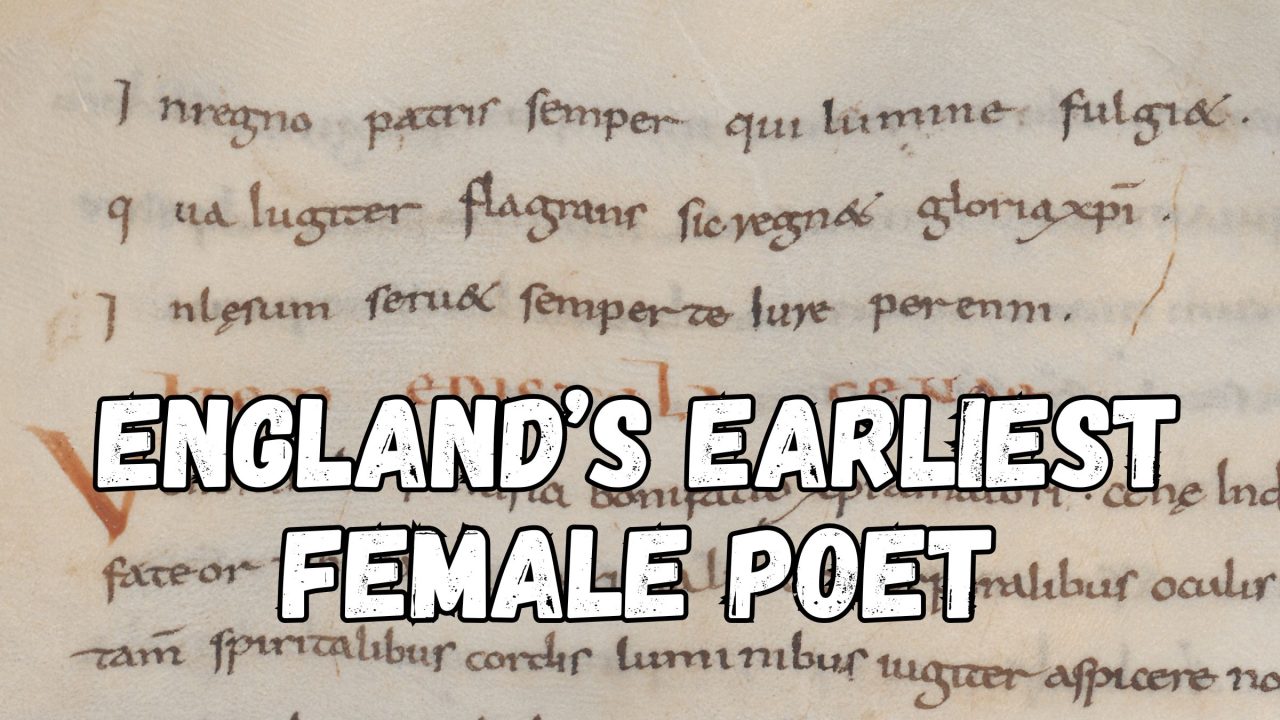
A four-line Latin poem written by an English nun in the eighth century has survived for more than a thousand years — and with it, the remarkable legacy of Leoba, now recognized as England’s earliest surviving female poet. Her work predates most of what we think of as early English literature, and yet her name remains largely unknown outside academic circles.
That quiet obscurity is worth questioning. Leoba composed her verse at a time when few women’s writing survived at all, in a language — Latin — that placed her squarely within the most serious intellectual tradition of her era. Her survival in the historical record, even through a single letter, tells us something meaningful about women, education, and literary culture in early medieval England.
Her story is also a reminder that English literature did not begin with the names most of us were taught in school.
Who Was Leoba, England’s Earliest Female Poet?
Leoba — also known as Leofgyth or Leobgytha — was born in Wessex and entered the convent at Wimborne in Dorset, where she received her education and took her religious vows. She wrote during the first half of the eighth century, a period when early medieval England was still taking shape as a literary and religious culture.
She was a native speaker of Old English, but she composed her poetry in Latin. That distinction matters less than it might seem. Scholars note that educated people in early medieval England — clerics, monks, and nuns alike — moved comfortably between Latin and Old English. Both were languages of learning and devotion. Writing in Latin did not make Leoba any less of an English poet; it placed her within the bilingual literary world her era inhabited.
Only one piece of her writing survives today: a single Latin letter addressed to her kinsman Saint Boniface, the celebrated English missionary to the Continent who became known as the “Apostle to the Germans.” Preserved within that letter are four lines of Latin verse — the sole surviving example of her poetry, and the earliest known poetry written by a woman in England.
The World That Shaped Her Writing
To understand why Leoba’s work matters, it helps to understand the world she wrote in. Early medieval England — broadly defined as the period from CE 597 to 1066 — was a society in which literacy was almost entirely the domain of the Church. Monasteries and convents were the centers of education, manuscript production, and intellectual life.
For women, the convent offered something rare: access to learning. Institutions like Wimborne in Dorset were not simply places of prayer. They were schools, scriptoria, and literary communities. Nuns like Leoba could receive a serious education in Latin grammar, scripture, and classical texts — the same foundations that shaped the male clerical writers of her time.
Her letter to Boniface reflects that education directly. Writing to a figure of significant ecclesiastical authority — and a blood relative — she included her own verse, an act that signals both confidence in her literary skills and an understanding of Latin poetry’s conventions. That she felt able to share her poetry with one of the most prominent English churchmen of the age speaks to the seriousness with which literary culture was practiced in her community.
Key Facts About Leoba and Her Surviving Work
| Detail | Information |
|---|---|
| Full name / variants | Leoba, also known as Leofgyth or Leobgytha |
| Period of activity | First half of the eighth century |
| Place of origin | Wessex, England |
| Religious house | Convent at Wimborne, Dorset |
| Language of writing | Latin |
| Surviving works | One Latin letter containing four lines of verse |
| Letter addressed to | Saint Boniface, “Apostle to the Germans” |
| Significance | England’s earliest surviving female poet |
- Leoba wrote during the early medieval period in England, defined as CE 597–1066
- Literary culture in this era was bilingual — Latin and Old English were both used by educated writers
- Her four surviving lines of verse are preserved within a personal letter, not a formal literary manuscript
- Saint Boniface was not only her kinsman but one of the most influential English churchmen of the age
Why This Matters More Than a Footnote in History
It would be easy to file Leoba away as a curiosity — a brief entry in the long catalog of medieval literature. Four lines of verse, one surviving letter. What can that really tell us?
Quite a lot, actually. The very existence of her poetry challenges assumptions about who was writing in early medieval England and who had access to literary education. Women’s writing from this period is exceptionally rare, and most of what did exist was never preserved. The fact that Leoba’s verse survived at all — embedded in a letter that was kept, copied, and transmitted across more than a millennium — suggests her work was valued by those who encountered it.
Her story also complicates the narrative of English literary history. The earliest names most readers associate with Old English literature are male — monks, scholars, anonymous scribes. Leoba’s existence as a confident, educated Latin poet writing in the same period pushes back against that picture. She was not an exception to the literary culture of her time. She was part of it.
For scholars of medieval women’s writing, early English literature, and the history of education, Leoba represents a thread worth following — evidence that women’s intellectual lives in the early Church were richer and more active than the surviving record typically suggests.
What the Historical Record Still Leaves Open
Beyond what is confirmed — her origins in Wessex, her education at Wimborne, her letter to Boniface, and her four lines of surviving verse — much about Leoba remains unknown. How much else she wrote, whether any other work circulated in her lifetime, and how widely she was read are questions the current historical record cannot answer.
What survives is a fragment. But fragments, when they are this old and this rare, carry an outsized weight. A single letter and four lines of poetry have been enough to secure Leoba’s place as England’s earliest surviving female poet — and to open a window onto the literary world of women in the eighth-century Church that might otherwise have remained entirely shut.
Frequently Asked Questions
Who was Leoba?
Leoba — also known as Leofgyth or Leobgytha — was an English nun born in Wessex who entered the convent at Wimborne in Dorset. She wrote in Latin during the first half of the eighth century and is recognized as England’s earliest surviving female poet.
What writing by Leoba has survived?
A single Latin letter addressed to her kinsman Saint Boniface survives, and within that letter are four lines of Latin verse — the only known example of her poetry.
Who was Saint Boniface?
Saint Boniface was a celebrated English missionary to the Continent, later known as the “Apostle to the Germans.” He was a kinsman of Leoba and the recipient of her surviving letter.
Why did Leoba write in Latin rather than Old English?
In early medieval England, educated writers — including nuns and monks — regularly used both Latin and Old English. Latin was one of the standard languages of literary and religious expression, and writing in it did not make Leoba any less of an English poet.
Where was Leoba educated?
Leoba received her education and took her religious vows at the convent of Wimborne in Dorset.
Why is so little of Leoba’s work known today?
Women’s writing from early medieval England is exceptionally rare, and most of what existed was never preserved. Leoba’s four lines of verse survive only because they were embedded in a letter that was kept and copied over more than a millennium.

Leave a Reply