
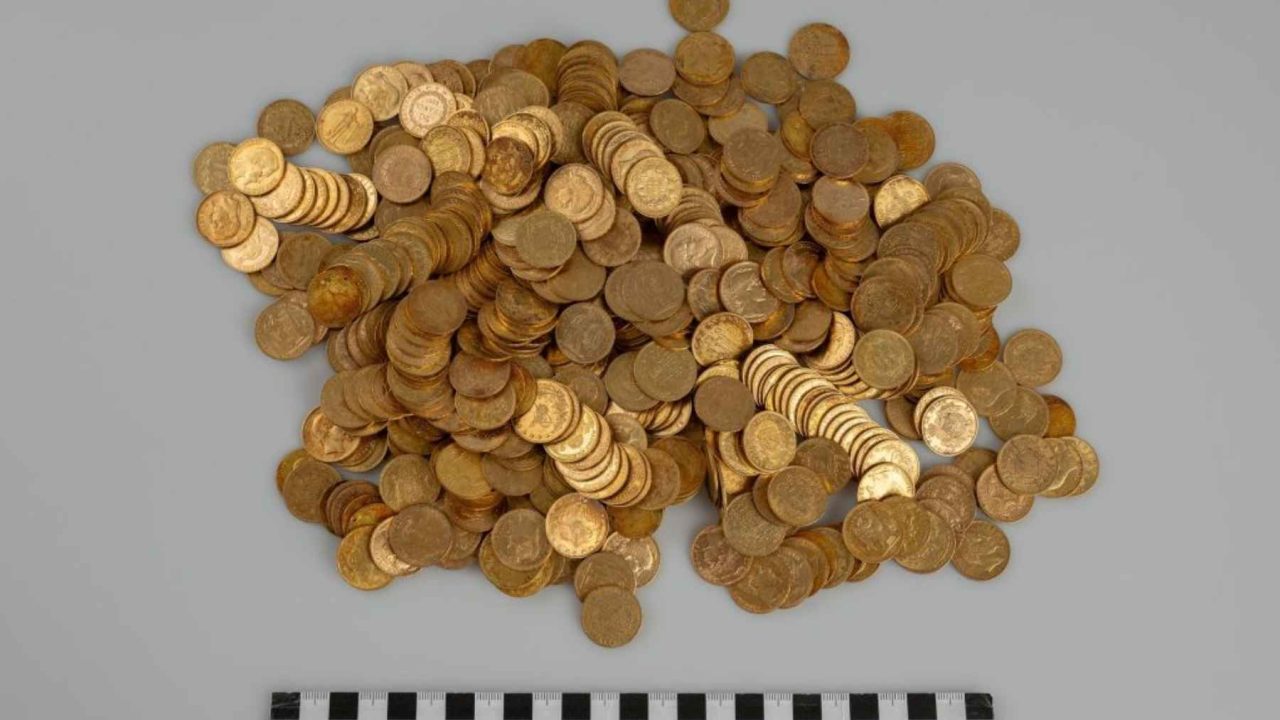
Inside a stone wall on a wooded hillside in northeastern Czechia, someone had tucked away a small fortune — and kept that secret for more than a century. Two hikers stumbled across it in February 2025, and what they found has left historians, archaeologists, and everyday treasure enthusiasts asking the same question: who hid it, and why?
Czech officials in the Hradec Králové Region have confirmed the discovery of 598 gold coins along with a collection of personal valuables, all concealed inside an artificial stone wall on the southwestern slope of Zvičina Hill. The hoard spans coins dated from 1808 to 1915, meaning whoever buried it did so sometime after 1921 at the earliest — and never came back to retrieve it.
The two hikers who reported the find are set to share a reward of 11.7 million Czech crowns, the equivalent of roughly $563,000 at current exchange rates. That number alone would make headlines. But the deeper story here isn’t the money — it’s the mystery of a person or family who buried their entire wealth and seemingly vanished.
What the Hikers Actually Found Inside That Wall
The discovery site is Zvičina Hill, a wooded area in northeastern Czechia where old field boundaries and stone walls are not unusual. What was unusual was the deliberate, careful way this particular cache had been hidden.
The hikers found two separate containers inside the wall, placed roughly three feet apart from each other. The first was an aluminum jar holding the coins, which had been stacked and wrapped in black cloth — a detail that suggests whoever hid them wanted to protect the metal from moisture and time. The second was a metal box containing other valuables.
The full hoard weighed approximately 15 pounds in total. Beyond the 598 gold coins, the collection included:
- 16 tobacco or cigarette cases
- 10 bracelets
- A fine metal mesh purse
- A comb
- A chain with a key
These aren’t the kinds of objects someone abandons carelessly. A comb, a purse, a key on a chain — these are personal effects. Officials have noted that the hiding place has the look of an “emergency plan,” as if someone gathered everything of value and concealed it in a hurry, fully intending to return.
A Timeline Frozen in Gold
The coins themselves tell part of the story. Spanning more than a century of minting — from 1808 to 1915 — they represent accumulated wealth rather than a single windfall. Someone, over years or even generations, had been quietly saving gold.
The fact that the youngest coin dates to 1915 and the cache was buried after 1921 places the hiding event in a turbulent window of European history. The early 1920s followed the collapse of the Austro-Hungarian Empire, the formation of Czechoslovakia, economic instability, and widespread uncertainty across Central Europe. Historians studying similar hoards from the region note that hiding valuables during periods of political upheaval was not uncommon — people feared bank failures, border changes, and confiscation.
| Detail | Confirmed Information |
|---|---|
| Discovery date | February 2025 |
| Location | Zvičina Hill, Hradec Králové Region, northeastern Czechia |
| Number of gold coins | 598 |
| Coin date range | 1808 to 1915 |
| Total weight of hoard | Approximately 15 pounds |
| Containers found | Two — an aluminum jar and a metal box |
| Distance between containers | Approximately three feet |
| Finder reward | 11.7 million Czech crowns (~$563,000 USD) |
| Earliest possible burial date | After 1921 |
Why Officials Are Calling This an Exceptional Find
Czech officials have described the hoard as an exceptional modern treasure — and that language matters. Hoards of this size and condition, particularly those containing gold coins spanning more than a century alongside personal objects, are rare. The careful wrapping of the coins in black cloth and the deliberate separation of the two containers suggest someone with knowledge of how to preserve valuables long-term.
The personal items found alongside the coins are arguably just as significant to researchers. A metal mesh purse and a comb are intimate objects. They suggest the person who hid this cache wasn’t just a wealthy investor storing gold — they were someone packing up their life, or the most important parts of it, against an uncertain future.
Officials have not yet publicly identified who the original owner may have been, and no living claimants have been reported. The hoard, for now, belongs to history.
What the Two Hikers Walk Away With
Under Czech law, finders of significant historical artifacts are entitled to a reward, and this case is no exception. The two hikers will split the 11.7 million crown reward — roughly $563,000 combined — after the gold was verified by authorities in the Hradec Králové Region.
It’s a life-changing sum for a winter walk that probably started with no particular destination in mind. The hikers noticed something strange about a section of stone wall, investigated, and reported what they found rather than quietly keeping it. That decision is what triggered the formal verification process and the reward.
It’s also a reminder that significant historical finds don’t always come from organized digs or professional surveys. Sometimes they come from someone paying attention to something that looks slightly out of place.
The Question That Still Has No Answer
The hoard has been found, verified, and rewarded. What remains is the human question at the center of it: who left this behind, and what happened to them?
The coins, the cigarette cases, the bracelets, the purse — someone gathered these objects with purpose. The wrapping, the separation into two containers, the choice of a hillside wall rather than a home or a bank — all of it reads, as officials have suggested, like a plan made under pressure. An emergency plan.
Whether that emergency was political, financial, or personal, and whether the person who made it survived to regret never returning, remains unknown. The gold waited more than a century in the wall of Zvičina Hill. The story of why it got there may take much longer to unravel — if it ever does.
Frequently Asked Questions
Where exactly was the gold hoard discovered?
The hoard was found on the southwestern slope of Zvičina Hill in the Hradec Králové Region of northeastern Czechia, hidden inside an artificial stone wall.
How many gold coins were in the hoard?
Authorities confirmed a total of 598 gold coins, with dates ranging from 1808 to 1915.
How much is the finder’s reward?
The two hikers who discovered the hoard will split a reward of 11.7 million Czech crowns, which is approximately $563,000 at current exchange rates.
When was the hoard buried?
Based on the coin dates and other evidence, officials believe the hoard was hidden sometime after 1921, though the exact date and circumstances remain unknown.
Who originally owned the gold?
This has not yet been confirmed. No living claimants have been publicly identified, and the identity of the original owner remains an open historical question.
What else was found alongside the coins?
In addition to the 598 gold coins, the hoard contained 16 tobacco or cigarette cases, 10 bracelets, a fine metal mesh purse, a comb, and a chain with a key — all stored across two separate containers in the wall.


Leave a Reply