
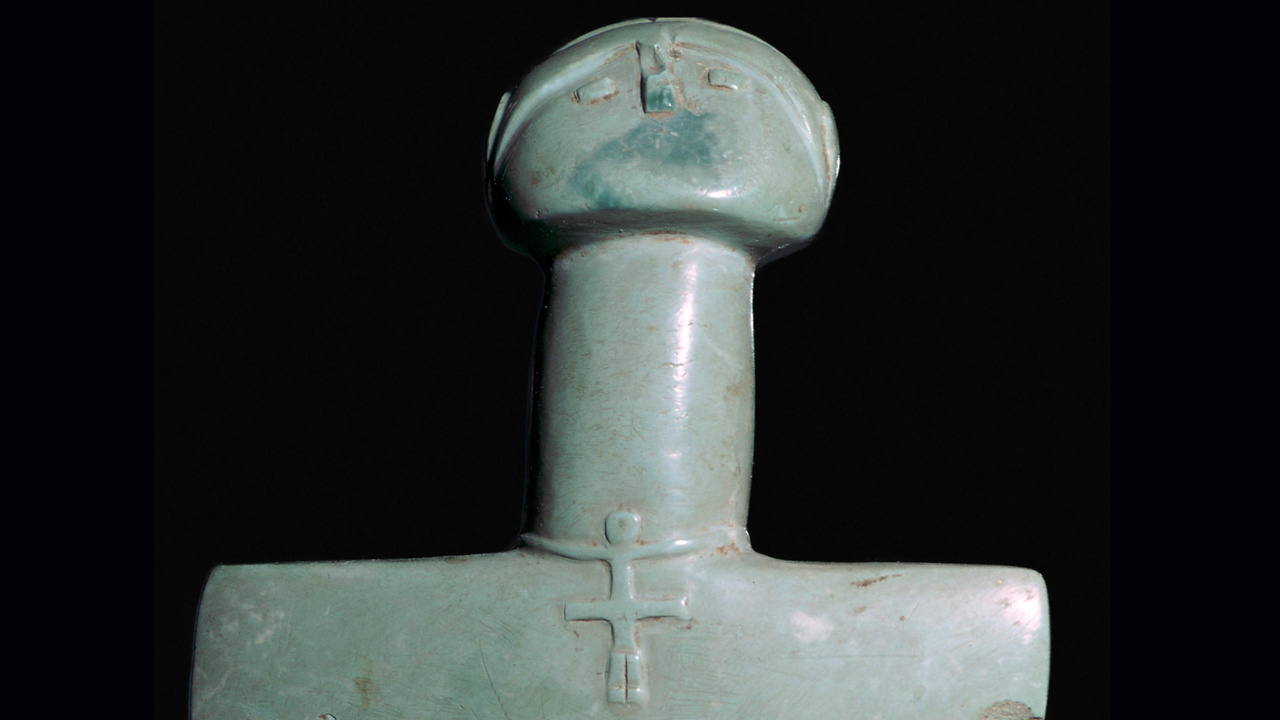
A tiny stone figurine, barely larger than a hand, has carried the weight of 5,000 years of history — and it wears a miniature version of itself around its own neck. That detail alone makes the Idol of Pomos one of the most quietly astonishing objects to survive from the ancient world.
Carved from local greenish stone on the island of Cyprus around 3000 B.C., this cross-shaped figurine was unearthed in the early 1930s during an archaeological excavation in the coastal village of Pomos. Since its discovery, it has grown into a symbol of Cypriot identity — and a window into a world that existed long before written history.
The figurine is considered the best-preserved example of a Copper Age fertility figurine from Cyprus, and its unusual design — a figure adorned with what appears to be a miniature of itself — has fascinated archaeologists and historians for nearly a century.
Who Found the Idol of Pomos and Where
The discovery came during excavations led by archaeologist Porphyrios Dikaios in the village of Pomos, located on the northern coast of Cyprus. Dikaios came across the figurine in the early 1930s, and what he found was remarkably intact for an object of such age.
The carving dates to approximately 3000 B.C., placing it squarely in the Copper Age — a period also known as the Chalcolithic era, when human societies in the eastern Mediterranean were beginning to experiment with metalworking while still relying heavily on stone tools and agrarian ritual practices.
Cyprus, positioned at the crossroads of Europe, Asia, and Africa, was already a place of cultural significance during this period. Fertility figurines were common across the ancient world, but the Idol of Pomos stands out for both its craftsmanship and its state of preservation.
What Makes the Idol of Pomos So Unusual
Most ancient fertility figurines are notable for their form — typically emphasizing features associated with fertility and the female body. The Idol of Pomos does that too, but it goes a step further with a detail that researchers find deeply intriguing: the figurine appears to wear a necklace bearing a tiny version of itself.
That kind of self-referential imagery — a figure adorned with its own miniature likeness — is rare in prehistoric art. It raises questions that archaeologists are still working through. Was this a deliberate artistic choice? A religious statement about cycles of life and rebirth? A mark of identity or status?
The cross-shaped design of the body itself is also significant. Cross-shaped or cruciform figurines appear across Chalcolithic Cyprus and are thought to be connected to fertility rituals and beliefs about human reproduction and the continuation of life. The greenish stone used to carve the idol is local to Cyprus, suggesting it was made on the island rather than imported.
Key Facts About the Idol of Pomos
| Detail | Information |
|---|---|
| Name | Idol of Pomos |
| Object Type | Carved figurine |
| Origin | Pomos, Cyprus (northern coast) |
| Date Created | Circa 3000 B.C. |
| Material | Local greenish stone |
| Historical Period | Copper Age (Chalcolithic) |
| Discovered By | Archaeologist Porphyrios Dikaios |
| Discovered | Early 1930s |
| Classification | Fertility figurine |
| Significance | Best-preserved Copper Age fertility figurine from Cyprus |
- The figurine has a distinctive cross-shaped (cruciform) body, consistent with other Chalcolithic Cypriot figurines
- It features what appears to be a miniature version of itself worn as a necklace — a rare detail in prehistoric art
- It was carved from greenish stone local to Cyprus, indicating it was crafted on the island
- It is considered the best-preserved example of its type from the Copper Age in Cyprus
- The idol has become a national symbol of Cyprus since its discovery
Why This 5,000-Year-Old Object Still Matters
Fertility figurines from the ancient world are not unusual finds — they appear across prehistoric Europe, the Middle East, and beyond. What makes the Idol of Pomos remarkable is the combination of its preservation, its artistic complexity, and what it tells us about the people who made it.
The Copper Age inhabitants of Cyprus were not leaving written records. Their beliefs, their social structures, and their understanding of life and death are largely reconstructed through objects like this one. A figurine that wears a smaller version of itself is communicating something — archaeologists broadly interpret this kind of imagery as connected to fertility, regeneration, or the transmission of life across generations.
The fact that it has become a symbol of Cyprus as a whole speaks to something beyond academic interest. There is an emotional resonance to an object this old that still looks deliberate, intentional, and carefully made. Someone in 3000 B.C. sat down and carved not just a figure, but a figure wearing itself — and that image has outlasted everything else about them.
Where the Idol Stands Today
The Idol of Pomos is recognized as one of the most significant archaeological artifacts associated with Cyprus. Its discovery by Porphyrios Dikaios in the early 1930s brought it to scholarly attention, and in the decades since, it has taken on a broader cultural role as an emblem of the island’s deep and layered history.
For researchers studying Chalcolithic Cyprus, the figurine remains a key reference point — not just for what it is, but for the questions it continues to raise about ritual, identity, and artistic expression in a world that existed thousands of years before the written word.
Objects like the Idol of Pomos are reminders that the human impulse to make meaning — to create images, to adorn them, to imbue them with significance — is not a modern invention. It is, apparently, at least 5,000 years old.
Frequently Asked Questions
What is the Idol of Pomos?
The Idol of Pomos is a cross-shaped figurine carved from local greenish stone, discovered in the village of Pomos on the northern coast of Cyprus. It dates to approximately 3000 B.C. and is considered the best-preserved Copper Age fertility figurine from Cyprus.
Who discovered the Idol of Pomos?
The figurine was discovered by archaeologist Porphyrios Dikaios during excavations in the early 1930s in the village of Pomos, Cyprus.
What makes the Idol of Pomos unusual compared to other ancient figurines?
The figurine appears to wear a necklace bearing a miniature version of itself — a rare and striking detail that sets it apart from most other prehistoric fertility figurines.
How old is the Idol of Pomos?
The figurine dates to circa 3000 B.C., making it approximately 5,000 years old and placing it in the Copper Age, also known as the Chalcolithic period.
What was the Idol of Pomos used for?
Based on its classification as a fertility figurine and the broader context of similar Chalcolithic Cypriot objects, it is generally associated with fertility rituals and beliefs about life and regeneration, though the exact use has not been definitively confirmed.
Where is the Idol of Pomos now?




Leave a Reply