
In California’s orchards, farmers are being asked to pull off something close to impossible: grow the same crops with significantly less water, even as drought tightens its grip and summer temperatures keep climbing. The pressure is relentless. But here’s the part that doesn’t get talked about enough — one of the biggest water problems in agriculture isn’t always too little irrigation. Sometimes, it’s watering the wrong trees too much.
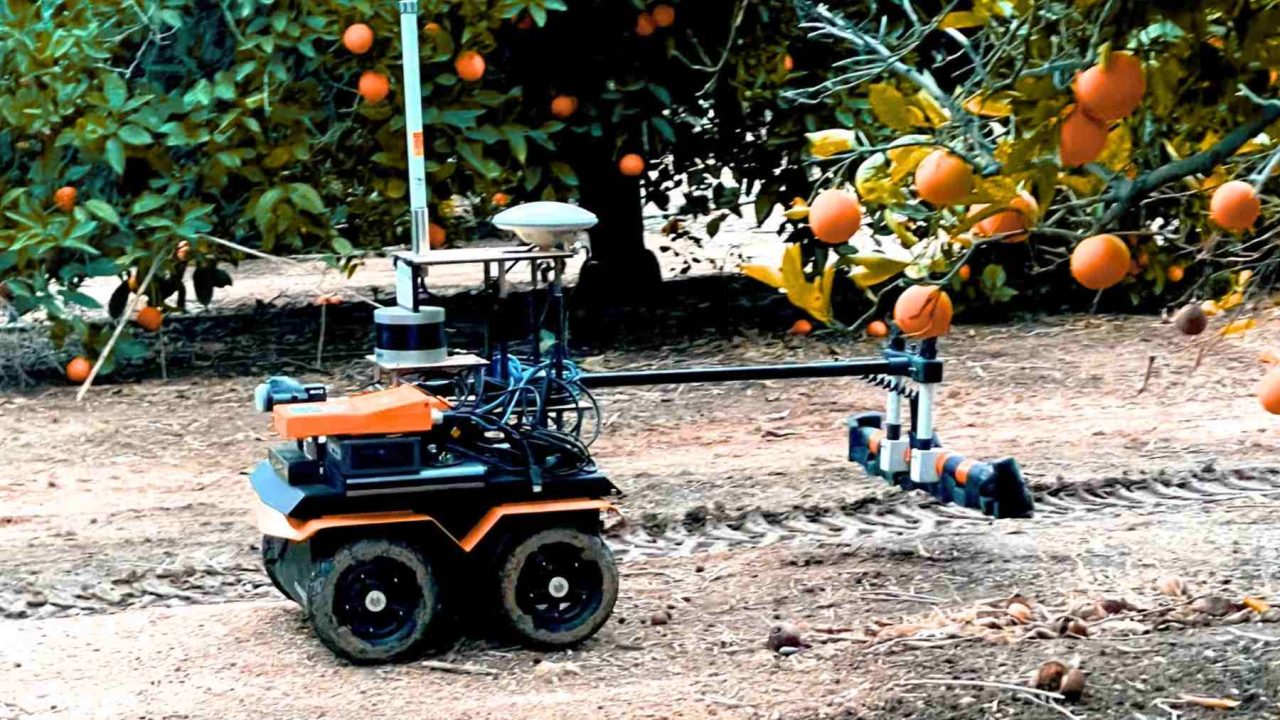
Researchers at the University of California, Riverside believe they’ve found a smarter path forward. Their new system uses a small ground-based robot to map soil moisture across an entire orchard, tree by tree, so farmers can target their irrigation precisely instead of applying the same amount of water everywhere and hoping for the best.
It sounds straightforward. But the science behind it — and the problem it’s solving — is more layered than it first appears.
Why Orchards Are Wasting Water Even When Farmers Are Being Careful
Stand in the middle of an orchard and everything might look uniform — neat rows, similar-sized trees, the same irrigation lines running beneath your feet. But the soil underneath tells a completely different story.
Soil composition varies significantly even across short distances. Fine, tightly packed soils hold water for longer periods. Sandy soils drain quickly. That means two trees standing just a few feet apart can be living in entirely different root zone conditions, even when they receive the exact same amount of irrigation water from the same sprinkler system.
That mismatch creates a real problem for growers. Without detailed, location-specific data, farmers are essentially guessing. And when you’re managing hundreds or thousands of trees, guessing is expensive — both in water wasted and in crop quality lost.
The traditional approach has been to bury a small number of moisture sensors across a field and use those readings to make decisions for the whole orchard. But as Elia Scudiero, a UC Riverside associate professor who led the project, put it directly:
“The information those sensors provide is very limited.”
A handful of sensors spread across a large orchard simply can’t capture the full range of conditions underground. The result is that irrigation decisions get averaged across the whole field — which means some trees get too much water while others may not get enough.
How the Robot Irrigation System Actually Works
The UC Riverside system takes a fundamentally different approach. Instead of relying on fixed sensors at a few static points, a small ground robot travels through the orchard and continuously maps soil moisture conditions across the entire area.
The key advantage is resolution. Rather than averaging conditions across a large zone, the robot builds a detailed picture of what’s happening at each individual tree. That data can then be used to direct irrigation only where it’s actually needed — and hold back water where the soil is already adequately moist.
This kind of precision matters enormously in a state where water is increasingly scarce and expensive. Overwatering doesn’t just waste a resource — it can also harm tree health, leach nutrients out of the root zone, and contribute to runoff that carries agricultural chemicals into waterways.
| Traditional Irrigation Approach | Robot-Assisted Precision Irrigation |
|---|---|
| Relies on a small number of buried sensors | Maps soil moisture tree by tree across the whole orchard |
| Data is limited and spatially sparse | Provides detailed, location-specific readings |
| Water applied uniformly across field zones | Water targeted only where soil conditions require it |
| High risk of overwatering in some areas | Reduces waste by identifying already-moist zones |
| Guesswork drives many irrigation decisions | Decisions grounded in real-time ground-level data |
The Quiet Cost of Overwatering Nobody Talks About
Most conversations about agricultural water use focus on drought stress — trees not getting enough water. And that’s a real concern. But the UC Riverside research highlights a problem that gets far less attention: overwatering in the wrong places is just as damaging to both resources and yields.
When irrigation is applied uniformly across a field with uneven soil types, the areas with fine, water-retaining soil end up receiving more moisture than their root zones can use. That excess water doesn’t help the trees — it sits, drains, or evaporates. Meanwhile, the grower has paid for it, pumped it, and in many cases treated it.
For California farmers operating under tightening water restrictions and rising utility costs, every gallon of over-applied irrigation represents a real financial loss on top of an environmental one.
The robot-based mapping system directly addresses this by giving growers the granular data they need to stop making blanket decisions about a field that is anything but uniform underneath the surface.
What This Means for Farmers Facing Water Restrictions
California agriculture operates under some of the most demanding water management pressures in the country. Growers are regularly asked to reduce consumption while maintaining production — a tension that has no easy resolution under conventional irrigation methods.
Tools like the UC Riverside robot system represent a shift in how that challenge can be approached. Rather than simply using less water across the board — which risks stressing crops in areas that genuinely need irrigation — precision mapping allows farmers to redistribute the same or smaller total water budget more effectively.
The trees that need water get it. The ones that don’t, won’t have it wasted on them. That targeted approach could allow growers to maintain crop health and yield quality even as overall water allocations shrink.
The research comes out of UC Riverside, one of the University of California campuses with a strong focus on agricultural science relevant to the state’s farming communities. Associate Professor Elia Scudiero led the project, and the team’s work reflects a broader push across California’s agricultural research community to develop practical, deployable solutions — not just theoretical models.
Where This Technology Goes From Here
What is confirmed is that the research has been developed at UC Riverside and is centered on real-world orchard conditions in California.
The broader trajectory for this kind of precision agriculture technology points toward increasing adoption as water costs rise and regulatory pressure intensifies. Ground-based robotic mapping systems that can operate autonomously between tree rows represent a logical next step beyond static sensor networks — and the UC Riverside work adds credible research backing to that direction.
For California’s farming communities, the question is no longer whether precision irrigation matters. It’s how quickly tools capable of delivering it can move from research fields into commercial orchards.
Frequently Asked Questions
Who developed this robot irrigation mapping system?
The system was developed by researchers at the University of California, Riverside, led by Associate Professor Elia Scudiero.
What does the robot actually do in the orchard?
The ground-based robot travels through the orchard and maps soil moisture conditions tree by tree, providing far more detailed data than traditional buried sensors can offer.
Why can’t farmers just use more buried sensors instead?
According to the UC Riverside research team, the information provided by conventional buried sensors is very limited — a small number of sensors cannot capture the full range of soil variation across a large orchard.
Does this system help with drought stress or overwatering?
It addresses both. By identifying exactly where soil moisture is low and where it is already adequate, the system helps farmers avoid both under-irrigating stressed trees and over-irrigating areas that don’t need water.
Is this technology currently available for California farmers to buy?
This has not yet been confirmed in the available source material. The research originates from UC Riverside, but no commercial availability or rollout timeline has been specified.
Why does soil variation matter so much in an orchard?
Fine soils retain water longer while sandy soils drain quickly, meaning two neighboring trees can experience completely different root zone conditions even when they receive identical amounts of irrigation water.
Leave a Reply