
Manuscripts that survived wars, reformations, and centuries of neglect are about to go on display in one of the most commercially charged art environments in the world. When EXPO Chicago opens in 2026, visitors will find themselves face to face with illuminated pages created more than 500 years ago — and the gallery behind the display argues that medieval art is more relevant to today’s collectors than many people assume.
Les Enluminures, a gallery specializing in medieval and Renaissance manuscripts, will present an exhibition titled Past Is Present: Collecting Medieval Art Today. The show is built around a simple but compelling premise: that the art of the medieval book — its miniature paintings, its gilded initials, its devotional imagery — continues to draw serious attention from modern collectors and audiences.
The selection on display offers a concentrated look at what that art actually looks like up close. Each manuscript in the exhibition represents a different corner of late medieval European culture, from a Flemish abbey to the workshops of Florence and Lombardy.
What the Exhibition Is Actually Showing
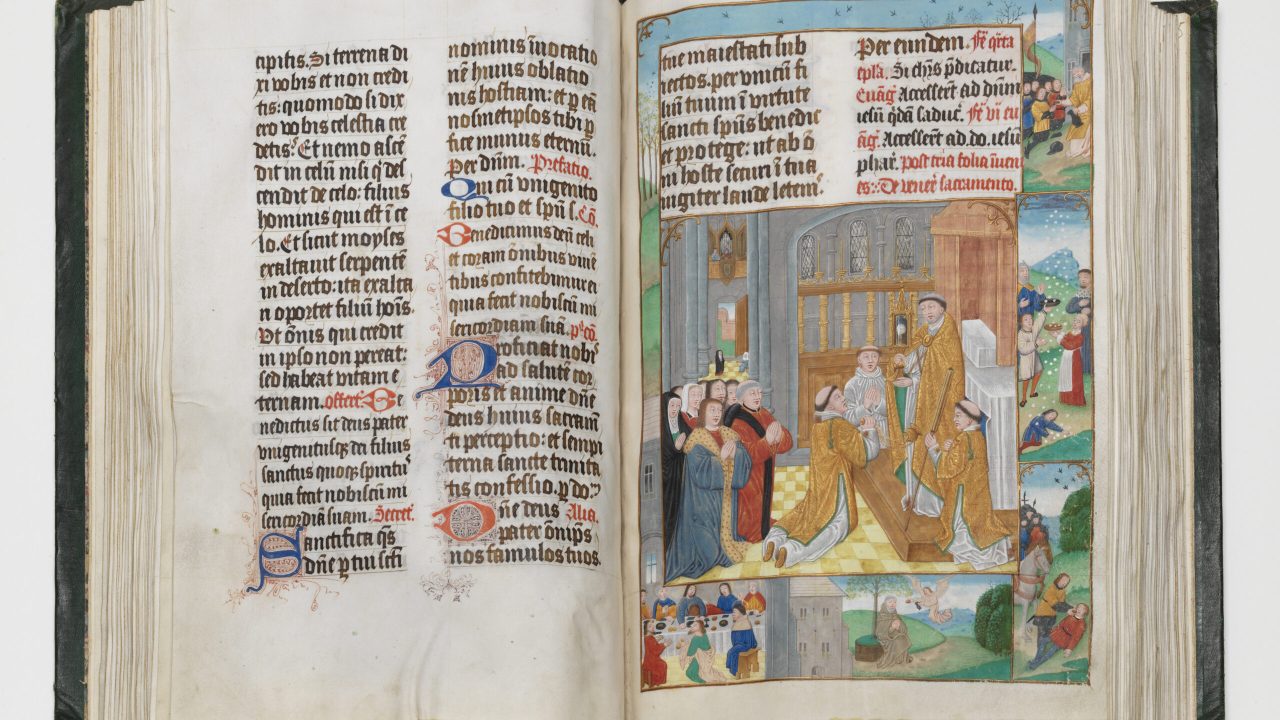
Three manuscripts anchor the display, and each one has its own story. The most historically grounded of the group is the Missal of St. Adrian’s Abbey in Geraardsbergen, a liturgical book produced in the early sixteenth century for Abbot Jan van Broedere. The missal was likely made for use at the altar of the abbey’s Lady Chapel.
One of its miniatures is particularly striking from a historical documentation standpoint: it shows the abbot himself, alongside the presumed patron Daniel van Boeckhout, kneeling during the Veneration of the Host. It is the kind of image that collapses the distance between a modern viewer and a specific moment in early sixteenth-century Flemish monastic life.
The second work comes from northern Italy. An Ascension of Christ miniature, cut from a choir book, is attributed to a follower of the Master of the Vitae Imperatorum and dated to around 1450 in Lombardy. At 122 by 107 millimeters, it is a small object with an outsized visual presence — the kind of detached miniature that collectors have prized for generations.
The third is a Florentine Book of Hours, Use of Rome, dated to approximately 1460 to 1475. Written in Latin on vellum, it contains 19 historiated initials attributed to Francesco di Antonio del Chierico, a Florentine illuminator whose work is associated with the refined taste of the city’s humanist culture in the mid-fifteenth century.
A Closer Look at the Three Manuscripts on Display
| Manuscript | Origin | Date | Notable Feature |
|---|---|---|---|
| Missal of St. Adrian’s Abbey, Geraardsbergen | Flanders | Early 16th century | Miniature of Abbot Jan van Broedere and Daniel van Boeckhout kneeling at the Veneration of the Host |
| Ascension of Christ, from a Choir Book | Lombardy, Italy | c. 1450 | Attributed to a follower of the Master of the Vitae Imperatorum; 122 × 107 mm |
| Book of Hours, Use of Rome | Florence, Italy | c. 1460–1475 | 19 historiated initials by Francesco di Antonio del Chierico; written in Latin on vellum |
Why Medieval Manuscripts Keep Drawing Collectors
Books of Hours were the devotional texts of the late medieval period — Les Enluminures describes them as the era’s bestsellers. They were personal objects, made to be held and used daily, and the best examples were decorated with extraordinary care. The Florentine Book of Hours in this exhibition, with its 19 historiated initials, represents exactly the kind of intimate, high-craft object that the manuscript market has long centered on.
What makes illuminated manuscripts unusual as collectibles is the combination of historical weight and physical intimacy. These are not monumental objects. They were made to fit in a person’s hands, to be read by candlelight, to travel with their owners. A miniature like the Lombardy Ascension of Christ measures just over four inches across. The detail packed into that space — figures, drapery, gold leaf, architectural framing — is the result of techniques developed and refined over centuries.
The title of the Les Enluminures exhibition, Past Is Present, speaks directly to this dynamic. The argument is not that medieval art is a curiosity or a historical artifact to be observed from a distance. It is that these objects remain genuinely compelling to look at, and that the market for them continues to attract serious buyers.
What EXPO Chicago Means for This Kind of Art
EXPO Chicago is one of the major international art fairs held in the United States, drawing galleries, collectors, and institutions from across the country and abroad. Bringing medieval manuscripts into that environment is a deliberate choice — it places works that are often seen only in museum vitrines or academic catalogues into direct conversation with contemporary art collecting.
For attendees who have never encountered an illuminated manuscript up close, the exhibition offers something rare: the chance to see objects of this age and quality outside of a strictly institutional setting. For collectors already active in the manuscript market, it represents another opportunity to engage with a gallery that has long specialized in this area.
The physical scale of the works matters here. None of these manuscripts are large. The choir book miniature from Lombardy fits in a hand. The Book of Hours, by definition, was designed for private use. Seeing them at an art fair, where the viewing conditions are more informal than a museum, may actually suit them better than a formal gallery context.
What to Expect When the Fair Opens
EXPO Chicago 2026 will feature Les Enluminures presenting the Past Is Present exhibition alongside the broader programming of the fair. The three manuscripts confirmed for display — the Geraardsbergen Missal, the Lombard choir book miniature, and the Florentine Book of Hours — represent distinct geographic and functional traditions within medieval manuscript production.
Whether additional works will be included in the exhibition beyond these three has not been confirmed in available information. Ticket and attendance details for EXPO Chicago 2026 have not been specified in
Frequently Asked Questions
What is the exhibition at EXPO Chicago 2026 called?
The exhibition is titled Past Is Present: Collecting Medieval Art Today, presented by Les Enluminures.
Which manuscripts are confirmed for display?
Three works are confirmed: the Missal of St. Adrian’s Abbey in Geraardsbergen, an Ascension of Christ miniature from a Lombardy choir book, and a Florentine Book of Hours, Use of Rome.
Who created the illuminations in the Florentine Book of Hours?
The 19 historiated initials in the Book of Hours are attributed to Francesco di Antonio del Chierico, a Florentine illuminator active in the mid-fifteenth century.
When was the Lombard choir book miniature made?
It is dated to approximately 1450 and attributed to a follower of the Master of the Vitae Imperatorum, working in Lombardy, Italy.
What is a historiated initial?
A historiated initial is a decorative letter at the start of a text that contains a small scene or figure — a common feature of illuminated manuscripts from the medieval period.
Are the manuscripts available for purchase at the fair?
This has not been confirmed in the available source material, though Les Enluminures is a commercial gallery that specializes in medieval manuscripts and works with collectors.


Leave a Reply