
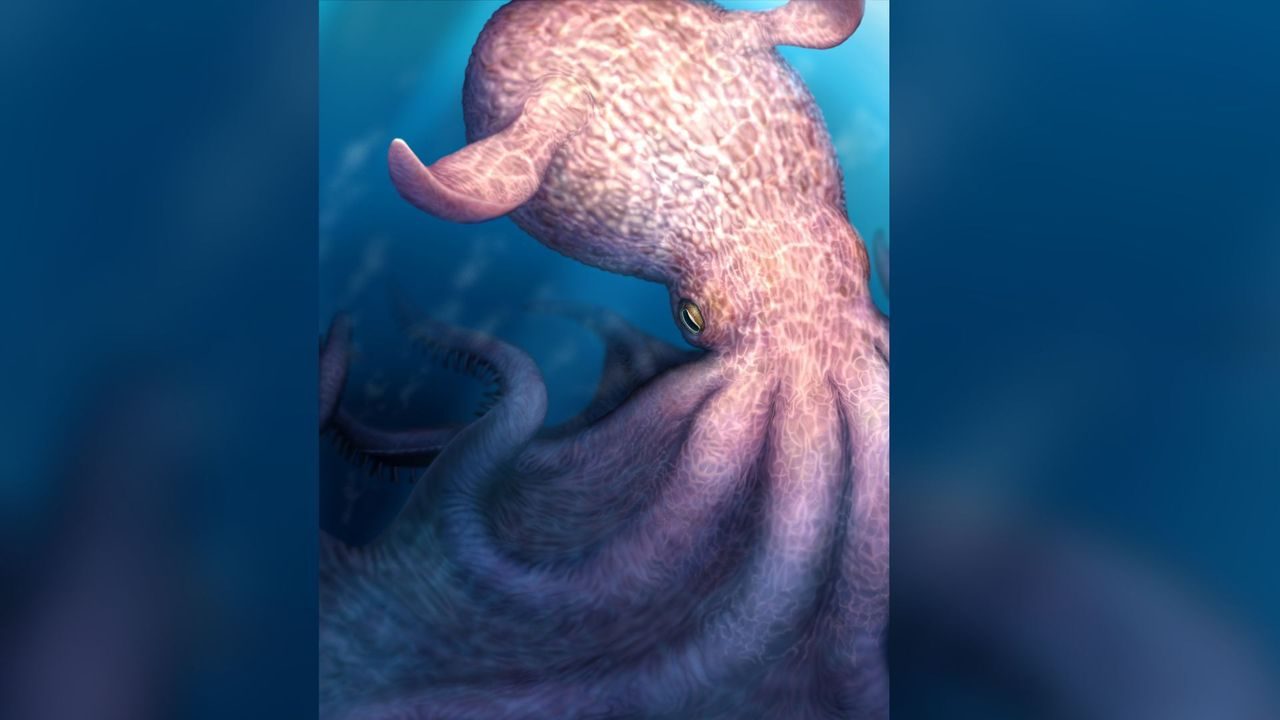
Sixty-two feet long. Nearly the length of two school buses end to end. That’s how large scientists believe a newly identified species of ancient octopus may have grown — making it a serious candidate for the largest invertebrate ever discovered.
Researchers have identified enormous finned “kraken” octopuses that prowled the world’s oceans during the Cretaceous period, the same era when dinosaurs ruled the land. The discovery is rewriting what scientists thought they knew about the early evolution of octopuses — and the sheer scale of life that once existed beneath the waves.
The findings also push back the oldest known octopus fossil record by approximately 5 million years, a significant leap that opens new questions about how these creatures evolved and how dominant they became.
What Scientists Actually Found — and Why It’s Remarkable
The key evidence came from fossil jaws. Researchers examined these ancient remains and found distinctive markings embedded in the bone — markings that tell a surprisingly detailed story about how these animals lived and hunted.
Those jaw markings suggest the kraken-like octopuses used powerful biting force to crush hard-shelled prey. That’s a critical detail. It means these weren’t passive drifters in the ancient ocean. They were active, capable predators equipped to take on armored animals.
Combined with their estimated size — up to 62 feet, or 19 meters — the picture that emerges is of a true apex predator. Something that sat at the very top of the marine food chain during the Cretaceous, competing for dominance in an ocean already filled with enormous and dangerous creatures.
The creatures are described as finned octopuses, which distinguishes them from the more familiar bottom-dwelling octopuses most people picture today. Fins would have made them more capable swimmers — better suited to open-water hunting at scale.
The Kraken Octopus in Context: Size, Era, and Significance
To understand why this discovery matters, it helps to place it in perspective. The Cretaceous period lasted roughly from 145 million to 66 million years ago. It ended with the mass extinction event that wiped out non-avian dinosaurs. These kraken octopuses were alive somewhere within that vast window of time.
| Feature | Detail |
|---|---|
| Estimated maximum length | 62 feet (19 meters) |
| Time period | Cretaceous (era of the dinosaurs) |
| Key fossil evidence | Fossil jaws with distinctive markings |
| Feeding behavior indicated | Crushing hard-shelled prey |
| Physical characteristic | Finned body type |
| Record pushed back by | Approximately 5 million years |
| Potential distinction | Largest invertebrate ever discovered |
The 5-million-year extension of the octopus fossil record is significant on its own. Fossil preservation for soft-bodied animals like octopuses is notoriously difficult — their bodies decay quickly and leave little trace. The fact that these jaw fossils survived at all, and in enough detail to reveal feeding behavior, is itself a scientific achievement.
An Apex Predator in an Age of Giants
The Cretaceous ocean was not a quiet place. It was home to massive marine reptiles — mosasaurs, plesiosaurs, and others — that competed fiercely for food. For a creature to be classified as an apex predator in that environment says something extraordinary about its capabilities.
A 62-foot octopus with jaws strong enough to crack shells would have been a formidable presence. Researchers suggest these animals may have been among the largest invertebrates ever to exist on Earth — a title that, if confirmed through further study, would cement their place as one of the most remarkable animals in the planet’s history.
The finned body shape is also worth noting. Modern finned octopuses — sometimes called “Dumbo octopuses” due to their ear-like fins — tend to live in deep water and are relatively small. The ancient kraken appears to have been a dramatically scaled-up version of that body plan, adapted for a very different kind of existence.
What This Means for Our Understanding of Octopus Evolution
Before this discovery, the octopus fossil record had a different starting point. Pushing that record back by 5 million years means scientists now have to reconsider timelines for when octopuses first evolved, how quickly they diversified, and how large they were capable of growing in the right environmental conditions.
It also raises a broader question that researchers will likely be exploring for years: if octopuses reached this scale during the Cretaceous, what drove them to become the comparatively smaller animals we see today? The mass extinction at the end of the Cretaceous reshaped life across the planet — in the oceans just as dramatically as on land.
The image credit associated with the research points to Hokkaido University’s Department of Earth and Planetary Sciences, suggesting this work comes out of serious institutional paleontological research. The illustration released alongside the findings offers a visual sense of just how massive these creatures were — and how alien the ancient ocean would look to modern eyes.
What Researchers Will Be Looking for Next
Fossil jaws are a starting point, not an endpoint. The distinctive markings that revealed feeding behavior are valuable, but a more complete picture of this animal will require additional fossil evidence — ideally remains that can confirm body size estimates more precisely and shed light on other aspects of the animal’s biology and behavior.
The claim that these may be the largest invertebrates ever discovered is significant enough that it will attract scrutiny. Scientists will want to verify size estimates, examine whether the jaw markings are consistent across multiple specimens, and determine more precisely where in the Cretaceous these animals lived and thrived.
For now, what the fossil record has handed researchers is something genuinely rare: evidence of a creature so large and so capable that it challenges assumptions about what invertebrate life was ever able to achieve.
Frequently Asked Questions
How long were the ancient kraken octopuses thought to be?
Scientists estimate these creatures may have reached up to 62 feet, or 19 meters, in length — roughly the size of two school buses placed end to end.
When did these giant octopuses live?
They lived during the Cretaceous period, the same era in which dinosaurs roamed the Earth.
What evidence did scientists use to identify them?
Researchers examined fossil jaws that contained distinctive markings, which indicated the animals used powerful biting force to crush hard-shelled prey.
How does this discovery change the octopus fossil record?
The findings push back the oldest known octopus fossils by approximately 5 million years, extending scientists’ understanding of when these animals first appeared.
Could these be the largest invertebrates ever to exist?
Researchers suggest they could be — but this remains a working hypothesis that will require further fossil evidence and scientific review to confirm definitively.
What made these octopuses different from modern ones?
Unlike most familiar octopuses today, these ancient creatures had fins, which would have made them more capable open-water swimmers, and they appear to have been dramatically larger than any octopus alive today.


Leave a Reply