
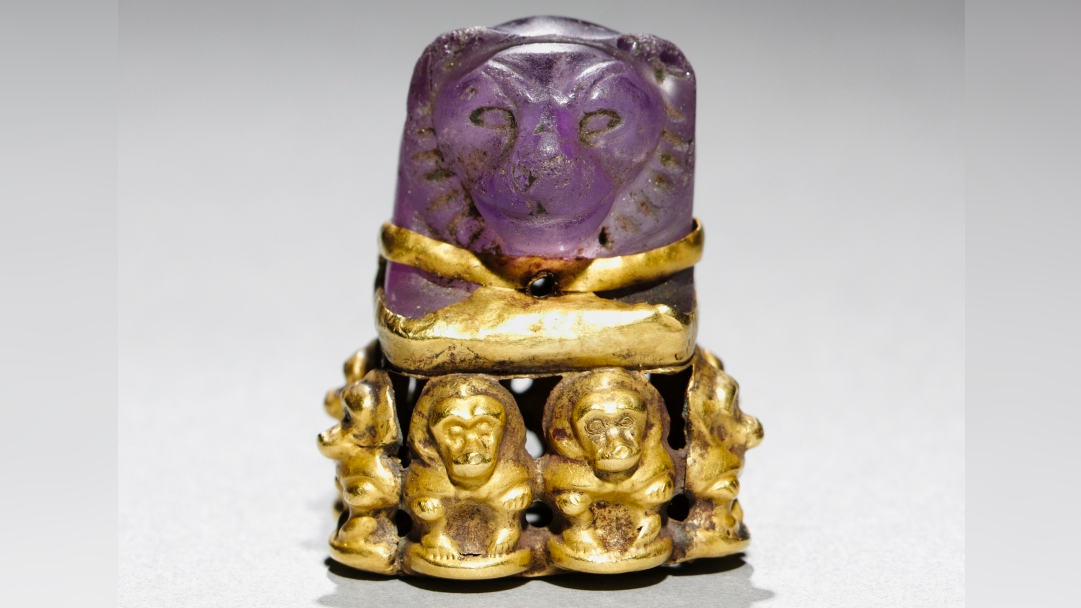
A small purple gemstone carved into a lion’s head sat quietly in a museum collection for decades before researchers pieced together its remarkable double life — first as an ancient Egyptian board game piece, then as a sacred religious object in Sudan, centuries later.
The artifact, now held at the Cleveland Museum of Art, tells a story that spans more than three millennia and crosses two civilizations. It is one of those rare objects that was never discarded — only transformed, reused, and given new meaning by people who recognized something powerful in it.
The museum acquired the pendant in 1987, and what makes it so unusual is not just its age, but the fact that its two main components were made roughly 800 years apart, by different cultures, for entirely different purposes.
A Board Game Piece That Became a Sacred Object
The lion’s head itself is carved from amethyst, a purple gemstone, and dates back to ancient Egypt’s New Kingdom period — roughly 3,500 years ago. At that time, it was likely used as a playing piece in senet, one of ancient Egypt’s most popular board games.
Senet was played on a board with 30 squares, and players moved their pawns across it in a race-style format. The lion shape was a recognized style for game pieces of that era, and the amethyst carving fits that tradition closely.
Then, approximately 2,700 years ago — around 800 years after the gemstone was first carved — an artisan in Sudan took the old Egyptian piece and did something entirely new with it. They mounted the lion’s head into a gold base decorated with eight seated baboons, transforming what had been a game token into a pendant with clear magical and religious significance.
The result was something that no longer looked like a toy. It looked like an amulet — an object meant to carry spiritual power.
What the Pendant Actually Looks Like
The finished object is small but striking. According to the Cleveland Museum of Art, the pendant measures approximately 1.4 inches (3.5 centimeters) tall. A hole pierced just beneath the lion’s chin allowed it to be suspended on a string and worn.
The combination of materials is unusual. Purple amethyst set into gold, with baboon figures ringing the base, would have created a visually arresting piece — one that signaled both wealth and religious intention to anyone who saw it.
| Detail | Information |
|---|---|
| Object name | Lion’s head pendant |
| Materials | Amethyst (lion’s head) and gold (base) |
| Height | Approximately 1.4 inches (3.5 cm) |
| Origin of gemstone | Ancient Egypt (New Kingdom, circa 1069–715 B.C.) |
| Origin of gold mount | Sudan, circa 2,700 years ago |
| Base decoration | Eight seated baboons |
| Current location | Cleveland Museum of Art |
| Year acquired | 1987 |
Why Baboons and Lions Together?
The pairing of a lion with baboon imagery was not accidental. Both animals carried deep symbolic weight in ancient Egyptian and Sudanese religious traditions. Lions were associated with power, protection, and royalty. Baboons, meanwhile, were closely linked to the god Thoth — a deity connected to wisdom, magic, and the moon — and were also associated with the sun god Ra, particularly at dawn.
Placing eight baboons around the base of a lion’s head pendant would have carried layered meaning for the person who wore it. The object was not decorative in a casual sense — it was intended to carry protective or magical force.
The fact that the artisan chose an older, Egyptian-made gemstone rather than carving a new one suggests the lion’s head itself may have been considered especially potent. Ancient peoples often attributed sacred significance to old objects, particularly those from other cultures or distant places. The age of the stone may have been part of its appeal.
The Civilization Behind the Gold Work
The gold mount was crafted in Sudan during a period that historians associate with the Kingdom of Kush — a powerful civilization that existed in what is now Sudan and was deeply influenced by, and at times in direct competition with, ancient Egypt. The date range given for the pendant, circa 1069 to 715 B.C., corresponds to the Third Intermediate Period of Egypt, when Kushite influence in the region was growing considerably.
Kushite artisans were highly skilled goldsmiths, and their work frequently blended Egyptian iconography with local religious traditions. This pendant is a near-perfect example of that synthesis — an Egyptian gemstone, reshaped by Sudanese hands, into something that served a Sudanese spiritual purpose.
It also reflects how ancient objects moved across cultures. The amethyst lion’s head traveled — whether through trade, tribute, conquest, or gift — from Egypt to Sudan, where it was given a second life entirely.
What This Object Tells Us About the Ancient World
Artifacts like this one are rare precisely because they preserve evidence of cultural exchange that written records often miss. The pendant does not just show craftsmanship — it shows that people 2,700 years ago were thinking carefully about old objects, assigning them meaning, and integrating them into new belief systems.
The Cleveland Museum of Art acquired the pendant through the J. H. Wade Fund, and it remains part of the museum’s collection as both an archaeological curiosity and a testament to the layered history of the ancient Nile Valley.
For anyone who has ever wondered how ancient people understood the past — whether they valued old things the way we do, or saw history as something alive and useful — this small purple lion offers a quietly compelling answer.
Frequently Asked Questions
What is the lion’s head pendant made of?
The pendant consists of a lion’s head carved from amethyst set into a gold base decorated with eight seated baboons.
How old is the pendant?
The amethyst lion’s head dates to ancient Egypt’s New Kingdom period, approximately 3,500 years ago, while the gold mount was added around 2,700 years ago in Sudan.
What was the lion’s head originally used for?
The lion’s head is believed to have originally been a playing piece in senet, an ancient Egyptian board game played on a 30-square board.
Where is the pendant now?
The pendant is held at the Cleveland Museum of Art, which acquired it in 1987 through the J. H. Wade Fund.
Why were baboons included in the design?
Baboons held significant religious symbolism in ancient Egyptian and Sudanese traditions, associated with gods including Thoth and Ra, making them a fitting choice for a magical or protective religious object.
Where was the gold mount made?
The gold base was crafted in Sudan, likely during the period of the Kingdom of Kush, which dates the finished pendant to roughly 1069 to 715 B.C.



Leave a Reply