
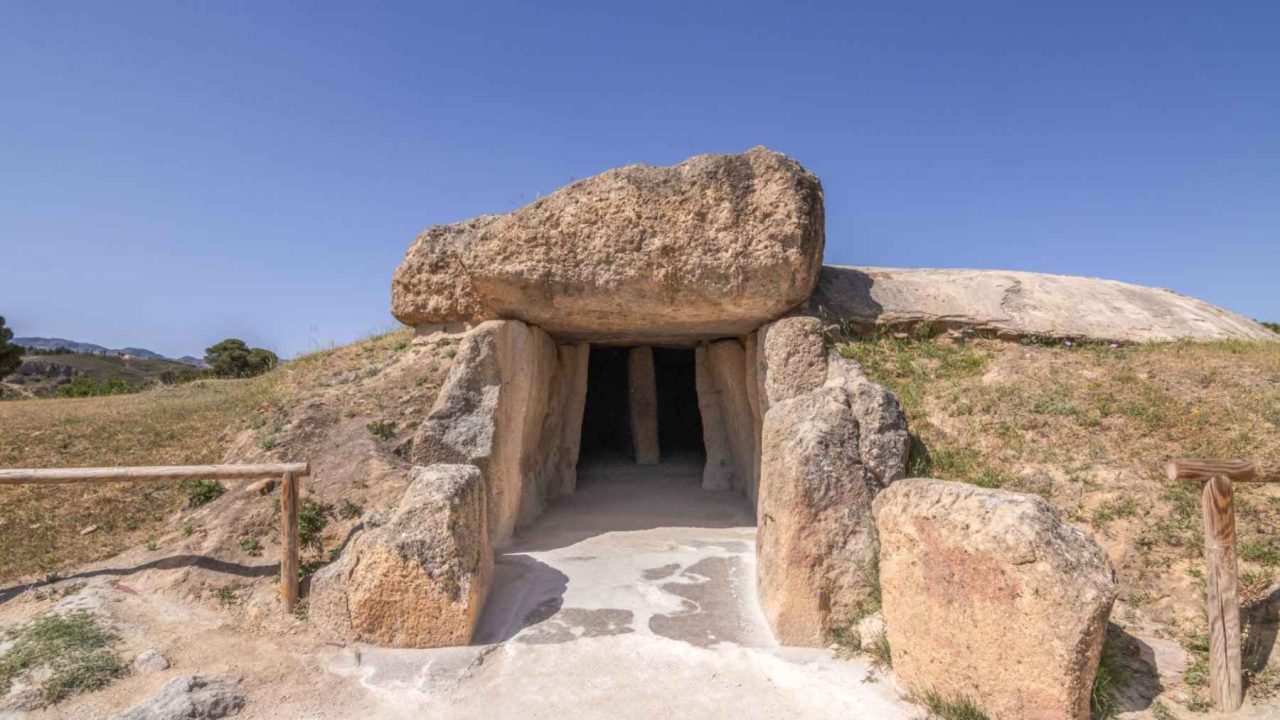
A massive Stone Age tomb in southern Spain — one so large that some of its capstones weigh around 165 tons — has yielded one of the more unexpected archaeological surprises in recent memory. Hidden near the entrance of a monument built more than 5,000 years ago, two medieval men were buried in a place that had no obvious reason to still matter to anyone living a thousand years ago. Now, ancient DNA is finally explaining who those men were, and the answer raises fascinating questions about memory, migration, and the long life of sacred places.
The discovery centers on the Dolmen of Menga, part of the UNESCO World Heritage landscape of Antequera in southern Spain. Archaeologists found the two adult male burials in 2005 while excavating the entrance area of the dolmen. What made the find puzzling wasn’t just the medieval dating — it was the location. Why would medieval people choose a prehistoric monument as a burial site? And who, exactly, were they?
Ancient DNA has now provided some answers, and they point to a Mediterranean world far more interconnected than many people assume when they think about life a millennium ago.
What the Dolmen of Menga Actually Is
Menga is not a modest structure. Researchers describe it as a huge passage grave approximately 82 feet long and roughly 20 feet wide, constructed from enormous upright stones and capstones. It sits within the Antequera Dolmens Site, a UNESCO World Heritage landscape where prehistoric architecture and the natural environment are considered inseparable.
Monuments like Menga were built during the Neolithic and Copper Age as collective burial chambers, often serving communities over generations. But what makes Menga unusual in this case is not just its age or scale — it’s the fact that it continued to hold meaning for people living thousands of years after its original construction.
The medieval burials found at the entrance suggest that whoever placed those men there understood the site as significant. Whether that significance was spiritual, territorial, or cultural is something researchers are still working to understand.
What the DNA Actually Revealed
The genetic data extracted from the two medieval men paint a striking picture of ancestry. Rather than reflecting a purely local Iberian population, the results point to a mix of European, North African, and Near Eastern ancestry. That combination, researchers note, underscores how connected the Mediterranean world already was roughly a thousand years ago.
Southern Spain during the medieval period was a crossroads. The Iberian Peninsula had experienced centuries of Roman rule, Visigothic settlement, and then the arrival of North African and Near Eastern populations following the Islamic expansion into the region beginning in the early 8th century. A person buried in medieval Andalusia carrying ancestry from multiple Mediterranean regions would not have been unusual in that historical context — but confirming it through ancient DNA adds a concrete genetic dimension to what historians have long described in broader terms.
The fact that these men were buried at the entrance of a Stone Age dolmen, rather than in a Christian churchyard or a more conventional medieval burial ground, adds another layer of intrigue. It suggests the site retained a cultural or sacred resonance that transcended the gap of millennia.
Key Facts at a Glance
| Detail | Information |
|---|---|
| Site name | Dolmen of Menga, Antequera, southern Spain |
| Monument age | Built more than 5,000 years ago |
| Monument dimensions | Approximately 82 feet long, roughly 20 feet wide |
| Largest stones | Capstones weighing approximately 165 tons |
| Medieval burials discovered | Two adult males, found in 2005 at the entrance |
| DNA ancestry findings | Mix of European, North African, and Near Eastern ancestry |
| UNESCO designation | Part of the Antequera Dolmens Site World Heritage landscape |
- The site is described as a UNESCO World Heritage landscape where architecture and nature are tightly intertwined
- The burials were located specifically at the entrance of the dolmen, not inside the main chamber
- The genetic mix reflects the broader Mediterranean connectivity of the medieval period
- The discovery challenges the assumption that a site’s oldest layer tells its whole story
Why This Finding Matters Beyond One Tomb
For archaeologists and historians, this case is a reminder that ancient monuments rarely have a single chapter. A dolmen built in the Stone Age did not simply become irrelevant when the people who built it were gone. Across Europe and beyond, prehistoric sites were reused, reinterpreted, and re-inhabited by later cultures who brought their own meanings to places they may not have fully understood.
The DNA results add a layer of human specificity to that broader pattern. These were not abstract “medieval people” — they were individuals whose genetic ancestry reflected real patterns of movement, trade, and settlement across the medieval Mediterranean. Their presence at Menga connects the deep past to a medieval world that was already, in its own way, remarkably diverse.
Researchers also note that the story carries implications for how we protect cultural landscapes. The Antequera site is described as a place where nature and human history are intertwined, and as climate pressures mount on heritage sites worldwide, understanding the full depth of a site’s human history — not just its oldest layer — becomes increasingly relevant to conservation arguments.
What Researchers Are Still Working to Understand
The DNA findings answer the question of who the men were in genetic terms, but deeper questions remain. Why specifically the entrance of Menga? Was this a deliberate act of association with an ancient, powerful place? Was the dolmen still visible and recognizable as a monument, or had it become something else in the medieval imagination — a hill, a ruin, a landmark?
Those questions will likely require a combination of continued excavation, historical research, and possibly further genetic analysis of other individuals from the region to answer fully. What the DNA has done is confirm that the story of Menga did not end when its original builders set down their tools. It kept going — for thousands of years.
Frequently Asked Questions
Where is the Dolmen of Menga located?
It is located in Antequera, in southern Spain, and is part of the UNESCO World Heritage Antequera Dolmens Site.
How old is the Dolmen of Menga?
The dolmen was built more than 5,000 years ago, making it a Neolithic or Copper Age monument.
When were the medieval burials discovered?
Archaeologists found the two adult male burials at the entrance of the dolmen during excavations in 2005.
What did the ancient DNA reveal about the medieval men?
The genetic data indicated a mix of European, North African, and Near Eastern ancestry, reflecting the connected nature of the medieval Mediterranean world.
Why were medieval people buried at a Stone Age site?
Researchers believe the site retained spiritual or cultural significance long after its original use, though the exact reasons behind the choice of burial location have not yet been fully confirmed.
How large is the Dolmen of Menga?
It is approximately 82 feet long and roughly 20 feet wide, with some capstones weighing around 165 tons.


Leave a Reply