
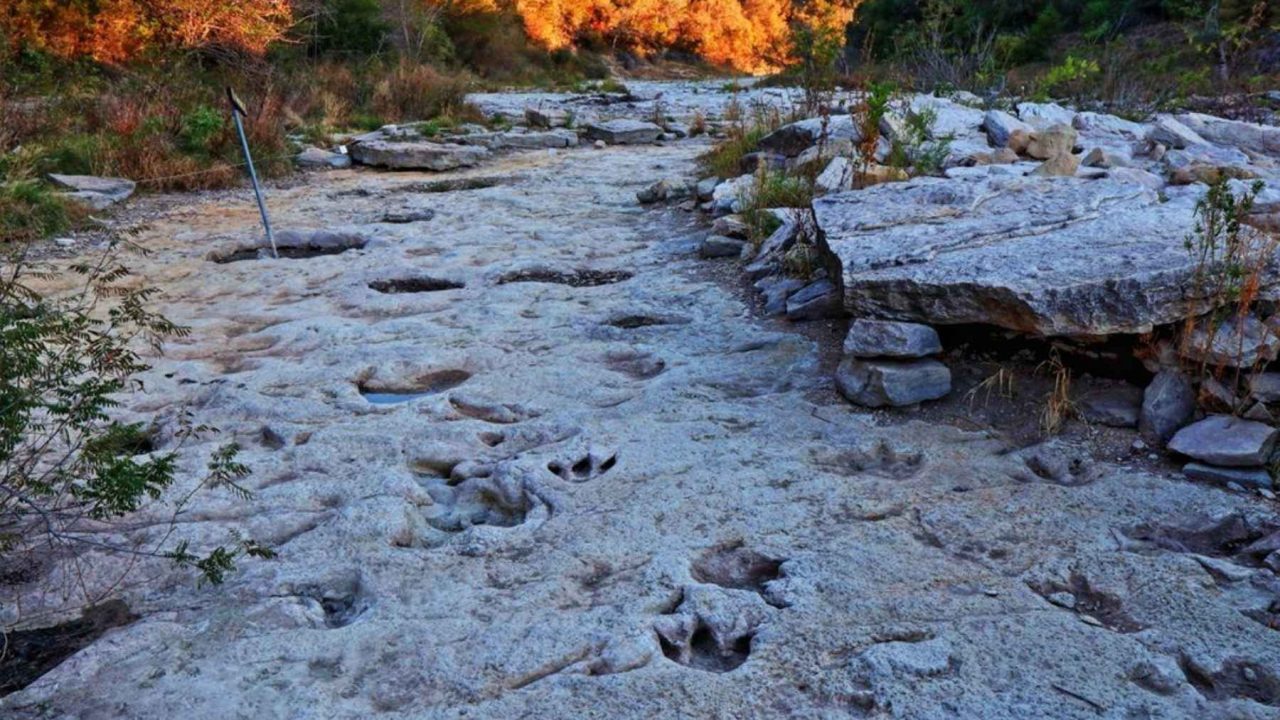
Fifteen giant, three-toed impressions — each roughly 18 to 20 inches long — were hiding in plain sight beneath a Texas creek bed for more than 110 million years. It took a summer storm to finally expose them.
When floodwaters tore through parts of Central Texas in the summer of 2025, the scene looked like any other disaster aftermath: mud, debris, downed brush, and the slow grind of cleanup. Then a volunteer noticed something in the newly exposed limestone that stopped everything cold. Pressed into rock that formed during the Cretaceous period were the unmistakable marks of a massive prehistoric animal — dinosaur footprints, preserved in near-perfect detail.
Officials have confirmed at least 15 prints so far. Researchers are now racing against the clock to document them before the elements — and human activity — can do what 110 million years of burial could not: erase them.
What the Flood Actually Uncovered
The tracks appeared along Sandy Creek after the storms stripped away brush and thin layers of sediment that had been sitting over the limestone for decades. The process is almost deceptively simple. A powerful enough rush of water removes the loose material on top, and suddenly what was invisible becomes visible — the same basic mechanics as a heavy rain washing out a patch of soil to expose tree roots, except infinitely older and far more significant.
The footprints date back to roughly 110 to 115 million years ago, placing them firmly in the Early Cretaceous period. At that time, Central Texas looked nothing like it does today. The region was covered by a shallow inland sea, and the land along its margins was home to large dinosaurs whose weight left impressions deep enough to survive geological time.
The three-toed shape of the prints gives researchers a starting point for identifying what kind of animal made them, though the site is still being studied and no species identification has been publicly confirmed.
The Key Facts About the Sandy Creek Discovery
Here is what has been confirmed about the site so far:
- Location: Sandy Creek, Central Texas
- Number of confirmed prints: At least 15
- Print size: Approximately 18 to 20 inches long each
- Estimated age: 110 to 115 million years
- Print shape: Three-toed impressions preserved in limestone
- Discovery trigger: Summer 2025 flooding that stripped away overlying sediment
- Discovery credit: A volunteer working flood cleanup noticed the prints
- Property status: Private land — public details have been intentionally limited
| Detail | Confirmed Information |
|---|---|
| Number of prints | At least 15 confirmed |
| Print dimensions | 18–20 inches long |
| Rock type | Limestone |
| Estimated age | 110–115 million years |
| Print shape | Three-toed |
| Discovery location | Sandy Creek, Central Texas |
| Who found them | A volunteer during flood cleanup |
Why This Discovery Is Already Under Threat
Here is the uncomfortable reality that makes this find so urgent: the same forces that revealed the prints are capable of destroying them.
Floods and storms can expose fossil sites that would otherwise remain buried indefinitely. But the rushing water, debris, and heavy equipment that follow a major storm can also grind down, chip away, or completely obscure the fine surface details that make a fossil scientifically valuable. A footprint that survived 110 million years underground can be damaged beyond recognition in a single afternoon of cleanup work.
Researchers have said they want to map and scan the site quickly, before wind, rain, and ongoing human activity degrade what is there. The goal is to create detailed digital records — essentially a permanent scientific copy — even if the physical prints themselves are eventually worn down.
The fact that the site sits on private property adds another layer of complexity. Officials have kept public details limited, which is standard practice for sensitive fossil sites. Disclosing exact locations can attract unauthorized visitors, and even well-meaning foot traffic can cause serious damage to exposed rock surfaces.
What a Footprint Surviving 110 Million Years Actually Means
It sounds almost impossible, but trace fossils — footprints, burrows, and other marks left by ancient animals — can preserve extraordinarily well under the right conditions. In this case, the animal likely walked across soft mud or sediment near a body of water. The impression dried and hardened, was buried under layers of additional sediment over millions of years, and gradually became part of the limestone bedrock.
Limestone is particularly good at holding this kind of detail. It forms slowly from calcium carbonate deposits, often in shallow marine or wetland environments — exactly the kind of landscape that existed in Central Texas during the Cretaceous. Once a print is locked into that rock, it can wait essentially forever, as long as nothing disturbs the surface above it.
In this case, decades of accumulated brush and creek-bed sediment served as an unintentional protective layer. The storm removed it. What came next was 110 million years of geological history, suddenly open to the sky.
What Happens Next at the Site
The immediate priority for researchers is documentation. Mapping and scanning the prints before any further deterioration occurs will preserve the scientific value of the discovery regardless of what happens to the physical rock. Photogrammetry — a technique that uses overlapping photographs to build precise three-dimensional models — is commonly used in situations like this, allowing scientists to study a site in detail long after the original surface has changed.
Beyond documentation, the site’s status as private property means that any longer-term plans for preservation, study, or public access will depend on the landowner’s decisions. No announcements about those plans have been made public.
What is clear is that this discovery would likely never have happened without the storm. And it is a useful reminder that the fossil record is not static — new finds emerge constantly, often by accident, and often in places that look completely ordinary until the ground shifts.
Frequently Asked Questions
Where exactly were the dinosaur footprints found?
The prints were discovered along Sandy Creek in Central Texas after summer 2025 flooding stripped away brush and sediment that had been covering the limestone.
How many footprints have been confirmed?
Officials have confirmed at least 15 individual prints so far, each measuring approximately 18 to 20 inches in length.
How old are the footprints?
The prints are preserved in limestone estimated to be roughly 110 to 115 million years old, dating to the Early Cretaceous period.
What kind of dinosaur made the prints?
The prints are described as three-toed impressions, but no specific species identification has been publicly confirmed at this stage of the investigation.
Can the public visit the site?
The site is on private property and officials have intentionally limited public details about its location. No public access has been announced.
Are the prints at risk of being damaged?
Yes — researchers have flagged urgency around mapping and scanning the site quickly, because wind, rain, and ongoing cleanup activity can degrade exposed fossil surfaces rapidly.



Leave a Reply