
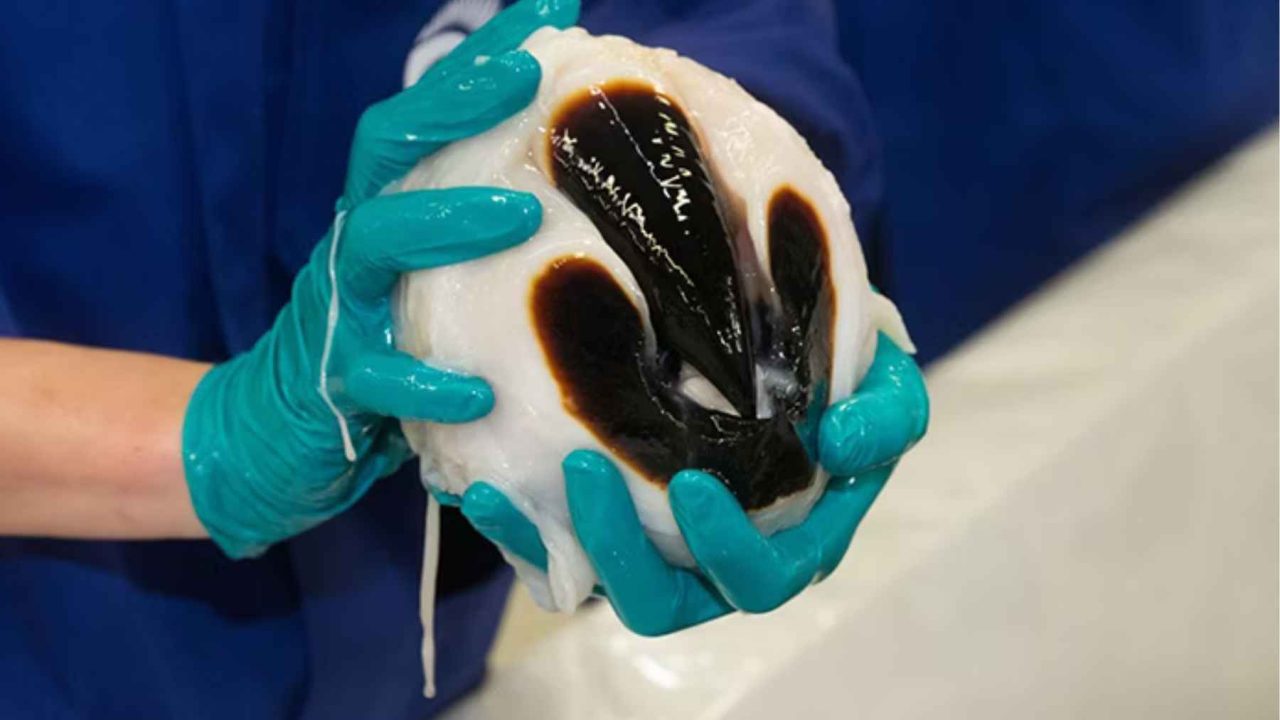
For a hundred years, scientists knew the colossal squid existed mostly through what it left behind — scars on fish, fragments in whale stomachs, and the occasional carcass hauled up from the deep. Then, on March 9, 2025, a remotely operated vehicle captured something no camera had ever recorded: a living colossal squid, drifting in the dark nearly 2,000 feet below the surface of the Southern Ocean.
The footage, confirmed by the Schmidt Ocean Institute, marks the first verified in situ video of Mesonychoteuthis hamiltoni — the colossal squid — alive and in its natural habitat. A century after the species was formally described by science, the legend finally has a face.
And here’s the twist that makes this even more remarkable: the animal in the video was only about 12 inches long. Roughly the size of a ruler sitting in a desk drawer. One of the ocean’s most feared and mythologized creatures, caught on camera as a juvenile, completely unbothered by the world above.
What Scientists Actually Filmed — and Where
The Schmidt Ocean Institute’s remotely operated vehicle, SuBastian, captured the footage near the South Sandwich Islands, a remote volcanic archipelago in the South Atlantic. The squid was spotted at approximately 600 meters — just under 1,970 feet — below the surface.
The expedition was part of a 35-day Ocean Census mission focused on deep-sea exploration using advanced robotics. Ocean Census is a global initiative aimed at accelerating the discovery of marine species, and this mission was built specifically around deep-sea robotics and international scientific collaboration.
The footage was reviewed and verified by independent experts, including Dr. Kat Bolstad, a squid specialist who confirmed the animal’s identity. Her reaction to seeing the footage was both enthusiastic and reflective.
“It’s exciting” and “humbling,” said Dr. Kat Bolstad, because the squid has “no idea that humans exist.”
That last detail matters more than it might seem. These animals live so far from human activity that they have never developed any awareness of or response to people. What the camera captured was completely natural behavior — undisturbed, unfiltered, and unprecedented.
Why the Colossal Squid Had Been So Hard to Find Alive
The colossal squid is not just rare on camera — it has historically been almost entirely invisible to science in any living form. For decades, researchers pieced together what they knew about the species from indirect evidence.
- Prey remains found in the stomachs of whales and seabirds
- Distinctive circular scars left on Antarctic toothfish — a sign the squid had attacked them
- Occasional specimens recovered already dead or dying
None of that gave scientists a clear picture of how the animal actually behaves in the wild — how it moves, how it hunts, or what its natural environment looks like at depth. Video changes all of that.
The South Sandwich Islands region, where SuBastian made the recording, sits in one of the most isolated and least-explored stretches of ocean on Earth. The depth at which the juvenile was found — around 600 meters — is well within the twilight and midnight zones of the ocean, where sunlight doesn’t reach and pressure would crush an unprotected human body.
Key Facts About the Discovery at a Glance
| Detail | Confirmed Information |
|---|---|
| Date of filming | March 9, 2025 |
| Species filmed | Mesonychoteuthis hamiltoni (colossal squid) |
| Life stage | Juvenile |
| Size of the animal | Approximately 12 inches (30 centimeters) |
| Depth of recording | Approximately 600 meters (1,970 feet) |
| Location | Near the South Sandwich Islands |
| Recording platform | ROV SuBastian, operated by Schmidt Ocean Institute |
| Mission type | 35-day Ocean Census expedition |
| Verification | Confirmed by independent experts including Dr. Kat Bolstad |
Why This Moment Matters Beyond the Headline
It would be easy to read this as a cool wildlife story and move on. But the significance runs deeper than a single video clip.
The colossal squid is believed to be the largest invertebrate on Earth by mass. Adults can grow to extraordinary sizes, yet science has almost no direct observational data on how they live. Every confirmed sighting, every piece of footage, adds to a picture that has been almost entirely blank.
Filming a juvenile is particularly valuable. Young animals reveal information about early development, habitat preferences, and behavior that can’t be inferred from dead adult specimens. The fact that this juvenile was found at 600 meters also gives researchers a concrete data point about where young colossal squid spend their time — information that was previously unknown.
More broadly, the discovery is a reminder of how little humanity has actually seen of the deep ocean. The technology aboard the Schmidt Ocean Institute’s research vessel — specifically ROV SuBastian — is part of a growing push to make the deep sea as observable as other ecosystems that have been studied for centuries.
What Comes Next for Colossal Squid Research
The Ocean Census initiative that produced this footage is designed to continue. Its mission is to dramatically increase the number of known marine species and expand scientific understanding of deep-sea environments through coordinated global expeditions.
Whether future missions will yield footage of adult colossal squid — animals that can reach sizes that dwarf the juvenile filmed here — remains an open question. The deep ocean is vast, and the colossal squid’s range is not fully mapped. But researchers now have something they didn’t have before: proof that the animals can be found and filmed alive, and a location where at least one juvenile was present.
That’s not a small thing. For a species that spent a century as little more than a rumor backed by stomach contents, visible proof is a foundation. Every future expedition into those waters now has a confirmed reference point to build from.
Frequently Asked Questions
When was the colossal squid first filmed alive in its natural habitat?
The first confirmed in situ video of a living colossal squid was recorded on March 9, 2025, by the Schmidt Ocean Institute’s ROV SuBastian near the South Sandwich Islands.
How big was the colossal squid that was filmed?
The juvenile squid was approximately 12 inches (30 centimeters) long — about the size of a standard ruler.
How deep was the squid when it was filmed?
The animal was recorded at approximately 600 meters, or just under 1,970 feet, below the ocean surface.
Who verified that the footage showed a real colossal squid?
Independent experts confirmed the identification, including Dr. Kat Bolstad, a specialist in squid biology who reviewed the footage after the expedition.
Why hadn’t scientists filmed the colossal squid alive before?
The species lives in extremely deep, remote waters in the Southern Ocean, and previous encounters with the species came almost entirely from dead specimens or indirect evidence like prey remains and toothfish scars.
What organization conducted the expedition?
The footage was captured during a 35-day Ocean Census expedition operated by the Schmidt Ocean Institute, using their remotely operated vehicle SuBastian.


Leave a Reply