
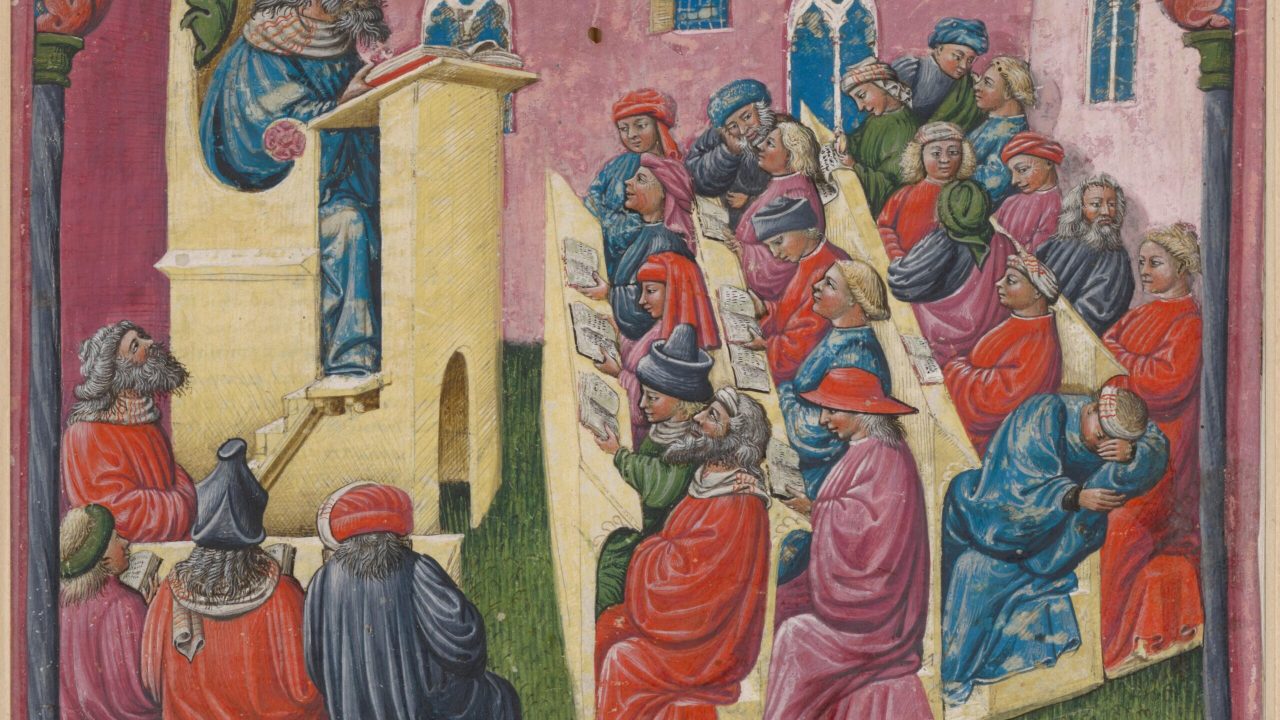
What happens when the debates raging outside the classroom walls are more urgent — and more unresolved — than anything on the syllabus? That question is at the heart of a paper delivered this year at the International Congress on Medieval Studies at Western Michigan University, and it reaches back more than three decades to find an answer that still holds.
Scholar Richard Utz presented the paper, titled “The Past and Future of the Medieval Classroom: Teaching the Conflicts in Troubled Times,” drawing on a landmark 1992 book to argue that academic controversy is not a problem to be managed — it is a resource to be used.
The argument is simple on its surface but genuinely difficult in practice: stop hiding the fights, and bring them into the room.
The Book That Reframed the Culture Wars
In 1992, scholar Gerald Graff published Beyond the Culture Wars: How Teaching the Conflicts Can Revitalize American Education — a book that landed in the middle of one of the most turbulent periods American higher education had seen in a generation.
Graff’s central claim was that the fierce debates of the era — over multiculturalism, the Western Canon, political correctness, and curricular diversity — were not signs of institutional collapse. They were signs of intellectual vitality. His prescription was to “teach the conflicts,” meaning educators should bring those disputes directly into the curriculum rather than pretend they don’t exist or resolve them behind closed doors.
The book was written explicitly as a response to traditionalist critics of higher education. But it wasn’t a defense of any single side. It was a call to action aimed at combating two specific problems Graff saw spreading through American universities: student apathy and curricular fragmentation.
The idea was that controversy, properly framed, mobilizes the life of the mind. Students who see real stakes in a debate pay attention. They think harder. They engage.
What the Higher Ed Landscape Looked Like in 1992
To understand why Graff’s argument resonated so widely, it helps to remember the specific pressures facing American universities at the time he was writing. Utz’s paper situates the book carefully within that context.
| Issue | What Was Happening in 1992 |
|---|---|
| Financial Crisis | Major financial pressures bearing down on institutions across the country |
| Federal Regulation | Higher Education Reauthorization Act governing for-profit institutions |
| Curriculum Debates | Western Canon vs. diversity; political correctness controversies |
| Desegregation | Supreme Court ruling that Mississippi had failed to desegregate its higher education system |
| Financial Aid | Intense pressure around access and student financial support |
That list will look familiar to anyone following higher education news today. The specific names and legislation change, but the underlying tensions — over who gets to define knowledge, who gets access to it, and who pays for it — have proven remarkably durable.
That durability is precisely Utz’s point. Graff was not writing about a temporary crisis. He was describing something structural about how academic institutions handle disagreement — and how rarely they handle it well.
Why Medieval Studies? Why Now?
Utz’s paper applies Graff’s framework specifically to the medieval classroom, a context that might seem removed from contemporary culture wars but has in fact become one of their more contested territories.
Medieval studies as a field has faced serious internal reckonings in recent years over questions of who gets centered in the curriculum, whose voices have historically been excluded, and how the period is invoked — sometimes distorted — in modern political and nationalist movements. These are not abstract debates. They have real consequences for what gets taught, how it gets taught, and which students feel the material belongs to them.
Graff’s model offers one path forward: rather than resolving these tensions before students enter the room, educators can make the tensions themselves the subject of inquiry. The conflict becomes the curriculum.
This approach demands something from instructors that is genuinely uncomfortable — a willingness to be uncertain in public, to model disagreement rather than authority, and to trust students with complexity rather than shielding them from it.
The Practical Challenge of Teaching Conflict Well
Advocating for controversy in the classroom is easier than managing it. Critics of Graff’s approach have long argued that not all conflicts are equally productive, and that without careful framing, “teaching the conflicts” can tip into false equivalence — treating settled questions as open debates, or giving harmful positions unwarranted legitimacy.
Supporters counter that the alternative — a curriculum that papers over disagreement in the name of coherence — produces exactly the student disengagement Graff diagnosed. When students sense that the real arguments are happening somewhere else, they stop showing up intellectually even when they’re physically present.
The medieval classroom, Utz suggests, is a useful testing ground for these questions precisely because the stakes feel both historical and immediate. Students can examine how conflicts were framed, fought, and sometimes resolved across centuries — while also recognizing that the arguments about whose history gets told are very much alive.
What This Means for Educators Right Now
Utz presented this paper at a moment when American higher education is again under significant pressure — financial, political, and cultural. The parallels to 1992 are hard to ignore.
For educators working in medieval studies and across the humanities more broadly, the argument is both a challenge and a reassurance. The challenge: stop treating controversy as a problem to contain. The reassurance: the conflicts themselves, if engaged honestly, are evidence that the questions being asked still matter.
That may be the most important thing a classroom can demonstrate right now — that difficult questions are worth staying in the room for.
Frequently Asked Questions
Who is Richard Utz?
Richard Utz is the scholar who delivered the paper “The Past and Future of the Medieval Classroom: Teaching the Conflicts in Troubled Times” at the International Congress on Medieval Studies at Western Michigan University.
What is Gerald Graff’s book about?
Published in 1992, Beyond the Culture Wars: How Teaching the Conflicts Can Revitalize American Education argues that academic debates over multiculturalism, the canon, and political correctness signal intellectual vitality and should be brought into the classroom rather than avoided.
What does “teach the conflicts” mean?
It is Graff’s prescription for educators: rather than hiding or resolving academic disputes before they reach students, bring those disputes directly into the curriculum as a way to combat student apathy and curricular fragmentation.
What higher education issues existed when Graff wrote the book in 1992?
The landscape included major financial crises, the Higher Education Reauthorization Act, debates over the Western Canon versus diversity, a Supreme Court ruling on desegregation in Mississippi’s higher education system, and intense pressure around financial aid.
Why does this argument apply specifically to medieval studies?
Medieval studies has become a contested field, with ongoing debates about whose voices are centered in the curriculum and how the medieval period is invoked in modern political movements — making it a relevant space for testing how educators handle conflict in the classroom.
Where was Utz’s paper delivered?
The paper was presented at the International Congress on Medieval Studies at Western Michigan University.



Leave a Reply