
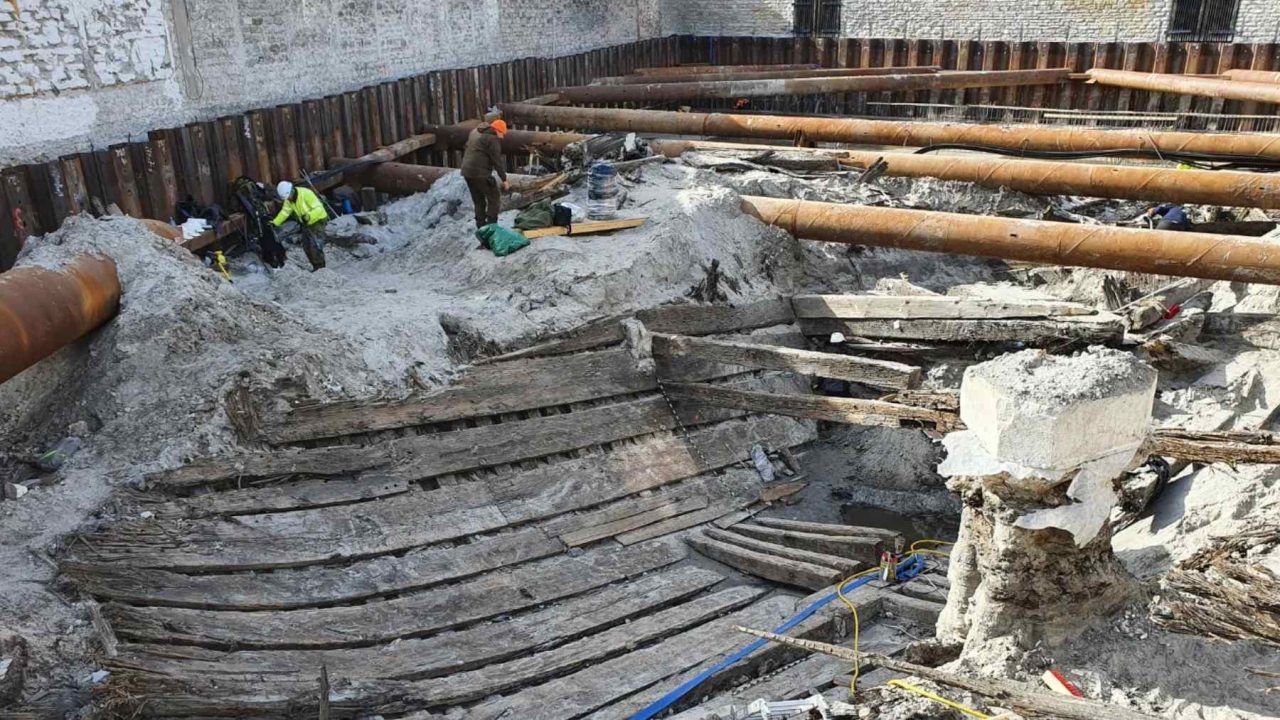
Just 1.5 meters below a busy Tallinn street, construction crews in 2022 broke through the surface of the modern city and into the medieval world — striking the timber hull of an 80-foot merchant ship that had been sitting quietly in the earth for centuries. Nobody expected it. Nobody had a plan for it. And what they found inside made the discovery even more unsettling.
The vessel, now called the Lootsi cog, is one of the most remarkable medieval shipwrecks found in Europe in recent memory. It stretches approximately 80 feet long, nearly 30 feet wide, and stands roughly 13 feet tall — a substantial, ocean-capable trading vessel that somehow ended up buried beneath what is now Lootsi Street in Estonia’s capital city. The fact that it survived at all, this close to the surface, in this kind of condition, is already extraordinary.
But it’s what researchers found — and what they didn’t find — that has made this discovery genuinely disturbing.
How a Construction Site Became an Archaeological Emergency
The story begins the way so many urban discoveries do: with heavy equipment and a deadline. Workers preparing the foundation for a new office building in Tallinn struck timber where they expected only soil. The ground beneath Lootsi Street had once been close to the city’s historic harbor, which meant that, in theory, old maritime remnants were possible. But an intact, 24-meter ship was not what anyone had in mind.
Once archaeologists were called in, the scale of the find became clear. This wasn’t a fragment or a few scattered planks. This was a whole vessel — a cog, the workhorse merchant ship of the medieval Baltic trade network — preserved well enough for researchers to begin serious analysis. The site was carefully documented, and the ship was examined in detail.
New tree-ring research, known as dendrochronology, has since added another layer to the story, suggesting the history of this vessel is even richer than the physical discovery alone could reveal.
What the Lootsi Cog Actually Looked Like
Cogs were the dominant cargo vessels of the medieval Baltic and North Sea trade routes. They were broad, sturdy, single-masted ships designed to carry heavy loads efficiently — grain, timber, salt, wool, and other bulk goods that powered the Hanseatic League’s commercial empire across northern Europe.
The Lootsi cog fits squarely within that tradition. Its dimensions tell the story of a serious working vessel, not a small coastal ferry.
| Measurement | Imperial | Metric |
|---|---|---|
| Length | ~80 feet | ~24 meters |
| Width | ~30 feet | ~9 meters |
| Height | ~13 feet | ~4 meters |
| Depth below pavement | ~5 feet | ~1.5 meters |
For a ship this size to have ended up this close to the surface, and this far inland from where the harbor now sits, it tells a story about how dramatically Tallinn’s coastline has changed over the centuries. Land reclamation and urban expansion have buried an entire harbor landscape under modern streets and buildings.
The Clue That Suggests Something Went Very Wrong
Here is where the story takes a darker turn. Researchers examining the wreck found evidence suggesting that the crew did not have time to collect their belongings before abandoning the ship. Personal items and cargo-related objects were left behind — the kind of things people would normally take with them if they had any warning or any time to act.
That detail points toward a sudden, uncontrolled end. Whether the ship sank rapidly at the harbor, was overwhelmed by an unexpected event, or met some other swift fate, the physical evidence left behind paints a picture of people leaving in a hurry — or not leaving at all under their own power.
It’s the kind of archaeological clue that transforms a shipwreck from a historical curiosity into something that feels viscerally human. Somewhere in that ship’s final moments, real people lost everything they had on board — and possibly more than that.
Why This Find Matters Beyond the Headlines
Medieval shipwrecks are rare enough on their own. Finding one this well-preserved, this close to the surface, in the middle of a living city, is genuinely unusual. But the Lootsi cog matters for reasons that go beyond the spectacle of the discovery itself.
- It provides direct physical evidence of Tallinn’s role as a major medieval trading port in the Baltic region.
- The dendrochronology research — analyzing tree rings in the ship’s timber — offers precise dating information that can help researchers understand the vessel’s construction and origins.
- The preserved state of the wreck gives archaeologists a rare opportunity to study medieval shipbuilding techniques up close.
- The personal items left aboard open a window into the everyday lives of Baltic sailors and merchants during the medieval period.
Tallinn was a significant Hanseatic city, and its harbor was a hub of commerce connecting Scandinavia, the German states, and the eastern Baltic. A ship like this cog would have been a familiar sight in those waters — and its sudden disappearance beneath the mud of the harbor would have been just one of countless tragedies that shaped the rhythm of medieval trade.
What Researchers Are Still Working to Understand
The discovery is still being studied. The dendrochronology findings represent a significant step forward in understanding the ship’s age and timber origins, but researchers have not yet resolved all of the key questions surrounding the wreck.
Among the things that remain under investigation:
- The precise date of the ship’s sinking or abandonment
- Where the timber used to build the vessel originally came from
- The full inventory of objects found aboard
- What specifically caused the crew to leave so suddenly
The broader significance of the Lootsi cog for our understanding of Baltic medieval seafaring is something researchers have described as potentially substantial. A find this complete, in a context this well-documented, does not come along often — and the analysis is expected to continue for years.
For now, the ship that sat silently under a Tallinn street for centuries is finally getting the attention it deserves. Whatever happened to its crew in those final moments, their story is only beginning to be told.
Frequently Asked Questions
Where exactly was the Lootsi cog discovered?
The ship was found beneath Lootsi Street in Tallinn, Estonia, during construction work on a new office building in 2022.
How deep was the ship buried?
The wreck was found approximately 1.5 meters — about 5 feet — below the surface of the pavement.
How large is the Lootsi cog?
The vessel is approximately 24 meters (80 feet) long, nearly 30 feet wide, and roughly 13 feet tall, making it one of the most significant medieval ship finds in Europe in recent years.
What is the disturbing clue researchers found?
Evidence suggests the crew did not have time to gather their belongings before abandoning the ship, pointing to a sudden and uncontrolled end to the vessel’s final voyage.
What type of ship is it?
The Lootsi cog is a medieval cog — the standard heavy cargo vessel used throughout the Baltic and North Sea trade routes during the medieval period.
Is the research on the ship still ongoing?
Yes. New dendrochronology research has recently added to what is known about the vessel, and analysis of the wreck and its contents is expected to continue for years.




Leave a Reply