
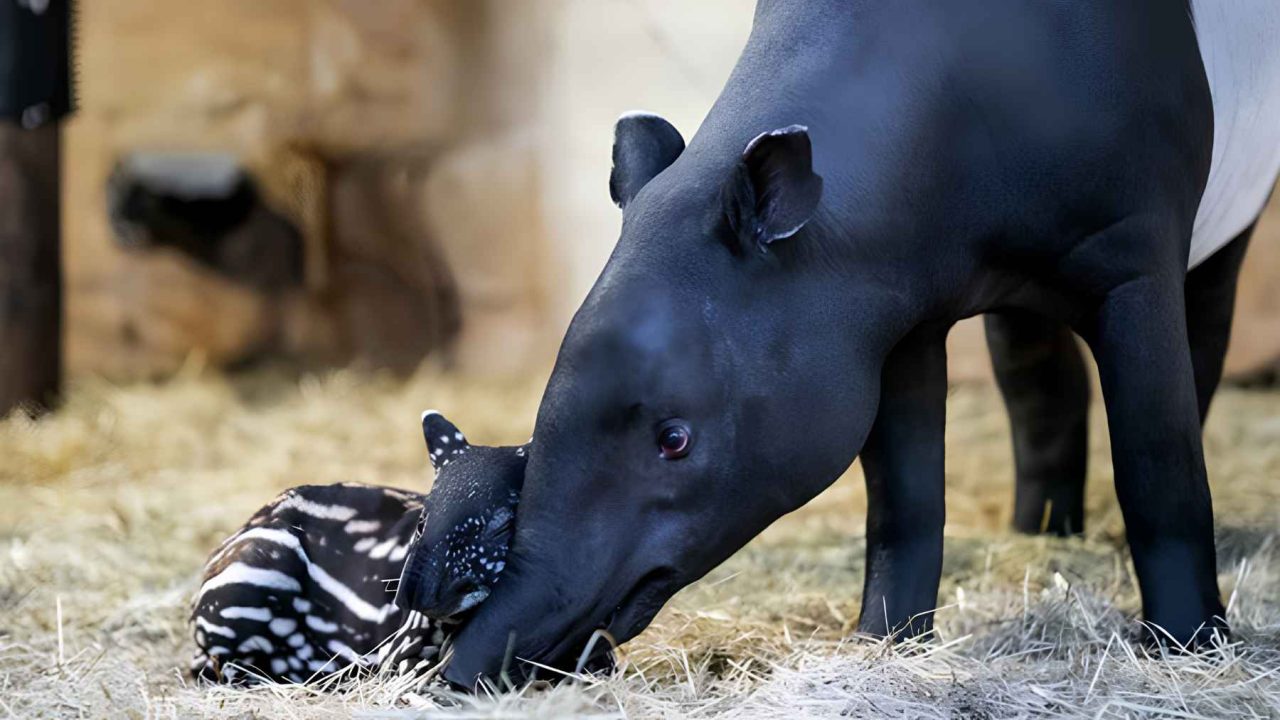
Fewer than 2,500 Malayan tapirs are believed to survive in the wild. That number alone explains why a single birth — even one happening thousands of miles from the animal’s native rainforests — is being treated as a genuine conservation milestone.
A Malayan tapir calf was born in southern Spain in the early hours of Saturday, March 29, 2025, marking the first recorded birth of this endangered species anywhere in the country. The newborn weighed an estimated 18 to 22 pounds — roughly 10 kilograms — and early reports confirmed that both the mother and calf were doing well in the days that followed.
It would be easy to scroll past this as a feel-good zoo story. But the pressures pushing Malayan tapirs toward extinction are real, relentless, and accelerating. This birth is the product of nearly two decades of careful work, and it lands at a moment when every individual animal counts.
Why the Malayan Tapir Is Running Out of Time
The Malayan tapir is the largest of the world’s four tapir species, and it is native to the rainforests of Southeast Asia. Its striking black-and-white coloring makes it one of the more visually distinctive large mammals on Earth — and one of the most at risk.
Conservation groups have pointed to a convergence of threats that have steadily reduced the species’ numbers. Deforestation clears the dense forest habitat the tapir depends on. Agricultural expansion fragments what forest remains. Hunting continues in parts of its range. And even road deaths and pollution have emerged as documented causes of mortality for a species that was already struggling.
With fewer than 2,500 individuals estimated to remain in the wild, the Malayan tapir is classified as endangered. Captive breeding programs run by accredited zoological institutions around the world play a direct role in keeping the species from sliding further toward the edge.
What Made This Birth Different
This was not a surprise. The park had been working toward this moment for roughly 20 years, and the level of preparation behind this birth reflects that long investment.
The pregnancy lasted approximately 14 months — around 424 days — which is typical for the species but demands sustained veterinary attention over an unusually long gestation period. Staff were able to conduct ultrasound checks right up to the final days before the birth, providing real-time monitoring of the calf’s development.
The birth itself happened before dawn, and the facility reported that cameras were running continuously throughout. After the calf arrived, it was kept in a quarantine period indoors while staff focused on two critical early priorities: ensuring the calf was nursing successfully and tracking its development on a steady upward curve.
Javier Vicent, who leads the zoology team, confirmed that the next planned step would be the calf’s first supervised introduction to an outdoor area — a significant transition for any young animal, and one that the team was approaching carefully.
Key Facts at a Glance
| Detail | Information |
|---|---|
| Date of birth | Saturday, March 29, 2025 |
| Time of birth | Before dawn |
| Estimated birth weight | 18–22 pounds (approximately 10 kg) |
| Gestation period | Approximately 424 days (about 14 months) |
| Historic significance | First recorded Malayan tapir birth in Spain |
| Wild population estimate | Fewer than 2,500 individuals |
| Years of preparation | Approximately 20 years |
| Zoology team lead | Javier Vicent |
- Both mother and calf were reported to be in good health following the birth
- Ultrasound monitoring continued through the final days of pregnancy
- Continuous camera surveillance was in place throughout the birth
- A quarantine and indoor observation period followed the birth
- The calf’s first outdoor access is being planned as the next major milestone
Why a Birth in Europe Matters for a Species in Asia
This is the question worth sitting with. The Malayan tapir lives in Southeast Asia. A birth in southern Spain does not directly restore a wild population or replant a single acre of rainforest. So what does it actually accomplish?
Captive breeding programs serve as a genetic safety net. They maintain healthy, genetically diverse populations of endangered animals in human care — populations that can, in the right circumstances, contribute to reintroduction efforts or simply ensure the species does not disappear entirely while conservation work continues in the field.
A first-ever birth of any species in a given country also carries institutional weight. It demonstrates that a facility has the expertise, infrastructure, and commitment to manage one of the world’s most demanding large-mammal pregnancies successfully. That matters for international breeding coordination, for funding, and for the long-term credibility of the program.
Twenty years is a long time to work toward a single birth. The fact that it succeeded — with monitoring, veterinary support, and a healthy outcome — signals that the program is capable of sustaining and building on this work.
What Happens Next for the Calf
The immediate priority, according to the park, remains the calf’s continued development indoors. Staff are monitoring feeding closely, which is standard practice in the critical early weeks of a tapir’s life.
The next publicly confirmed step is the calf’s first supervised move into an outdoor area — a transition that Javier Vicent identified as the team’s near-term focus. No specific timeline for that move has been confirmed.
Beyond that, the calf’s longer-term role within international Malayan tapir breeding programs has not yet been detailed publicly. Given the species’ endangered status and the rarity of successful captive births, it is reasonable to expect the animal will eventually become part of coordinated breeding efforts — but that remains to be confirmed.
What is confirmed is that a species with fewer than 2,500 wild individuals just added one more living representative, in a country that had never achieved this before, after 20 years of sustained effort. In conservation terms, that is not a small thing.
Frequently Asked Questions
When was the Malayan tapir calf born in Spain?
The calf was born before dawn on Saturday, March 29, 2025, in southern Spain.
How much did the newborn tapir weigh?
The calf was estimated to weigh between 18 and 22 pounds, approximately 10 kilograms, at birth.
Why is the Malayan tapir endangered?
The species faces threats including deforestation, agricultural expansion, hunting, road deaths, and pollution, which have reduced the wild population to fewer than an estimated 2,500 individuals.
How long was the tapir’s pregnancy?
The pregnancy lasted approximately 424 days, or around 14 months, which is typical for the Malayan tapir species.
Is this the first Malayan tapir born in Spain?
Yes, according to the source reporting, this is the first recorded birth of a Malayan tapir in Spain.
What happens next for the calf?
Staff are continuing to monitor the calf’s feeding and development indoors, with the next planned step being a first supervised move into an outdoor area, as confirmed by zoology team lead Javier Vicent.


Leave a Reply