
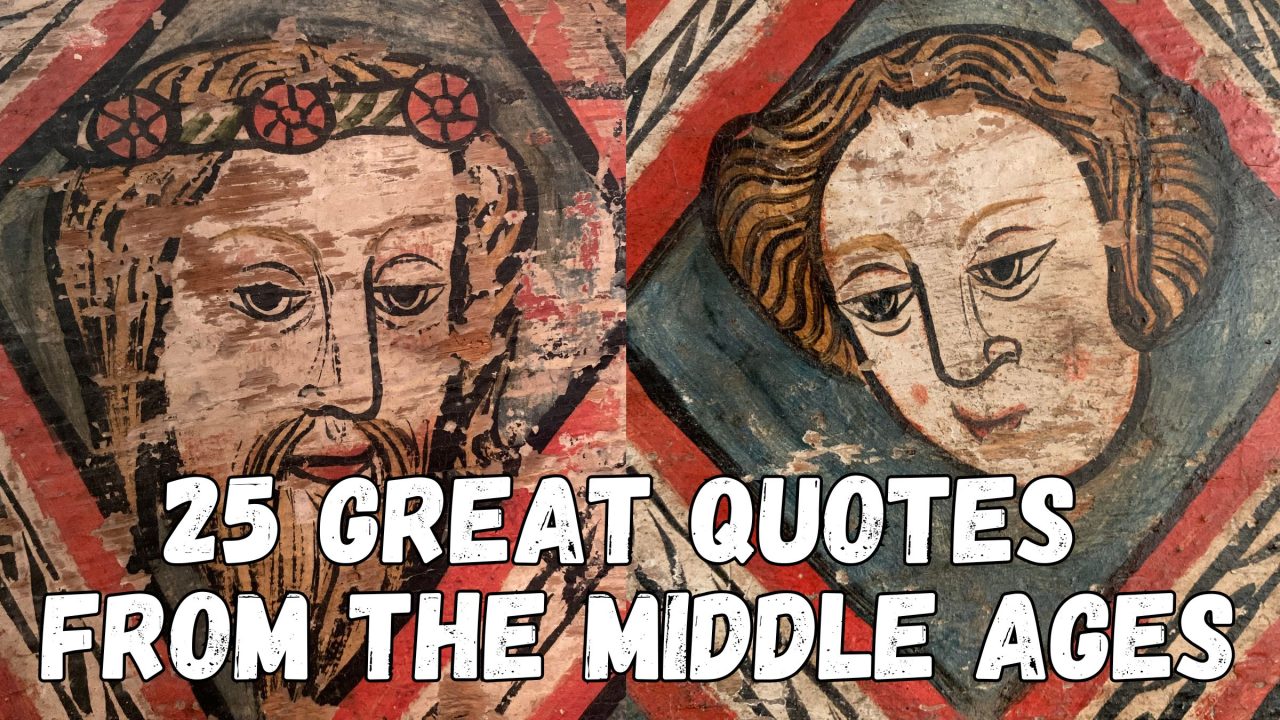
Across centuries and continents, the people of the Middle Ages had a great deal to say — and some of it sounds startlingly modern. From a German abbess describing the soul of music to a Mongol conqueror justifying conquest as divine punishment, medieval voices carry a weight and directness that cuts straight through the distance of time.
A collection of 25 quotes gathered by Medievalists.net draws on writers, rulers, and thinkers from Europe, the Middle East, and Asia, spanning roughly a thousand years of human experience. What emerges is a portrait of an era that was far more curious, reflective, and philosophically alive than its popular reputation often suggests.
These aren’t dusty relics. Several of these lines could appear in a modern speech, a philosophy lecture, or a late-night conversation and feel completely at home.
Why Medieval Quotes Still Hit Hard
The Middle Ages are often reduced to a shorthand for backwardness — plague, superstition, and mud. But the voices preserved from that period tell a more complicated story. These were people grappling with the same questions humans have always wrestled with: the nature of love, the limits of power, the purpose of learning, and what it means to live well.
What makes these quotes particularly striking is their range. They come from a 12th-century German abbess, an Icelandic saga, a Dominican friar doing proto-scientific thinking, and one of history’s most feared conquerors. That breadth alone challenges the idea that medieval thought was monolithic or confined to a single tradition.
Some of these lines are beautiful. Some are unsettling. A few are both at once.
The Quotes Themselves — What the Medieval World Left Behind
Here are the quotes confirmed in They live as they are sung, for the words are the body and the music the spirit.”
Each of these voices comes from a radically different context — yet each one lands with a clarity that needs no translation or footnote to understand.
The Lines That Deserve a Closer Look
Hildegard von Bingen’s reflection on music and language is perhaps the most poetic of the group. Writing in 12th-century Germany, she framed words as mere physical containers — hollow without the spirit of music to animate them. For a woman who composed an extraordinary body of sacred music, this wasn’t abstract theory. It was lived conviction.
The line from The Saga of Grettir the Strong is deceptively simple. “A tale is but half told when only one person tells it.” In an era before mass media, before recorded history was standardized, this was a real epistemological warning. It also reads like a founding principle of modern journalism.
Thomas à Kempis wrote about love with an intensity that feels almost overwhelming. His list — sweeter, higher, stronger, larger, more joyful, fuller, better — reads like someone trying to exhaust the language of superlatives and still finding them insufficient.
Then there’s Chinggis Khan addressing the people of Bukhara in 1220, after conquering the city. His words are chilling precisely because of their logic. He didn’t present himself as a conqueror driven by ambition. He presented himself as an instrument of divine justice — and placed the moral responsibility for the destruction squarely on his victims. It is one of the most extraordinary pieces of rhetorical self-justification in recorded history.
Albertus Magnus asking whether many worlds exist — in the 13th century — is a reminder that the questions driving modern astronomy and cosmology are not new. A Dominican friar in medieval Europe was already treating this as one of the most important questions a thinking person could ask.
What These Voices Tell Us About the Medieval World
Read together, these quotes suggest a medieval world that was genuinely engaged with big ideas. There is curiosity here — about the cosmos, about love, about the nature of power and punishment. There is artistry. There is also, in Chinggis Khan’s address, a ruthless political intelligence that understood how to frame brutality as moral order.
The geographic spread matters too. These voices come from Germany, Iceland, the Netherlands, Central Asia, and the broader Islamic world touched by Mongol conquest. Medieval thought was not a single European conversation. It was a global one, carried across trade routes, conquests, and manuscript traditions that connected civilizations most people today treat as separate.
The Icelandic saga’s observation about storytelling is particularly worth sitting with. It’s a line that acknowledges the limits of any single perspective — a form of intellectual humility built into the oral tradition of a culture that understood how stories shape reality.
Frequently Asked Questions
Who was Hildegard von Bingen?
She was a 12th-century German abbess, composer, and writer whose work spanned music, theology, and natural science. Her quote about music and language comes from her reflections on sacred composition.
When did Chinggis Khan speak to the people of Bukhara?
According to
Who was Albertus Magnus?
He was a 13th-century Dominican friar and scientist who asked whether multiple worlds might exist — a question the source describes as one he considered among the most noble in the study of Nature.
Where does the quote “A tale is but half told when only one person tells it” come from?
It comes from The Saga of Grettir the Strong, a medieval Icelandic saga included in the Medievalists.net collection.
Who was Thomas à Kempis?
He was a 15th-century religious scholar living in the Netherlands, best known for his devotional writing. His quote on love is drawn from that body of work.
How many quotes are in the full Medievalists.net collection?
The full collection contains 25 quotes drawn from writers and rulers across Europe, the Middle East, and Asia during the medieval period.



Leave a Reply