
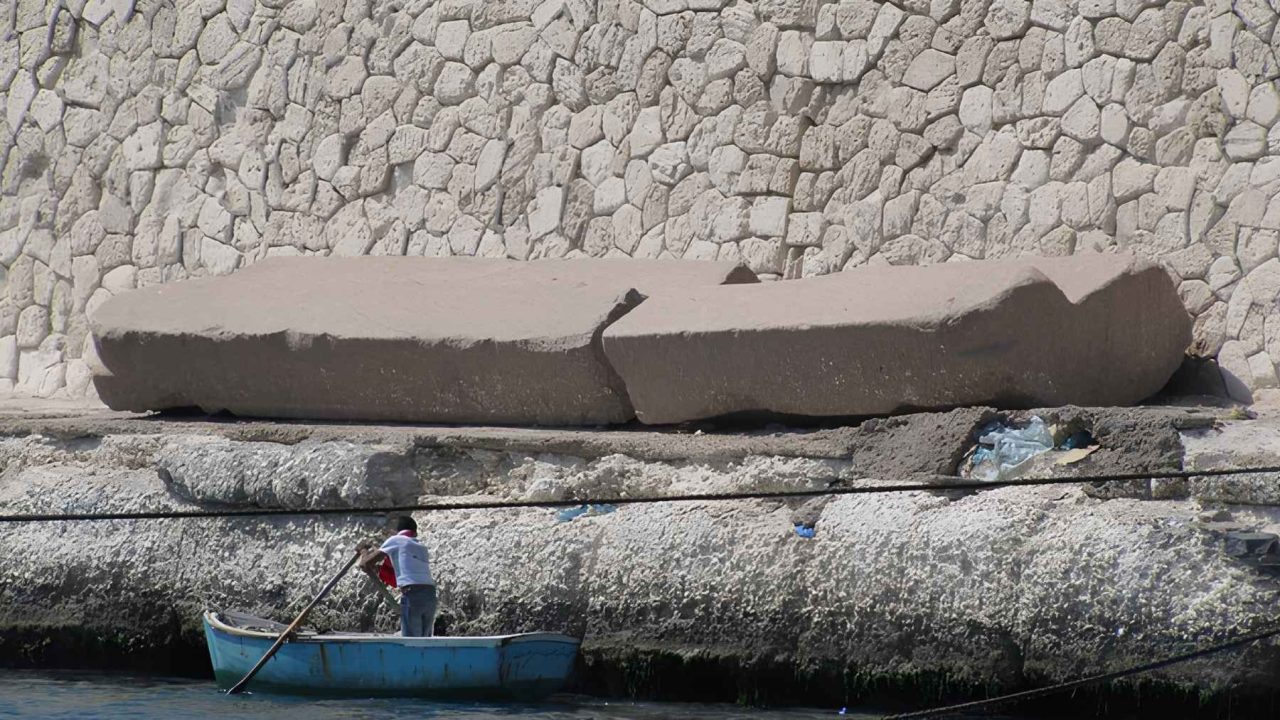
Twenty-two massive stone blocks — some weighing between 77 and 88 U.S. tons each — have just been pulled from the floor of the Mediterranean Sea off the coast of Alexandria, Egypt. They are believed to be connected to the Lighthouse of Alexandria, one of the Seven Wonders of the Ancient World, and their recovery is reigniting one of archaeology’s longest-running mysteries.
This is not a discovery of gold coins or jeweled artifacts. What researchers have found is something arguably more valuable: physical pieces of a building that most historians believed was lost forever. These stones are a direct link to a structure that guided sailors into one of the ancient world’s greatest ports for centuries before it vanished from history.
The recovery operation is now drawing serious international attention, and for good reason. What comes next could reshape everything we thought we knew about how the lighthouse looked, how it was built, and what actually happened to it.
What Was the Lighthouse of Alexandria — and Why Does It Matter?
The Lighthouse of Alexandria stood on the island of Pharos, just off the coast of Alexandria, Egypt. It was one of the tallest man-made structures in the ancient world and served as a navigational beacon for ships entering the city’s harbor. Ancient sources described it as an extraordinary feat of engineering, and it earned its place among the Seven Wonders of the Ancient World alongside structures like the Great Pyramid of Giza and the Colossus of Rhodes.
Unlike the Great Pyramid, the lighthouse did not survive. It was gradually damaged by a series of earthquakes over several centuries, with the final collapse believed to have occurred sometime in the medieval period. By the time modern archaeology developed the tools to look for it, the structure was gone — its stones scattered, repurposed, or swallowed by the sea.
That is what makes this recovery so significant. For the first time, researchers have physical material directly tied to the lighthouse that can be measured, scanned, and analyzed with modern precision.
What Archaeologists Actually Pulled from the Sea
The recovered blocks are not random rubble. According to the research team, the collection includes a specific and telling range of architectural elements that point clearly to a monumental structure.
- Door lintels — the horizontal beams that sit above doorways
- Upright side pieces that would have framed those doorways
- A threshold — the base stone of an entrance
- Large base slabs
- Parts of a previously unknown pylon, described as a monumental gateway
The sheer size of the pieces tells its own story. Moving them from the seafloor was less like collecting artifacts and more like relocating sections of an entire building. These were not decorative fragments — they were load-bearing architectural components of something enormous.
| Detail | Confirmed Information |
|---|---|
| Number of blocks recovered | 22 stone blocks |
| Weight of individual blocks | Approximately 77 to 88 U.S. tons each |
| Recovery location | Mediterranean seafloor off Alexandria, Egypt |
| Types of elements recovered | Door lintels, side pieces, threshold, base slabs, pylon fragments |
| Connected monument | Lighthouse of Alexandria, one of the Seven Wonders of the Ancient World |
| Scientific director | Isabelle Hairy, archaeologist and architect |
The Team Behind the Discovery
This is not a solo operation. The mission is being carried out under the scientific direction of Isabelle Hairy, an archaeologist and architect, and it involves a notable coalition of institutions working together across national boundaries.
The organizations involved include France’s Centre National de la Recherche Scientifique, the Centre d’Études Alexandrines, the Egyptian Ministry of Tourism and Antiquities, and La Fondation Dassault Systèmes.
The involvement of Dassault Systèmes — a company known for advanced 3D modeling and digital simulation technology — hints strongly at what the team intends to do with the data gathered from these blocks. The goal, according to
That kind of digital reconstruction would be a landmark achievement. Historians and architects have attempted to model the lighthouse for generations, but without physical evidence of this scale and specificity, every previous attempt has relied heavily on guesswork drawn from ancient texts and coins bearing the lighthouse’s image.
Why a Previously Unknown Pylon Changes the Picture
One of the most striking elements of this recovery is the mention of a previously unknown pylon — a monumental gateway structure — among the recovered pieces. This suggests that the lighthouse complex may have been larger, or differently configured, than existing reconstructions have assumed.
A pylon of this kind would have been a major architectural feature, the kind of grand entrance that framed the approach to an important building. Its existence had apparently not been established before this recovery, which means the physical footprint and design of the lighthouse site may need to be reconsidered from the ground up.
This is the kind of find that does not just add detail to an existing picture — it potentially rewrites the outline of the picture itself.
What Happens Next with These Stones
The immediate priority for the research team is scanning and analysis. The blocks will be studied to extract as much architectural and historical data as possible, with the stated goal of producing a digital reconstruction of the lighthouse that reflects real physical evidence rather than informed speculation.
The participation of La Fondation Dassault Systèmes strongly suggests that advanced 3D modeling will play a central role in that process. If successful, the project could produce the most accurate visual and structural representation of the Lighthouse of Alexandria that has ever existed.
Beyond the reconstruction itself, the data gathered from these stones may help answer questions that have lingered for centuries — about the lighthouse’s true height, its internal structure, the materials used in its construction, and the scale of the complex that surrounded it.
For now, 22 enormous stones are back above water, and the lighthouse of Alexandria is, in a very real sense, closer to being seen again than it has been in hundreds of years.
Frequently Asked Questions
Where were the stone blocks found?
The 22 stone blocks were recovered from the Mediterranean seafloor off the coast of Alexandria, Egypt.
How heavy are the recovered stones?
Some of the individual blocks weigh approximately 77 to 88 U.S. tons each.
Who is leading the archaeological mission?
The mission is under the scientific direction of Isabelle Hairy, an archaeologist and architect, in collaboration with France’s Centre National de la Recherche Scientifique, the Centre d’Études Alexandrines, the Egyptian Ministry of Tourism and Antiquities, and La Fondation Dassault Systèmes.
What will researchers do with the recovered blocks?
The team plans to scan and study the blocks in order to create a more accurate digital reconstruction of the Lighthouse of Alexandria than has previously been possible.
What is the previously unknown pylon mentioned in the discovery?
A pylon is a monumental gateway structure. The recovery included fragments of one that had not been previously identified, suggesting the lighthouse complex may have been larger or differently designed than earlier reconstructions assumed.
Is the Lighthouse of Alexandria still standing anywhere?
No. The lighthouse was gradually destroyed by earthquakes over several centuries and no longer stands. Its physical remains were lost until underwater archaeological work began recovering submerged fragments in the Alexandria harbor area.




Leave a Reply