
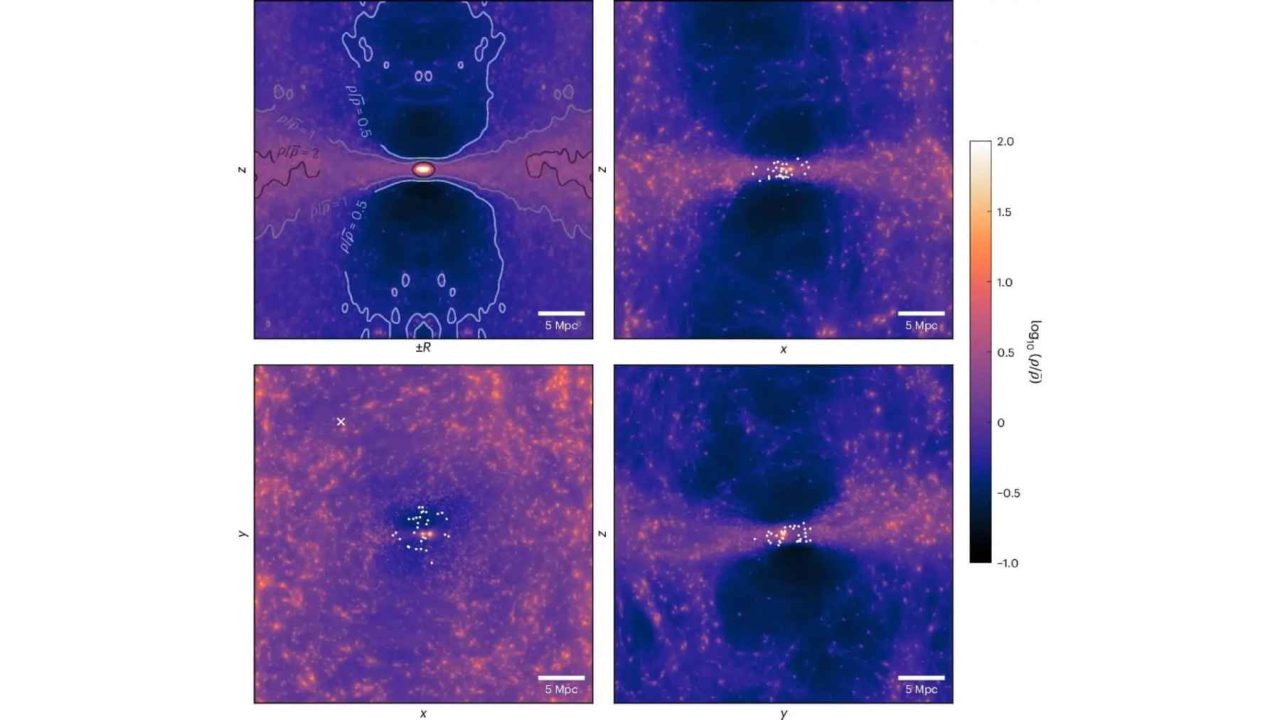
What if the Milky Way isn’t just floating in space — but is actually resting on an invisible cosmic sheet stretching tens of millions of light-years in every direction? That’s the striking possibility raised by a new study published on January 27, 2026, which suggests our galactic neighborhood is embedded in a vast, flattened structure of dark matter that scientists are only beginning to map.
The finding challenges decades of assumptions about how mass is distributed around our corner of the universe. And while it won’t change your daily commute, it fundamentally reshapes how astronomers understand the invisible scaffolding that holds the cosmos together.
For most people, dark matter sounds abstract. But this discovery makes it feel remarkably structural — like finding out the ground beneath your feet is part of a continent you never knew existed.
The Universe Isn’t a Smooth Fog — It’s a Web
Galaxies don’t spread evenly through space. They cluster together, stretch into long filaments, and leave behind enormous empty regions called voids. Scientists have known this for years. What’s newer — and more surprising — is the growing evidence that our own Local Group sits inside one of these large-scale structures in a very specific, flattened way.
The Local Group is our galactic neighborhood. It’s anchored by two heavyweights: the Milky Way and the Andromeda galaxy. For decades, many models treated the mass surrounding the Local Group as something like a roughly spherical bubble — mass distributed more or less equally in all directions.
The new research challenges that picture. Instead, the study finds that the mass around the Local Group appears to lie in a plane — a flattened sheet that stretches across tens of millions of light-years, with comparatively emptier regions sitting above and below it.
That geometry, the researchers argue, better explains something that has puzzled scientists: why most nearby galaxies drift away so calmly, even with large galaxies like ours in the vicinity.
Why Dark Matter Is the Key to This Discovery
Dark matter is the central character in this story, even though it’s invisible. It emits no light, reflects no light, and can’t be directly observed with any telescope. Researchers can only track it by watching how its gravity tugs on the visible galaxies around it.
Think of it like watching a crowd of people on a windy day. You can’t see the wind directly, but you can map its direction and strength by watching how everyone leans.
By carefully analyzing the motions of galaxies near the Local Group, the research team was able to reconstruct where the hidden mass must be concentrated — and the answer pointed toward a sheet-like distribution rather than a spherical one.
The study was led by Ewoud Wempe, alongside collaborators Simon D. M. White, Amina Helmi, Guilhem Lavaux, and Jens Jasche.
What the Research Actually Found
The core claim is both simple and profound. The mass surrounding the Local Group appears to be concentrated in a flattened plane rather than spread spherically. That plane extends across a scale measured in tens of millions of light-years.
| Feature | Previous Model | New Finding |
|---|---|---|
| Mass distribution around Local Group | Roughly spherical | Flattened sheet (plane) |
| Scale of structure | Not well defined | Tens of millions of light-years wide |
| Regions above and below plane | Not distinguished | Comparatively emptier (void-like) |
| Explanation for calm galaxy drift | Incomplete | Better matched by sheet geometry |
| Study publication date | — | January 27, 2026 |
Key researchers involved in the study:
- Ewoud Wempe — lead researcher
- Simon D. M. White — collaborator
- Amina Helmi — collaborator
- Guilhem Lavaux — collaborator
- Jens Jasche — collaborator
Why This Changes the Map of Our Cosmic Address
If this model holds up, it means scientists have been working with an incomplete picture of the mass environment surrounding our galaxy. The Milky Way isn’t just floating in a roughly uniform sea of dark matter — it’s sitting on something more like a cosmic raft, a wide, thin concentration of invisible mass.
That matters because dark matter governs how galaxies move, how they form, and how clusters of galaxies evolve over billions of years. Getting its distribution wrong means getting a lot of other predictions wrong too.
The sheet structure also offers a more natural explanation for the observed behavior of nearby galaxies. The relatively calm drift of galaxies in our region — which has been somewhat puzzling given the gravitational influence of large nearby galaxies — fits more cleanly with a flattened mass distribution than with a spherical one.
In short: the geometry of dark matter around us may be telling us something important about how our entire cosmic neighborhood was shaped.
What Comes Next for This Research
The study published in January 2026 is a significant step, but it’s the beginning of a conversation, not the end of one. Confirming a structure of this scale requires ongoing observation, and dark matter research by its nature demands indirect methods — there’s no instrument that can simply point at dark matter and measure it directly.
Future work will likely focus on refining the galaxy motion data used to reconstruct the mass distribution, and testing whether the sheet-like geometry holds up as more precise measurements become available. Surveys that map the positions and velocities of thousands of galaxies will be critical tools in that effort.
The research team’s approach — using the gravitational influence of dark matter on visible galaxies as a tracer — is a well-established method, but applying it at this scale to reveal a sheet structure around the Local Group represents a meaningful advance in how scientists model our immediate cosmic environment.
Frequently Asked Questions
What is the Local Group?
The Local Group is our galactic neighborhood, anchored by the Milky Way and the Andromeda galaxy.
What did the new study find about dark matter?
The study found that the mass surrounding the Local Group appears to lie in a flattened sheet stretching tens of millions of light-years, rather than being distributed in a roughly spherical shape.
When was this study published?
The study was published on January 27, 2026.
Who led the research?
The research was led by Ewoud Wempe, with collaborators Simon D. M. White, Amina Helmi, Guilhem Lavaux, and Jens Jasche.
Why can’t scientists observe dark matter directly?
Dark matter does not emit or reflect light, so researchers can only track it by observing how its gravity influences the movement of visible galaxies.
Does this discovery change anything about how we understand galaxy movement?
Yes — the sheet-like geometry of dark matter better explains why nearby galaxies drift away relatively calmly, even with large galaxies like the Milky Way in close proximity.




Leave a Reply