
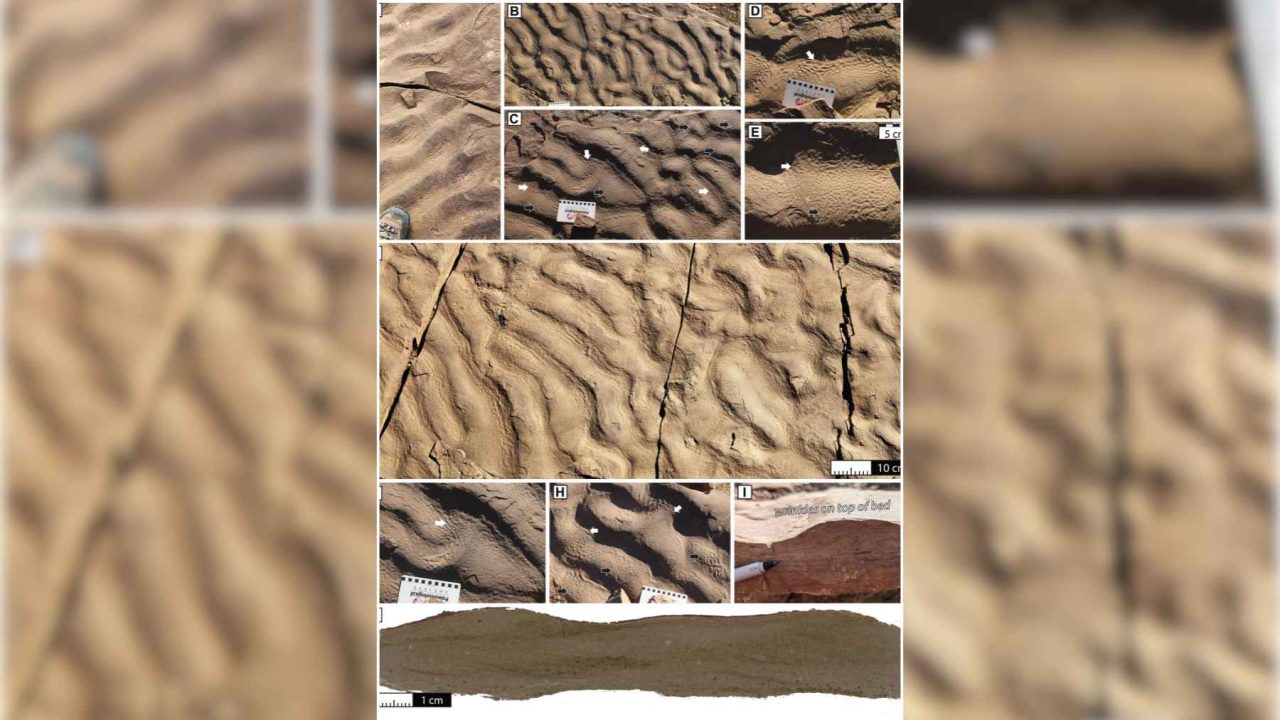
A rock face in Morocco’s Dadès Valley looks, at first glance, like crumpled leather — wrinkled, creased, and oddly textured in a way that stops geologists mid-stride. What those folds actually represent has researchers rethinking one of the most basic assumptions in the study of ancient life.
The rock layers in Morocco’s Central High Atlas Mountains are approximately 180 million years old, dating back to the Early Jurassic period. And according to researchers, those strange wrinkle patterns may be the preserved signature of microbial life — organisms that survived without a single ray of sunlight.
That second detail is the part that changes everything.
What Scientists Found in the Moroccan Mountains
The discovery traces back to 2016, when Dr. Rowan Martindale, a paleoecologist and geobiologist at the University of Texas at Austin, was hiking through the Dadès Valley and noticed something unusual on a rock face. She flagged down Stéphane Bodin of Aarhus University and pointed out a rippled surface covered in what appeared to be “wrinkle structures.”
The texture was later compared in a university report to “elephant skin” — an uneven, folded surface that looked almost biological in its patterning. And that instinct turned out to be scientifically significant.
What the team identified were ripple marks overlaid by creases and carbon-rich layers. That combination is considered a strong indicator of ancient microbial mats — thin films of microorganisms that once carpeted the seafloor and left behind a chemical and physical imprint in the sediment as it hardened into rock over millions of years.
A news release from the Geological Society of America, published on January 14, 2026, confirmed the findings, with researchers pointing to chemosynthetic microbes as the most likely explanation for what left those marks behind.
Why “Chemosynthetic” Is the Word That Matters Here
Most people are familiar with photosynthesis — the process plants and many microbes use to convert sunlight into energy. Chemosynthesis works on an entirely different fuel source: chemical reactions. No light required.
Organisms capable of chemosynthesis can survive in environments that would be completely inhospitable to most life — deep ocean floors, volcanic vents, oxygen-depleted sediment layers. They don’t need the sun. They need chemistry.
This is why the Moroccan rock layers present such a puzzle. Wrinkle structures like these have historically been associated with shallow, sunlit water where photosynthetic microbes thrive near the surface. The assumption has long been that if you find wrinkle structures in ancient rock, you’re looking at evidence of life from a bright, shallow marine environment.
But the evidence in the Central High Atlas Mountains tells a different story. These formations appear to have originated in deeper, darker water — the kind of environment where photosynthetic life would have no business being. If the wrinkle structures formed in darkness, driven by chemosynthetic microbes rather than sunlight-dependent ones, then geologists may have been misreading similar formations in deep-water rocks for decades.
Key Facts at a Glance
| Detail | Information |
|---|---|
| Rock age | Approximately 180 million years old (Early Jurassic) |
| Location | Central High Atlas Mountains, Morocco (Dadès Valley) |
| Discovery year | 2016 |
| Lead researcher | Dr. Rowan Martindale, University of Texas at Austin |
| Collaborating researcher | Stéphane Bodin, Aarhus University |
| Announcing body | Geological Society of America (January 14, 2026) |
| Proposed microbial type | Chemosynthetic microbes (no sunlight required) |
| Key physical evidence | Ripple marks, creases, carbon-rich layers, wrinkle structures |
- The wrinkle structures resemble what researchers described as “elephant skin” on the rock surface
- Carbon-rich layers within the rock support the presence of once-living organic material
- Wrinkle structures were previously assumed to form only in shallow, sunlit marine environments
- The Moroccan formations challenge that assumption by appearing in what was likely a deep-water setting
What This Means for the Fossil Record
The implications extend well beyond one rock face in Morocco. If chemosynthetic microbial mats can produce wrinkle structures indistinguishable from those formed by photosynthetic communities, then geologists studying ancient deep-water rock formations may have been overlooking biological signatures hiding in plain sight.
Ancient life left its marks in rock in subtle ways — chemical residues, textural imprints, shifts in sediment layering. Scientists have developed reliable tools for reading those marks, but those tools are only as good as the assumptions that underpin them. If one of those core assumptions — that wrinkle structures mean shallow, sunlit water — turns out to be incomplete, the fossil record in deep-water environments may need to be reassessed.
That’s a significant recalibration. Deep-water sedimentary rocks cover vast stretches of geological history, and if microbial evidence within them has been systematically underrecognized, researchers may be missing large chapters of early life on Earth.
What Researchers Are Still Working to Understand
The findings announced by the Geological Society of America represent a strong hypothesis, not a closed case. The identification of chemosynthetic microbes as the source of these structures is described as the most likely explanation — which means the scientific community is still working through the evidence.
The broader question now is whether similar formations exist in other deep-water rock deposits around the world, and whether they too have been misclassified or overlooked. If the Moroccan site turns out to be one example among many, the field of geobiology — the study of the relationship between life and Earth’s geological systems — could be entering a period of meaningful revision.
For now, a hike through a Moroccan valley in 2016 and one researcher’s sharp eye for unusual texture have opened a line of inquiry that reaches back 180 million years and forward into the future of how scientists read the story of life on Earth.
Frequently Asked Questions
Where were the 180-million-year-old wrinkle structures found?
They were found in the Central High Atlas Mountains of Morocco, specifically in the Dadès Valley.
What are wrinkle structures in rock?
Wrinkle structures are textured patterns preserved in ancient rock layers, widely believed to be imprints left behind by microbial mats — thin communities of microorganisms — that once lived on the seafloor.
What makes these particular wrinkle structures unusual?
Wrinkle structures are typically associated with shallow, sunlit water environments. These formations appear to have formed in deeper, darker water, suggesting they were created by chemosynthetic microbes that don’t require sunlight.
What are chemosynthetic microbes?
Chemosynthetic microbes are organisms that produce energy through chemical reactions rather than sunlight, allowing them to survive in dark, deep-water environments where photosynthetic life cannot.
Who discovered these formations?
Dr. Rowan Martindale of the University of Texas at Austin first noticed the wrinkled rock texture during a hike in 2016, and worked with Stéphane Bodin of Aarhus University on the findings.
Has this discovery been officially confirmed by a scientific body?
The Geological Society of America published a news release on January 14, 2026, describing chemosynthetic microbes as the most likely explanation for the structures, though the research is ongoing.


Leave a Reply