
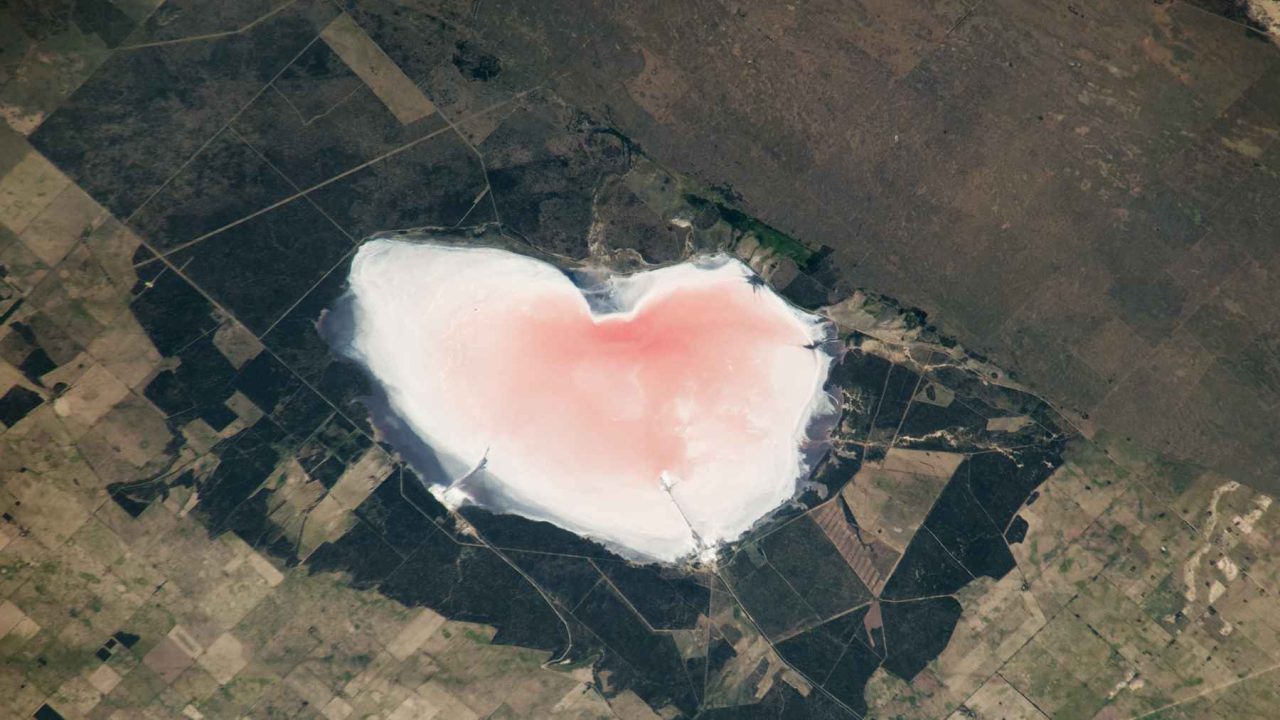
From roughly 250 miles above Earth, an astronaut aboard the International Space Station looked down at the Argentine countryside and spotted something that stopped them cold — a near-perfect pink heart, almost 10 kilometers wide, resting quietly in a patchwork of farmland.
The image, shared by NASA’s Earth Observatory, spread quickly for obvious reasons. It looks almost too deliberate, like something painted onto the landscape for Valentine’s Day. But the story behind that color is far less romantic — and far more interesting — than the shape itself suggests.
This is Salinas Las Barrancas, a salt lake in Argentina’s Buenos Aires province, and it has a lot to tell us about how fragile and dynamic some of Earth’s most beautiful places actually are.
What NASA Actually Photographed — and Where It Is
Salinas Las Barrancas sits roughly 33 miles west of Bahía Blanca, a port city on Argentina’s Atlantic coast. The lake stretches approximately 6.2 miles across at its widest point — big enough to be clearly visible from orbit, yet easy to walk past on the ground without fully grasping its scale or shape.
The basin occupies a natural low depression in the landscape. When rain falls, water collects there. When the sun returns — and in this part of Argentina, it returns hard — that water evaporates and leaves behind a bright, flat layer of salt. According to local reports cited in NASA’s coverage, parts of the lakebed sit around 131 feet below sea level, which is precisely why water pools there after wet weather rather than draining away.
From the ground, it’s a salt flat. From space, it’s a heart. The difference in perspective is part of what makes the image so striking.
Why Salinas Las Barrancas Is Pink — and What That Actually Means
The color is the real story here. That soft, pastel pink is not a trick of the light or a photographic filter. It comes from salt-loving microorganisms — halophilic bacteria and algae — that thrive in the lake’s extreme, high-salinity environment.
These microorganisms produce pigments as part of their biological processes, and those pigments tint the water in shades ranging from pale rose to deep magenta depending on the concentration of salt and the intensity of sunlight. The back-and-forth between rainfall and intense evaporation drives the salinity up and down, which in turn affects how vivid the pink becomes at any given time.
It’s a similar process to what makes other famous pink lakes around the world — like Lake Hillier in Australia — look the way they do. The color is biological, not geological, and it shifts with the seasons and the weather.
That sensitivity is part of what makes places like this worth paying attention to. They respond visibly and quickly to changes in their environment. What looks like a pretty color from space is actually a living indicator of conditions on the ground.
Key Facts About Salinas Las Barrancas at a Glance
| Feature | Detail |
|---|---|
| Location | Buenos Aires province, Argentina |
| Distance from Bahía Blanca | Approximately 33 miles west |
| Width at widest point | Approximately 6.2 miles (nearly 10 km) |
| Depth below sea level (parts of lakebed) | Around 131 feet below sea level |
| Color source | Salt-loving (halophilic) microorganisms |
| Photographed by | Astronaut aboard the International Space Station |
| Published by | NASA’s Earth Observatory |
- The lake fills with water after rainfall, then dries out and leaves salt flats behind
- Its heart shape is visible from orbit but not immediately obvious from ground level
- The pink color intensity changes with salinity levels, which shift with weather patterns
- The surrounding landscape is a patchwork of agricultural fields, visible clearly in the ISS photograph
Why Images Like This One Matter Beyond the Visual Wow
NASA regularly publishes photographs taken by astronauts aboard the ISS as part of its Earth observation mission. The goal isn’t just to produce beautiful images — it’s to document how Earth’s surface is changing over time and to draw public attention to ecosystems that might otherwise go unnoticed.
Salt lakes and salinas like this one are among the world’s most ecologically sensitive environments. They support unique communities of microorganisms found almost nowhere else, and they respond rapidly to shifts in rainfall, temperature, and human activity in surrounding areas. When conditions change, the color changes. When the color changes dramatically or permanently, it signals something worth investigating.
The fact that an image like this catches widespread attention because it looks like a heart is actually a feature, not a distraction. It gets people looking at a landscape they’d never have searched for on their own — and then, ideally, asking questions about what they’re actually seeing.
What Happens When the World Starts Looking Closer
Images published through NASA’s Earth Observatory reach millions of people. When a photograph like this one circulates widely, it tends to generate renewed scientific and public interest in the featured location — including questions about its long-term health, the pressures it faces from surrounding agriculture, and whether it is being monitored or protected.
Salinas Las Barrancas is not currently among the world’s most studied salt lakes, but photographs like this one have historically prompted follow-up research and conservation conversations. The image was taken from the ISS and published by NASA’s Earth Observatory, lending it credibility and reach that local reporting alone rarely achieves.
For now, the lake sits quietly in Buenos Aires province — filling, drying, turning pink, fading — doing what it has done for centuries. The astronauts just gave the rest of us a reason to finally notice.
Frequently Asked Questions
Where exactly is Salinas Las Barrancas located?
It is located in Argentina’s Buenos Aires province, approximately 33 miles west of the port city of Bahía Blanca.
How big is the pink heart-shaped lake?
Salinas Las Barrancas stretches approximately 6.2 miles — nearly 10 kilometers — across at its widest point.
Why is the lake pink?
The pink color comes from salt-loving microorganisms, specifically halophilic bacteria and algae, that produce pigments in the lake’s highly saline water.
Who photographed it and when was the image published?
An astronaut aboard the International Space Station took the photograph, and NASA’s Earth Observatory published the image, with coverage circulating in April 2026.
How deep below sea level is the lakebed?
Local reports cited in NASA’s coverage indicate that parts of the lakebed sit around 131 feet below sea level, which allows water to pool there after rainfall.
Does the lake stay pink year-round?
The color intensity shifts depending on salinity levels, which change with rainfall and evaporation cycles, so the pink hue is not constant throughout the year.




Leave a Reply