
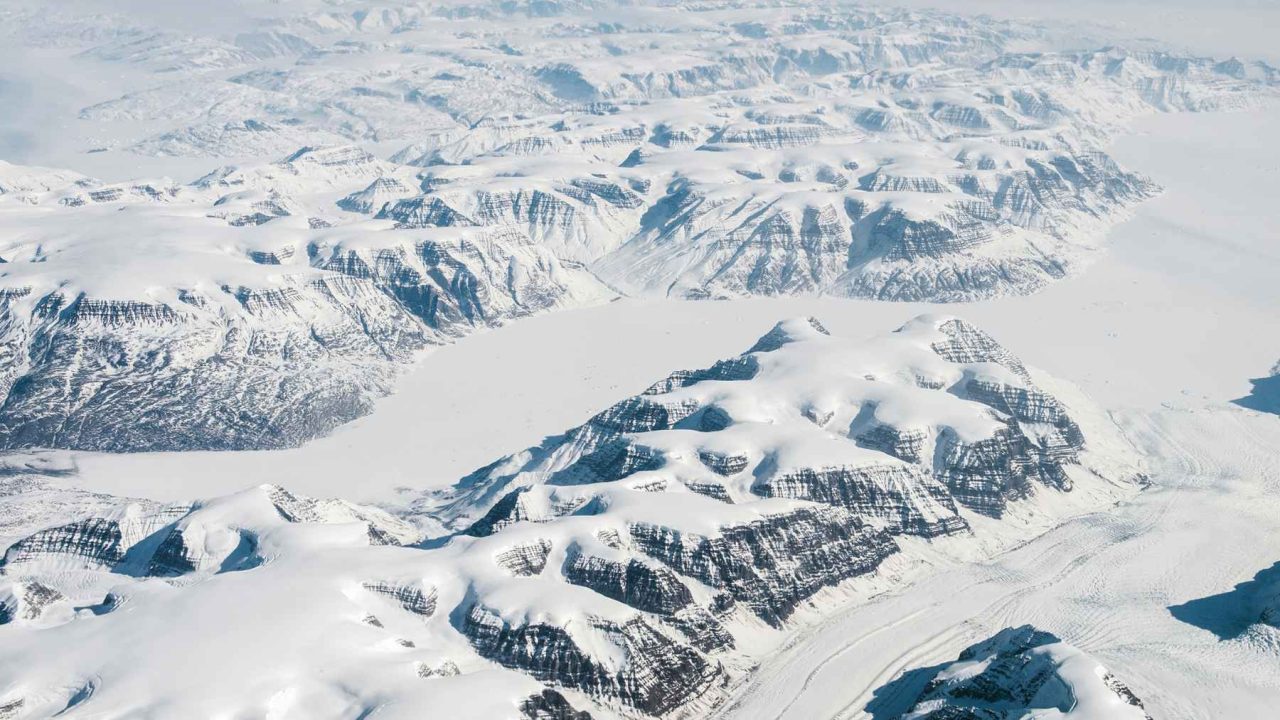
A research aircraft flying over the Greenland Ice Sheet in April 2024 was supposed to be doing something routine — testing radar equipment. Instead, it picked up something that had no business being buried under all that ice: straight lines, sharp angles, and a checkerboard pattern of tunnels that looked nothing like natural geology.
What the instruments found was Camp Century, a long-abandoned U.S. military installation sometimes called the “city under the ice.” The site dates back to 1959, and its rediscovery is raising questions that go well beyond Cold War history. As the climate changes and Greenland’s ice shifts, what’s buried under there isn’t staying buried forever.
Alex Gardner, a cryosphere scientist at NASA’s Jet Propulsion Laboratory, captured the moment simply: “We were looking for rocks, but instead we found an abandoned nuclear bunker.” That one line says a lot about how unexpected this find really was.
What Camp Century Actually Is — and Why It Was Built
Camp Century was constructed in 1959, roughly 240 kilometers off the coast of Greenland, deep within the ice sheet. The U.S. military built it during the Cold War, and it was presented publicly as a research station. In reality, the facility served military purposes beneath a scientific cover story.
The site earned its nickname — “the city under the ice” — because of its scale. It wasn’t just a few rooms. It was a network of tunnels laid out in a grid, a checkerboard of corridors carved into the ice. At its operational peak, it functioned almost like a small underground settlement, complete with infrastructure to support the people working there.
The base was eventually abandoned, and the ice slowly swallowed it. For decades, it sat frozen in place, largely out of sight and largely out of mind. That changed in April 2024, when a radar instrument on a research flight accidentally lit it back up.
How the Abandoned Nuclear Bunker Was Rediscovered
The flight wasn’t looking for Camp Century. It was a technical mission — researchers were calibrating and testing radar equipment over the Greenland Ice Sheet, approximately 150 miles east of Pituffik Space Base. The instrument was doing what it was designed to do: reading the layers of snow and ice beneath the aircraft.
But the data came back with something unexpected. Instead of the smooth, featureless signal you’d expect from undisturbed ice, the radar showed geometric shapes. Straight lines. Right angles. A pattern that ice simply does not form on its own.
The researchers recognized what they were seeing: the buried tunnels of Camp Century, still intact beneath the surface, still readable by modern instruments even after more than six decades of being locked in ice.
| Detail | Information |
|---|---|
| Discovery date | April 2024 |
| Original construction | 1959 |
| Location | Approximately 240 km off the coast of Greenland |
| Distance from Pituffik Space Base | About 150 miles east |
| Discovered by | Research aircraft testing radar equipment |
| Key scientist quoted | Alex Gardner, Jet Propulsion Laboratory |
| Tunnel layout | Checkerboard (grid) pattern |
The Climate Concern Hidden Inside This Cold War Story
Here’s where the story gets genuinely uncomfortable. Camp Century wasn’t just a tunneling project. It was a nuclear-era military installation, which means what’s buried there includes more than concrete and steel. The site contains waste — radioactive and otherwise — that was left behind when the base was abandoned, under the assumption that the ice would keep it sealed away permanently.
That assumption made sense in 1959. It makes considerably less sense now.
The rediscovery of Camp Century is being treated by climate scientists not just as a historical curiosity but as a signal. As ice sheets change — and Greenland’s ice is changing — the contents of sites like this one don’t necessarily stay locked in place. The radar find highlights what researchers describe as a quieter but persistent concern in climate science: when ice changes, old human leftovers can come back into play.
Camp Century sits at the intersection of two very different timelines. One is the Cold War, now decades in the past. The other is the ongoing shift in global ice coverage, which is very much happening in the present.
What This Means Beyond the Discovery Itself
The practical implications aren’t simple. Camp Century is located on Greenland, which is an autonomous territory of Denmark. The question of who is responsible for whatever eventually emerges from that ice — and when — involves international diplomacy, environmental liability, and climate projections that are still being refined.
The radar technology that made this accidental rediscovery possible is also significant. Scientists weren’t looking for the site, but the instruments found it anyway. That raises a reasonable follow-up question: what else might be buried under ice sheets around the world, left behind by Cold War-era military programs and now slowly becoming accessible again as conditions change?
Researchers have noted that the Greenland Ice Sheet is not a static archive. It is a dynamic system, and what goes into it doesn’t necessarily stay where it was put. The Camp Century find makes that point in a way that’s hard to ignore.
What Comes Next for Camp Century
What the April 2024 discovery did produce is renewed attention — from scientists, from policymakers, and from the public — on a facility that most people had never heard of.
The radar data gives researchers a clearer picture of the tunnels’ current layout and condition than they’ve had before. That information will likely feed into ongoing discussions about the long-term fate of the site, particularly as climate projections for Greenland continue to be updated.
For now, Camp Century remains where it has been since the late 1960s — buried under ice, out of reach, but no longer entirely out of sight.
Frequently Asked Questions
What is Camp Century?
Camp Century is an abandoned U.S. military installation built in 1959 beneath the Greenland Ice Sheet, sometimes called the “city under the ice” due to its extensive tunnel network.
When was Camp Century rediscovered?
A research aircraft accidentally detected the buried complex in April 2024 while testing radar equipment over the Greenland Ice Sheet.
Who discovered the site?
The find was made during a radar testing flight. Alex Gardner, a cryosphere scientist at NASA’s Jet Propulsion Laboratory, is among the researchers associated with the discovery.
Why does Camp Century matter for climate science?
The site contains abandoned waste from its Cold War-era military operations, and scientists are concerned that changes to Greenland’s ice could eventually bring that material back to the surface.
How far is Camp Century from the Greenland coast?
The site is located approximately 240 kilometers off the coast of Greenland, about 150 miles east of Pituffik Space Base.
Are there plans to clean up the site?
No confirmed remediation plans or formal timelines have been announced based on currently available information from this discovery.

Leave a Reply