
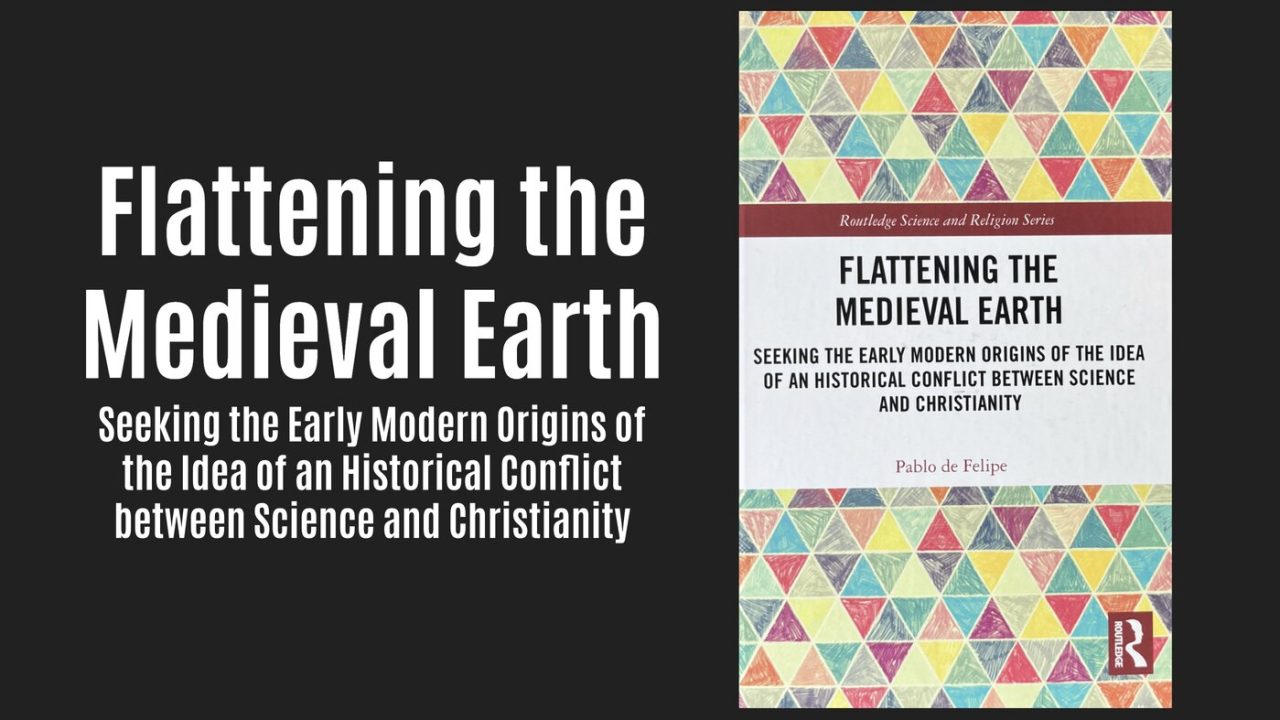
Medieval people believed the Earth was flat — or so the story goes. That claim, repeated in textbooks, documentaries, and casual conversation for generations, turns out to be one of history’s most persistent and consequential myths. And according to a newly published academic book, the origins of that myth can be traced to a surprisingly specific moment in time: around the year 1600.
The book is Flattening the Medieval Earth: Seeking the Early Modern Origins of the Idea of an Historical Conflict between Science and Christianity, written by Pablo de Felipe and published by Routledge. Its central argument is direct and well-documented — people in the Middle Ages did not believe the world was flat. What they did believe, largely, is what educated people across the ancient and medieval world had understood for centuries: that the Earth is a sphere.
The question de Felipe sets out to answer is not whether the flat-earth myth is false. That part is settled. The real question is where the myth came from, who invented it, and why it stuck so stubbornly to our picture of the medieval world.
The Myth That Rewrote History
The idea that medieval Christians rejected spherical-earth science — clinging instead to a flat, disc-shaped world out of religious stubbornness — has shaped how people understand the relationship between faith and science for well over a century. It is the kind of story that feels intuitively right, even when the evidence points firmly in the opposite direction.
De Felipe traces the emergence of this distortion to the early modern period, approximately around 1600. That is when, the book argues, the narrative of an irreconcilable conflict between Christianity and science began to take shape — not as a description of what medieval people actually believed, but as a polemical tool for framing religion as an obstacle to human progress.
The term de Felipe uses for this historical distortion is “flat error” — a phrase coined by historian Jeffrey Burton Russell in his 1991 book Inventing the Flat Earth. De Felipe credits Russell’s work as a turning point in his own research, describing how reading it in the winter of 2001–2002 shifted his focus from ancient and medieval debates about the Earth’s shape toward what he calls their modern misreception.
What the Book Actually Argues
De Felipe’s academic background is in science — he notes his undergraduate science training and a long-standing interest in the history of science and its relationship with philosophy and religion. In the 1990s, he read extensively about the Copernican debates of the mid-16th to 17th centuries, the period when heliocentrism challenged established cosmology and provoked genuine religious controversy.
It was through that research that he first encountered a 6th-century debate in Christian Alexandria about the shape of the Earth — a debate that, importantly, was not representative of mainstream medieval Christian thought on the subject. The spherical Earth was not a controversial idea in medieval Europe. It was the accepted view among educated people.
The book argues that the “flat error” — the false belief that medieval Christians were flat-earthers — did not arise from the Middle Ages themselves, but from how later writers, particularly from around 1600 onward, chose to characterize that era. That mischaracterization then fed into broader, and also often misleading, narratives about science and religion being locked in eternal conflict.
Key Facts at a Glance
| Detail | Information |
|---|---|
| Book Title | Flattening the Medieval Earth |
| Author | Pablo de Felipe |
| Publisher | Routledge |
| ISBN | 978-1-032-89306-8 |
| Key Claim | Medieval people did not believe the Earth was flat |
| Estimated Origin of the Myth | Around the year 1600 |
| Term for the Myth | “Flat error” (coined by Jeffrey Burton Russell) |
| Russell’s Foundational Work | Inventing the Flat Earth (1991) |
- The flat-earth myth is not a medieval invention — it is an early modern one
- De Felipe’s interest in the topic developed through studying Copernican debates of the 16th and 17th centuries
- A 6th-century debate in Christian Alexandria about the Earth’s shape is documented, but was not mainstream medieval Christian thought
- The “flat error” has influenced broader perceptions of science-religion relations, not just Earth-shape history
Why This Matters Beyond Medieval History
This might sound like a narrow academic dispute, but the implications stretch far beyond medieval studies. The flat-earth myth has been used for well over a century to argue that religious belief is inherently hostile to scientific progress — that faith and reason are natural enemies, and that the Middle Ages prove it.
If that premise is built on a fabricated history, then a significant portion of the science-versus-religion debate rests on a foundation that does not hold up. De Felipe’s book does not argue that there were never tensions between religious institutions and scientific ideas — the Copernican debates alone demonstrate that there were. What it challenges is the use of a fictional medieval flat-earth belief as evidence for a sweeping historical conflict that, in the form usually described, did not exist.
That distinction matters for how students are taught history, how science communicators frame the past, and how the public understands the relationship between intellectual progress and religious culture across centuries.
What Comes Next for This Research
De Felipe’s book is positioned as a contribution to ongoing scholarly work on the history of science and religion — a field that has grown considerably since Russell’s Inventing the Flat Earth appeared in 1991. The publication of Flattening the Medieval Earth by Routledge, a major academic press, signals continued serious scholarly interest in correcting the historical record on this question.
Whether the myth itself will fade from popular culture is a different matter. Misconceptions with this kind of staying power tend to outlast the corrections made against them. But the academic case, at least, continues to build.
Frequently Asked Questions
Did medieval people actually believe the Earth was flat?
No. According to the book and the broader historical record it draws on, people in the Middle Ages did not believe the world was flat. The spherical Earth was the accepted view among educated people of the era.
When did the flat-earth myth about the Middle Ages begin?
The book argues the myth emerged around the year 1600, during the early modern period, rather than originating in the Middle Ages themselves.
Who coined the term “flat error”?
The term was coined by historian Jeffrey Burton Russell in his 1991 book Inventing the Flat Earth, and Pablo de Felipe uses it throughout his new work.
What is the book’s main argument?
That the idea of medieval Christians as flat-earthers is a historically false narrative with early modern origins, and that this “flat error” has distorted broader understanding of the relationship between science and Christianity.
Who wrote Flattening the Medieval Earth and who published it?
The book was written by Pablo de Felipe and published by Routledge, with ISBN 978-1-032-89306-8.
Does the book argue there was never any conflict between science and religion?
De Felipe’s focus is specifically on correcting the false flat-earth narrative, not on dismissing all historical tensions between scientific and religious institutions.


Leave a Reply