
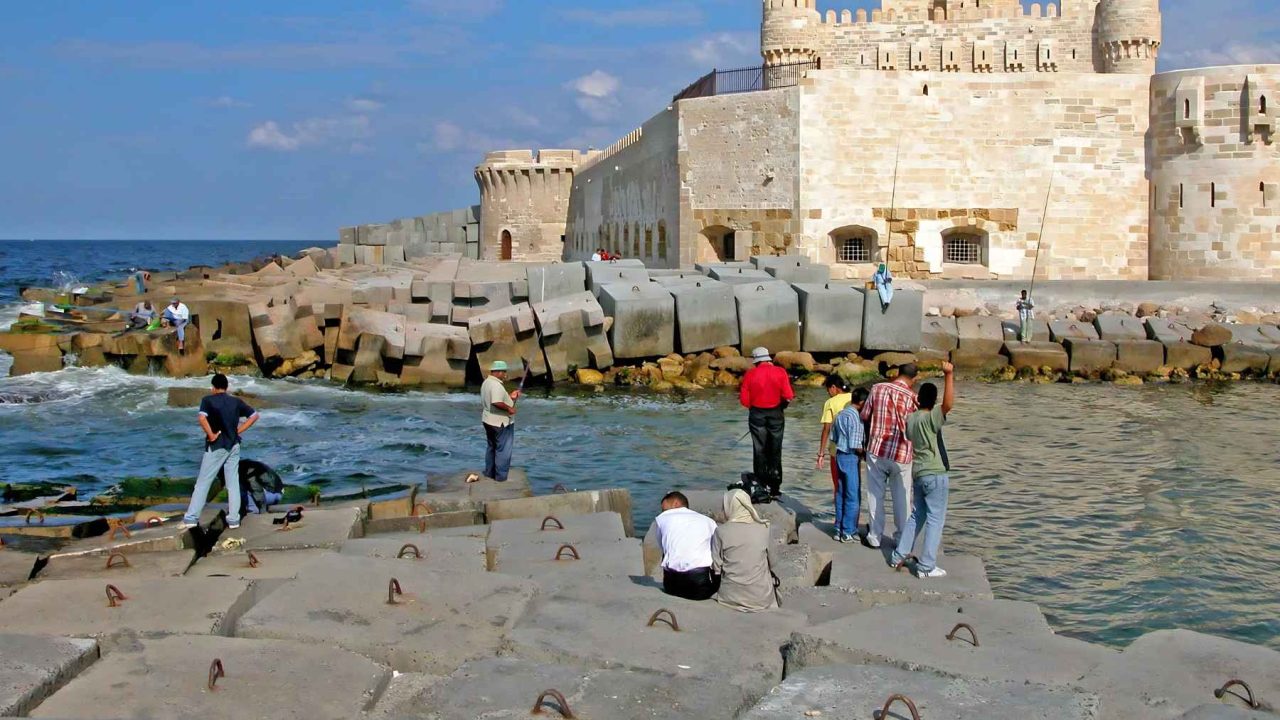
Twenty-two stone blocks — some weighing as much as 88 U.S. tons apiece — have been pulled from the floor of Alexandria’s Eastern Harbor, and they are believed to be remnants of one of the most famous structures ever built: the ancient Lighthouse of Alexandria, also known as the Pharos.
This isn’t a small academic exercise. The Pharos was one of the Seven Wonders of the Ancient World, a tower so tall and so bright that ancient sailors used it as a navigation landmark across the Mediterranean. For centuries, its precise form and construction have remained a mystery. These recovered blocks are now offering the closest physical look at that structure that modern researchers have ever had.
The scale of the recovery effort alone signals how significant this find is. Lifting stones that weigh tens of thousands of pounds off the seafloor requires serious engineering. The fact that researchers did it — and are now scanning and studying each piece — suggests they believe what they’ve found is worth every bit of that effort.
What the PHAROS Program Is Actually Doing
The recovery is part of a formal research initiative called the PHAROS program. It is led by France’s National Center for Scientific Research, known as the CNRS, in partnership with Egypt’s Centre d’Études Alexandrines. The project operates under the authority of Egypt’s Ministry of Tourism and Antiquities, with additional support from La Fondation Dassault Systèmes.
The recovered blocks are being studied and digitally scanned — a modern technique that allows researchers to create precise three-dimensional models of each piece. That kind of digital record is enormously useful. It means scholars around the world can examine the stones without physically being in Egypt, and it creates a permanent archive that won’t deteriorate over time the way physical objects can.
The combination of hands-on archaeology and digital technology reflects how the field has changed. This isn’t just about digging things up — it’s about building a comprehensive digital record of what was found, where it was, and how it relates to everything else on the seafloor.
The Blocks Themselves — What Was Recovered
The 22 recovered pieces are not random chunks of ancient masonry. Researchers say the haul includes elements that appear to have formed a monumental entrance to the lighthouse structure. Specifically, the recovered stones include:
- Lintels — horizontal stones that would have spanned the top of a doorway or entrance
- Jambs — the vertical side elements of a doorway
- A threshold — the base stone at the bottom of an entrance
- Large base slabs — foundational stones from the lower structure
Taken together, those elements suggest researchers may have recovered something close to a complete entrance assembly from the ancient lighthouse — not just scattered debris, but a coherent architectural unit.
| Block Type | Architectural Function | Approximate Weight (per piece) |
|---|---|---|
| Lintels | Top span of entrance doorway | Up to ~88 U.S. tons |
| Jambs | Vertical sides of entrance | Up to ~88 U.S. tons |
| Threshold | Base of entrance doorway | ~77–88 U.S. tons |
| Base slabs | Foundational structure | ~77–88 U.S. tons |
The weight figures — roughly 154,000 to 176,000 pounds per block — are staggering by any standard. For context, a standard shipping container weighs around 5,000 pounds empty. These stones weigh the equivalent of more than 30 fully loaded ones.
Why This Discovery Is Rewriting What We Know About the Pharos
The Lighthouse of Alexandria was built on the island of Pharos, just off the coast of what is now the city of Alexandria, Egypt. Ancient sources describe it as one of the tallest man-made structures in the ancient world, likely standing somewhere between 330 and 430 feet tall. It guided ships into one of the ancient world’s busiest ports for centuries before being damaged and eventually destroyed by a series of earthquakes between the 10th and 14th centuries CE.
Because the lighthouse collapsed — much of it into the sea — physical evidence of its actual construction has been scarce. Historians have relied heavily on ancient texts and illustrations, which vary considerably in their details. Every stone recovered from the seabed adds a new data point to that incomplete picture.
The presence of what appears to be a full entrance assembly is particularly valuable. Entrance structures carry a lot of architectural information — proportions, stylistic choices, construction techniques — that can help researchers understand how the rest of the building was designed and built. Researchers have noted that the haul also includes parts of a previously unidentified element, though full details on that finding have not yet been published.
The Bigger Picture — Archaeology Against a Rising Sea
There is an urgency to this work that goes beyond academic curiosity. Alexandria’s Eastern Harbor, where these stones have rested for centuries, sits in a region increasingly affected by rising sea levels and coastal changes driven by climate shifts. Underwater archaeological sites face threats that land-based sites do not — shifting sediment, saltwater corrosion, and the physical pressure of warming, expanding oceans.
The question researchers are quietly grappling with is not just what the lighthouse looked like — it’s whether the remaining material on the seafloor can be documented and recovered before environmental conditions make that harder or impossible. Digital scanning offers one answer: even if the physical stones can’t all be lifted, their shapes and positions can be preserved virtually.
That tension between a famous ancient wonder and a changing modern environment gives this project a relevance that stretches well beyond archaeology departments.
What Comes Next for the Recovered Stones
The 22 blocks are currently being studied and digitally scanned as part of the ongoing PHAROS program. The project is a collaboration between French and Egyptian institutions, operating with Egyptian government oversight, which means the stones remain under Egyptian authority throughout the research process.
Further analysis of the blocks — including the previously unidentified elements mentioned by researchers — is expected to continue. As the digital scans are processed and compared against existing architectural records, researchers anticipate that new details about the lighthouse’s original design will emerge. Whether additional recovery efforts are planned has not been confirmed in current reporting.
For now, 22 enormous pieces of one of history’s greatest lost monuments are back above water — and the story of the Pharos is being rewritten, one stone at a time.
Frequently Asked Questions
Where were the blocks found?
The 22 stone blocks were recovered from Alexandria’s Eastern Harbor in Egypt, where remnants of the ancient Lighthouse of Alexandria have rested on the seafloor for centuries.
Who is leading the recovery effort?
The project is part of the PHAROS program, led by France’s National Center for Scientific Research (CNRS) and Egypt’s Centre d’Études Alexandrines, operating under Egypt’s Ministry of Tourism and Antiquities with support from La Fondation Dassault Systèmes.
How heavy are the recovered blocks?
Individual blocks weigh approximately 154,000 to 176,000 pounds, which is roughly 77 to 88 U.S. tons per stone.
What types of architectural pieces were recovered?
The recovered stones include lintels, jambs, a threshold, and large base slabs — elements consistent with a monumental entrance structure from the ancient lighthouse.
Will the blocks be put on public display?
This has not yet been confirmed in current reporting. The stones are presently being studied and digitally scanned as part of the ongoing research program.
Why did the Lighthouse of Alexandria end up underwater?
The lighthouse was damaged and eventually destroyed by a series of earthquakes between the 10th and 14th centuries CE, with much of its structure collapsing into the sea over time.



Leave a Reply