
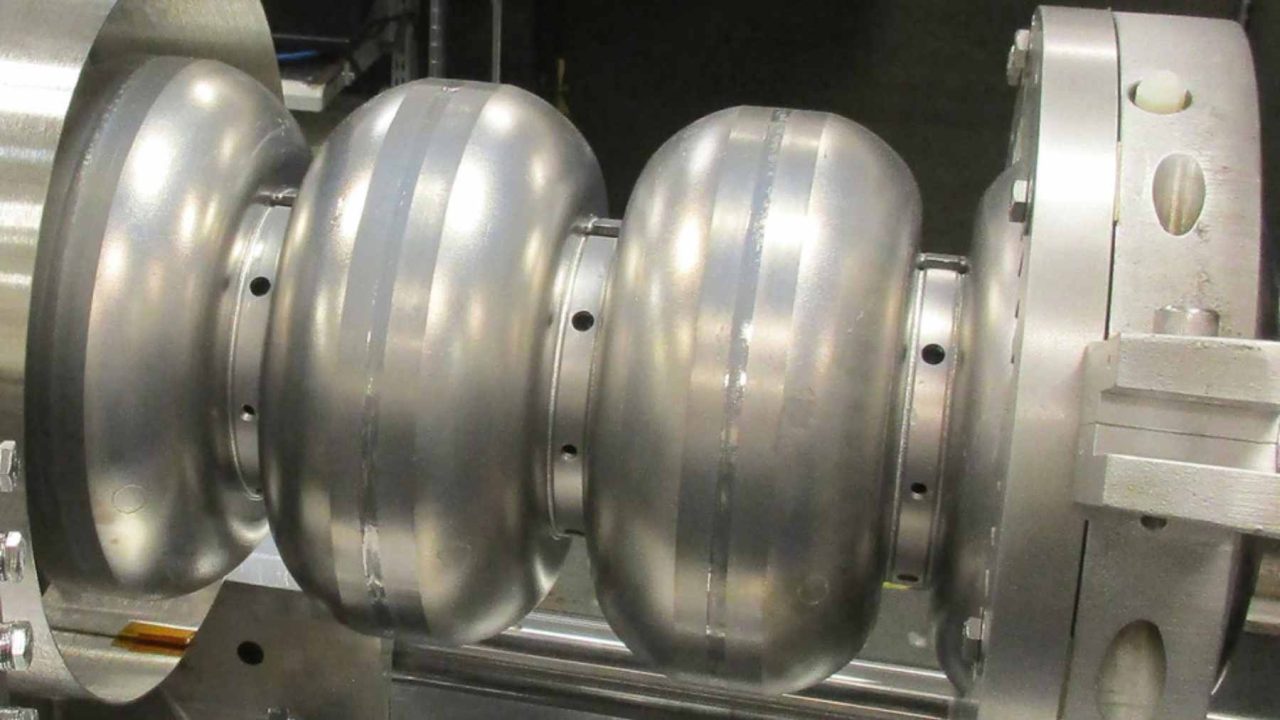
Nuclear waste that stays dangerous for 100,000 years is one of the most uncomfortable facts about modern energy production. That figure — longer than recorded human history, longer than most civilizations have existed — sits at the center of every serious conversation about nuclear power’s future. Now, a federally funded research effort is asking whether particle accelerators might be able to cut that timeline down to just a few centuries.
It sounds almost too good to be true. But in February 2026, the U.S. Department of Energy’s Advanced Research Projects Agency-Energy committed real money — $8.17 million — to two projects aimed at doing exactly that. The work is led by accelerator scientist Rongli Geng, and the goal is to transform the longest-lasting radioactive components of used nuclear fuel into materials that lose their dangerous properties far sooner.
If it works, the implications reach far beyond a single laboratory. The question of what to do with nuclear waste has blocked energy policy, frustrated governments, and unsettled communities for decades. A credible answer — even a partial one — would change the terms of that debate entirely.
The 100,000-Year Problem That Scientists Are Now Trying to Solve
Used nuclear fuel does not simply stop being dangerous after a plant shuts down. The radioactive materials it contains continue emitting harmful radiation for extraordinarily long periods. Some isotopes — specific versions of elements that carry more or fewer neutrons than usual — remain hazardous for timescales that dwarf all of recorded civilization.
The federal effort behind these new projects is called NEWTON, and it is focused on a process known as transmutation. The concept, while technically complex, is straightforward in principle: instead of simply storing long-lived radioactive isotopes and hoping nothing goes wrong for millennia, you deliberately convert them into different isotopes that decay much faster.
Think of it as nudging a problem element into a less dangerous version of itself through controlled nuclear reactions. The long-lived isotopes absorb neutrons and transform — changing their identity at the atomic level and, crucially, shortening the clock on their radioactive decay.
Geng described the potential shift plainly:
“Instead of having a lifetime of 100,000 years in storage, you can shorten the storage years down to 300.”
Three hundred years is still a long time. But it is a problem that human institutions, engineering, and infrastructure can actually plan around. One hundred thousand years is not.
How a Particle Accelerator Fits Into a Nuclear Waste Solution
The specific setup these projects are exploring is called an accelerator-driven reactor. Rather than relying on a self-sustaining chain reaction — the way a conventional nuclear power plant operates — an accelerator-driven system uses a particle accelerator to fire a beam of high-energy particles into a target. That process generates the neutrons needed to trigger the transmutation of long-lived isotopes.
The approach is sometimes described as “burning” the most problematic components of used nuclear fuel. The accelerator keeps the reaction going in a controlled way, and the long-lived waste essentially becomes the fuel that gets consumed in the process.
This is not a brand-new concept in nuclear physics, but turning the theory into a working, scalable system has proven difficult. The ARPA-E funding is intended to advance that work toward practical application.
What the Funding Covers and Who Is Behind It
The two projects funded under this ARPA-E award are both led by Rongli Geng, described in reporting as an accelerator scientist. The combined award totals $8.17 million, granted in February 2026 under the NEWTON program.
| Detail | Information |
|---|---|
| Funding agency | U.S. Department of Energy’s ARPA-E |
| Program name | NEWTON |
| Total award amount | $8.17 million |
| Number of projects funded | Two |
| Lead scientist | Rongli Geng |
| Announcement date | February 2026 |
| Current waste storage timeline | Approximately 100,000 years |
| Target storage timeline (if successful) | Approximately 300 years |
The NEWTON program’s funding notice specifically identifies unprocessed used nuclear fuel as the target material — the spent fuel rods and radioactive byproducts that accumulate at nuclear facilities and currently have no permanent disposal solution in the United States.
Why This Matters Beyond the Laboratory
The United States has no permanent repository for high-level nuclear waste. Spent fuel sits in temporary storage at reactor sites across the country, a situation that has persisted for decades while political and logistical obstacles blocked any long-term solution. The proposed Yucca Mountain repository in Nevada was studied for years before being effectively shelved. Nothing has replaced it.
Against that backdrop, the idea of transmutation offers something different: not just a better storage location, but a fundamental reduction in how long the material needs to be stored at all. A 300-year storage requirement is still serious, but it is a challenge that existing engineering and institutional planning can reasonably address. Facilities, monitoring systems, and regulatory frameworks can be designed to last centuries. Designing anything to last 100,000 years reliably is a different category of problem entirely.
For communities near nuclear plants, for policymakers trying to plan energy infrastructure, and for anyone who has wondered whether nuclear power can ever be truly clean, the gap between 100,000 years and 300 years is not just a technical detail. It is the difference between a problem that feels permanent and one that feels solvable.
What Comes Next for Accelerator-Driven Transmutation
The ARPA-E funding positions these projects at an early but serious stage of development. ARPA-E, by design, funds high-risk, high-reward research — concepts that are promising but not yet proven at scale. The $8.17 million award signals that the agency considers accelerator-driven transmutation worth serious scientific investment, but it does not mean the technology is ready for deployment.
The next steps will involve demonstrating whether the accelerator-driven approach can transmute meaningful quantities of long-lived isotopes consistently and efficiently. Scaling the process, managing the energy requirements of running a particle accelerator, and integrating the system with existing nuclear fuel cycles are all challenges that remain ahead.
What the NEWTON program represents is a structured federal commitment to finding out whether those challenges can be overcome — and to doing so before the waste problem grows any larger.
Frequently Asked Questions
What is nuclear transmutation?
Transmutation is the process of deliberately converting one radioactive isotope into another through nuclear reactions, with the goal of producing isotopes that decay much faster and are less hazardous over time.
How much money did the U.S. government award for these projects?
The U.S. Department of Energy’s ARPA-E awarded $8.17 million in February 2026 for two projects led by accelerator scientist Rongli Geng under the NEWTON program.
How much could this technology reduce nuclear waste storage time?
According to Rongli Geng, the approach could potentially reduce the required storage period from approximately 100,000 years down to around 300 years.
What is an accelerator-driven reactor?
It is a system that uses a particle accelerator to generate neutrons, which then trigger nuclear reactions that can convert long-lived radioactive isotopes into shorter-lived ones — effectively “burning” the most problematic waste.
Is this technology ready to be used at nuclear plants now?
No. The ARPA-E funding supports early-stage research and development. The technology is promising but has not yet been demonstrated or scaled for practical deployment.
What federal program is overseeing this research?
The research falls under a program called NEWTON, run by the U.S. Department of Energy’s Advanced Research Projects Agency-Energy, which focuses specifically on nuclear waste transmutation.



Leave a Reply