
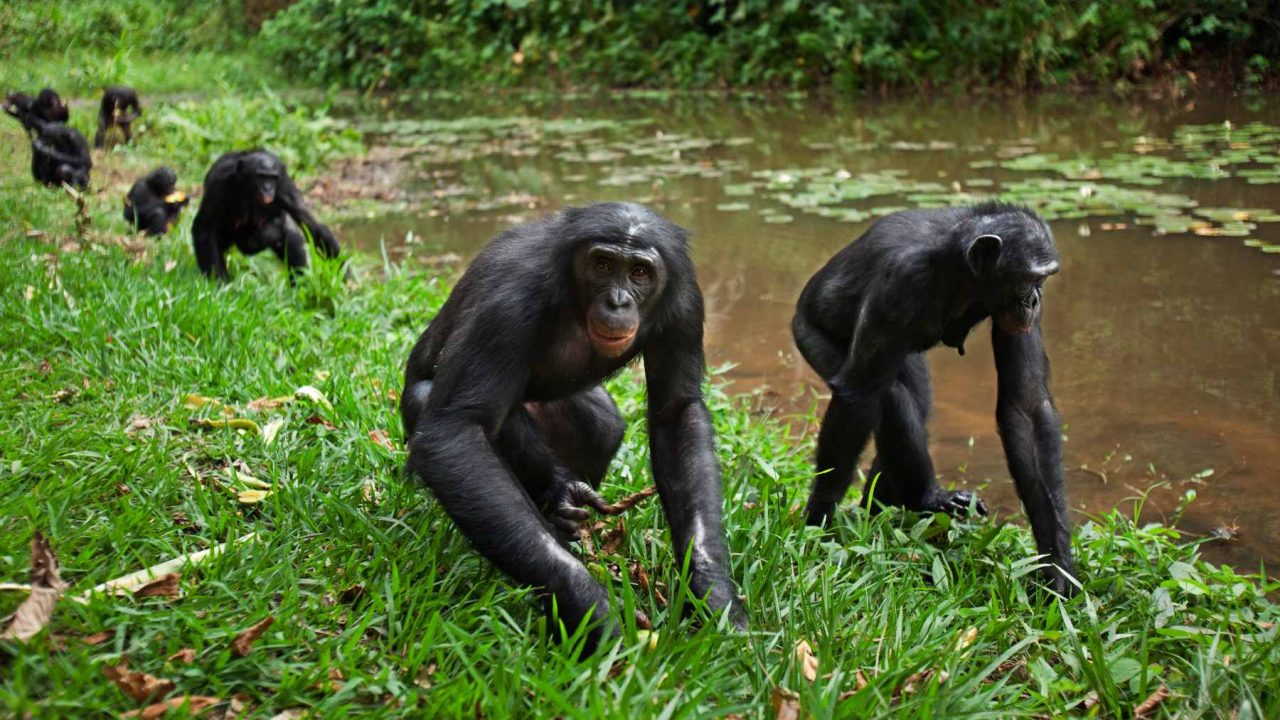
A bonobo named Kanzi chose the correct “pretend” cup of juice about 68% of the time in a series of make-believe experiments — and that single number is quietly reshaping what scientists think they know about the minds of our closest animal relatives.
Two separate lines of research are converging on a striking possibility: that great apes may share more of the cognitive building blocks behind human imagination and cultural learning than anyone previously gave them credit for. And the implications go well beyond academic curiosity.
When a population of chimpanzees or bonobos disappears, researchers are increasingly arguing, it may take with it not just genes but something closer to a culture — a set of learned skills and, possibly, a surprisingly rich inner mental world.
What Kanzi Actually Did — and Why It’s So Unusual
The experiment was designed by researchers at Johns Hopkins University. An experimenter mimed pouring pretend juice from an empty pitcher into two empty, clear cups. Then the experimenter acted out dumping one of those cups — throwing the imaginary juice away — before asking Kanzi: “Where’s the juice?”
Kanzi, a bonobo who has been trained to communicate with humans, consistently pointed to the cup that still held the “pretend” juice. He chose correctly roughly 68% of the time, well above what random chance would predict.
The experiment didn’t stop there. When Kanzi was later offered a choice between real juice and a cup of pretend juice, he chose the real drink in 14 out of 18 trials — approximately 78% of the time. That result matters because it shows he wasn’t just tracking an arbitrary rule. He understood the difference between something imaginary and something real, and acted on that understanding in a practical way.
This kind of thinking — tracking objects or states that don’t physically exist — is called pretend play, and it’s considered a hallmark of human cognitive development. Toddlers do it naturally when they pour tea from empty cups or treat a stuffed animal as a living creature. The fact that a bonobo can follow the same logic, even in a simplified experimental setting, is genuinely remarkable.
The Chimpanzee Tool Tradition That Builds Across Generations
Running alongside the Kanzi findings is a separate but related line of research suggesting that chimpanzee tool use isn’t just individual cleverness — it may be something that accumulates over time, passed from one generation to the next in ways that gradually improve or expand the skill.
This concept, sometimes called cumulative cultural evolution, was once thought to be uniquely human. The idea is that knowledge doesn’t just transfer between individuals; it builds. Each generation inherits what came before and, sometimes, adds to it. The result, over many generations, is a tradition that becomes more sophisticated than any single individual could have invented alone.
The hint that chimpanzees may do something similar is significant. If ape communities can slowly “build” tool traditions across generations, then the gap between human cultural learning and what happens in the forest may be narrower than the textbooks have suggested.
Key Findings at a Glance
| Finding | Subject | Result |
|---|---|---|
| Pretend cup experiment | Kanzi (bonobo) | Chose correct pretend cup ~68% of the time |
| Real vs. pretend juice choice | Kanzi (bonobo) | Chose real juice in 14 out of 18 trials (~78%) |
| Cumulative tool traditions | Chimpanzees (general) | Evidence suggests skills may build across generations |
| Research institution | Pretend play study | Johns Hopkins University |
- Kanzi is a bonobo trained to communicate with humans, not a wild-caught subject.
- The pretend play experiment used empty pitchers and clear cups to test whether Kanzi could track imaginary states.
- The separate chimpanzee tool study focuses on how traditions evolve across generations within communities.
- Both lines of research challenge long-held assumptions about what makes human cognition unique.
Why This Matters Far Beyond the Lab
These findings aren’t just intellectually interesting — they carry a conservation argument that rarely gets enough attention.
Most public conversations about protecting endangered ape populations focus on habitat loss, poaching, and genetic diversity. Those are real and urgent concerns. But if chimpanzee and bonobo communities also carry cultural knowledge — tool traditions built across generations, and possibly even something like shared imaginative understanding — then the loss of a population becomes a different kind of tragedy.
It isn’t just animals that disappear. It may be entire ways of knowing, doing, and perhaps even playing, that vanish with them and cannot be recovered.
Researchers argue this reframing should change how conservationists prioritize which populations to protect. A group of chimpanzees living in a specific forest may carry tool traditions and learned behaviors that exist nowhere else on Earth. Once that group is gone, those traditions are gone too — regardless of how many chimpanzees survive elsewhere.
The Question These Studies Leave Open
What neither study fully resolves is how widespread these abilities are. Kanzi is a bonobo with an unusually extensive history of human contact and language training. Whether wild bonobos or chimpanzees who have never interacted with humans engage in anything resembling pretend play remains an open question.
Similarly, the evidence for cumulative cultural evolution in chimpanzees is suggestive rather than conclusive. Researchers are still working to understand exactly how tool traditions spread and whether they genuinely build in complexity over time, or whether what looks like accumulation is something simpler.
Still, the direction of travel in this research is clear. The more carefully scientists look at great ape cognition, the more they find. And each new finding makes the case for treating these animals — and their communities — as something worth protecting not just ecologically, but culturally.
Frequently Asked Questions
Who is Kanzi, and why is he significant?
Kanzi is a bonobo who has been trained to communicate with humans. He was the subject of pretend play experiments run by researchers at Johns Hopkins University.
What did the pretend juice experiment actually test?
It tested whether Kanzi could track an imaginary state — specifically, whether he understood which cup still held “pretend” juice after one cup was mimed as emptied.
How well did Kanzi perform in the experiments?
He chose the correct pretend cup about 68% of the time, and chose real juice over pretend juice in 14 out of 18 trials, roughly 78% of the time.
What is cumulative cultural evolution, and do chimpanzees really do it?
It refers to knowledge that builds across generations rather than simply transferring unchanged. Research hints that chimpanzee tool traditions may work this way, though the evidence is still developing.
Why does this matter for conservation?
If ape communities carry cultural knowledge built over generations, then losing a population means losing unique learned traditions — not just individuals or genetic material.
Do wild chimpanzees show the same cognitive abilities as Kanzi?
This has not yet been confirmed. Kanzi has an unusual background involving extensive human contact and language training, and whether wild apes display similar abilities remains an open research question.


Leave a Reply